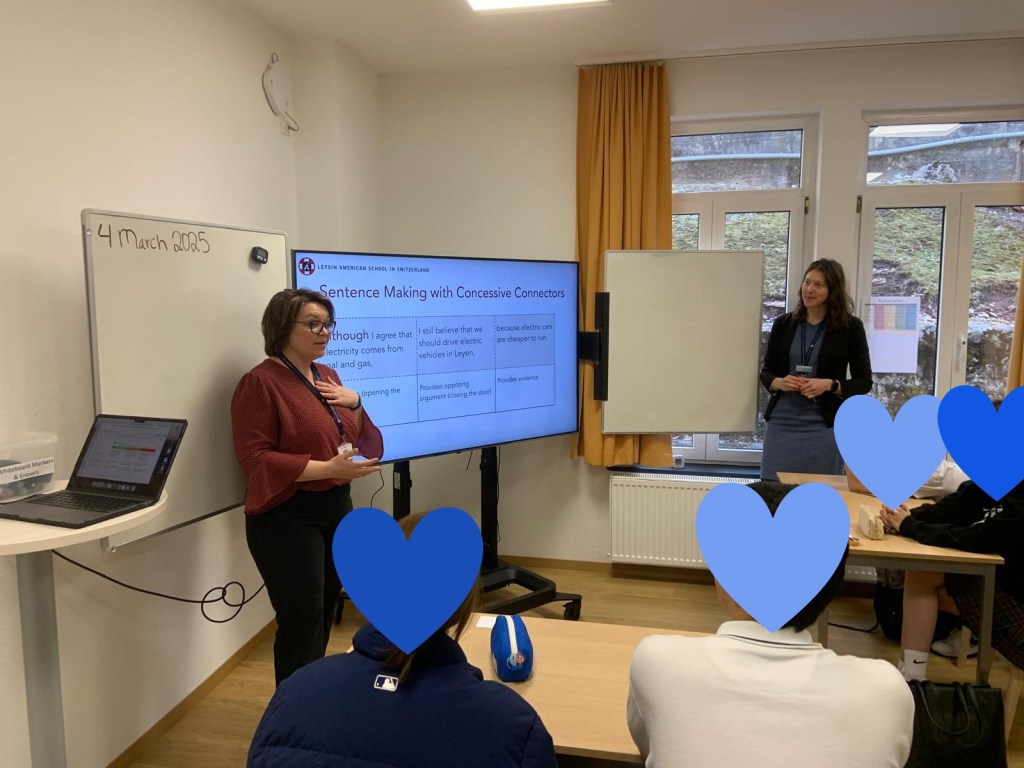
In March 2025, I had an opportunity to visit Switzerland as a Visiting Scholar in Leysin American School. I worked with Mari McCarville, a phenomenal teacher who teaches English as an Additional Language (EAL) students who speak a variety of languages (Romanian, Spanish, French, Chinese, Korean and others) with language development levels 1.8-3.7 (measured by WIDA MODEL). Some of the students are neurodiverse and dyslexic. This blog provides an account of that experience with a brief reflection on the experience itself. The blog is dedicated to these students.
*The language opening and closing doors for other voices comes from Sally Humphrey, my SFL mentor and teacher who taught me discourse semantics on my visit to Australia in 2016.
UNIT OVERVIEW: Over the past six weeks, Mari’s high school students have been investigating transportation around the world and building knowledge about sustainable transport here in Switzerland. This unit started with building general knowledge on the various types of transportation, moving from the global to the local level, and connecting to a local issue impacting students in the town where their school is.

| Phase 1. Transport Around the World (5 lessons) The purpose of this first phase was to build knowledge around types of transportation, introduce new vocabulary, and tap into students’ opinions about transport. |
| Phase 2. Leysin 365 (5 lessons) The purpose of Phase 2 was to take transportation from the global to the local level, explore a current project in the Leysin community that will affect our small mountain town for years to come, and write a persuasive letter to the town government. |
| Phase 3. Electric Vehicles (14 lessons)The purpose of this final phase was to tie the content and language from the previous two phases into a culminating debate. The students gathered evidence to build claims and counterclaims. |
| Additional Phase: Deconstruction The purpose of adding Deconstruction was to teach the key language resources for constructing and refuting claims in a very explicit manner by selecting only those text connectives that are needed by students to get a particular job done: text connectives needed for concession and rebuttals: while, although, despite, even if. |
| Additional Phase: Joint Construction The purpose of adding Joint Construction was to apprentice students to the language of concessions and rebuttals through joint negotiation of meaning by shaping students’ spoken-like contributions into concessive sentences in the written mode. |
Table 1. Instructional Phases in the Unit on Transportation
Deconstruction Activities:
- Talk about argumentation as both agreeing with the opposing view for a little bit (conceding, we call opening the doors to other voices) and disagreeing and providing an opposing perspective (rebuttal, we call closing the door).
- Show students three parts in the sentences: 1) concession with the connective while, although, despite, even if; 2) rebuttal with the connective however or but, and 3) elaboration of the rebuttal (screenshots below).
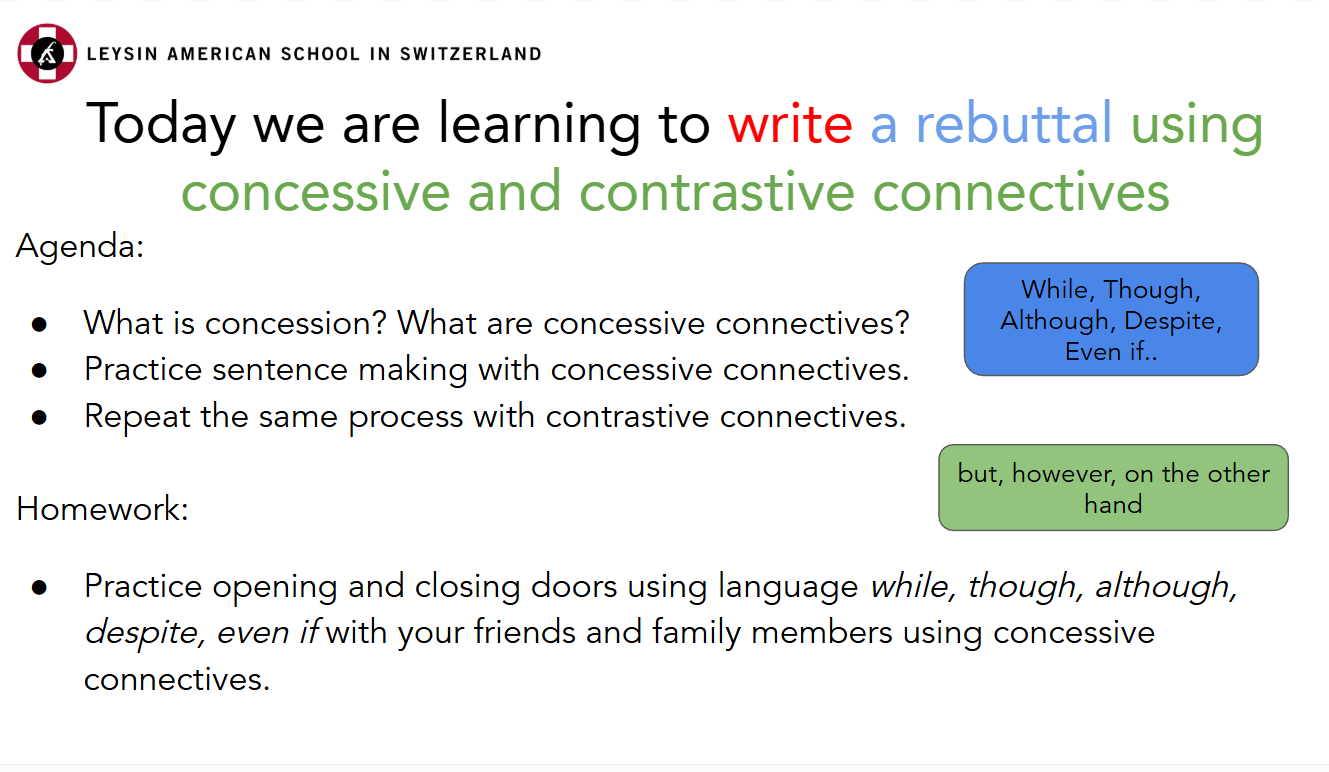


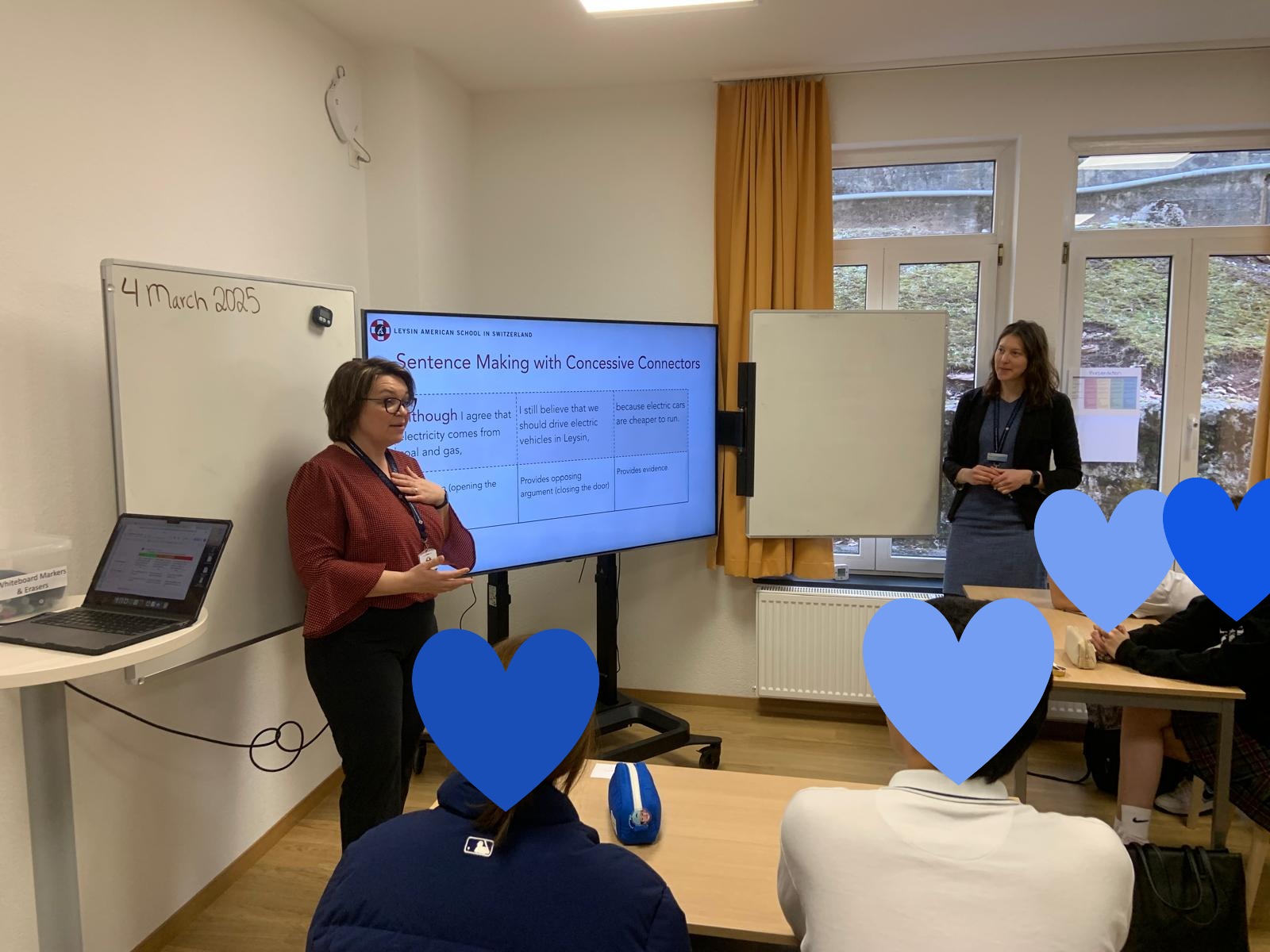

Deconstruction Activity 3. Distribute sentence parts divided into concessive sentence chunks and rebuttals chunks. Assign partner talk to practice the concessive and rebuttal sentences in English and in their home languages. Concessive connectives lead to a particular way of reasoning, not only use of text connectives as a language exercise. Students need to think and language that way in and across all their languages to build reasoning and thinking skills required for mature argumentation.

Deconstruction Activity 4: Students put together cut up text in Box 1 below in order to think through how the preceding information is related to the next chunk in the argument.
Deconstruction Activity 5: Contextualize text connectives in the context of the whole text through a “Scavenger Hunt” activity: students read the mentor text they’ll be using for the final rebuttal and find the connectives in their debate text.
Students use the text below (Box 1 below) to do a scavenger hunt to find the language of concession and then the language of rebuttals.
| The affirmative team starts by saying: Electric cars are better for the environment. They don’t produce pollution from their engines, which helps keep the air clean. Negative says: You said that EVs are better for the environment, but making electric car batteries requires mining materials like lithium and cobalt, which harms the environment. Affirmative says: While I agree that the batteries can be harmful, electric cars use energy more efficiently than gas cars. They waste less energy and go farther on the same amount of power. Negative says: You said that electric cars are more efficient than gas-powered cars. However, most electricity still comes from coal and gas. If you charge an electric car with dirty energy, it still pollutes. Affirmative says: Although I agree that electricity comes from coal and gas, I still believe that we should drive electric vehicles in Leysin, because electric cars are cheaper to run. Electricity costs less than gas, and they don’t need as much maintenance. Negative says: While I agree that electric vehicles don’t need much maintenance, electric cars are expensive to buy. Even with discounts, many people can’t afford them. Affirmative says: Some electric vehicles may be expensive now, but EVs and charging stations are becoming more common. Governments and businesses are adding more places to charge. Negative says: You argued that there will soon be more places to charge, but charging takes much longer than filling a gas tank, and some areas like Leysin don’t have many chargers. Affirmative says: While that might be true now, electric car technology is improving. Batteries last longer, and prices are going down, making them a better choice over time. Negative says: I still disagree because old batteries are hard to recycle. If not handled properly, they can become a big waste problem. Generated by ChatGPT and edited by Mari McCarville to include connectives |
JOINT CONSTRUCTION
The purpose of Joint Construction is to provide a shared experience of translating spoken-like text into written-like to meet the genre and the audience expectations for adults in our life to take our arguments seriously. Drawing on the research during Knowledge Building phase is critical here also because rebuttals need to have substance to them, not just “correct grammar” but well-informed facts.
Joint Construction Activities:
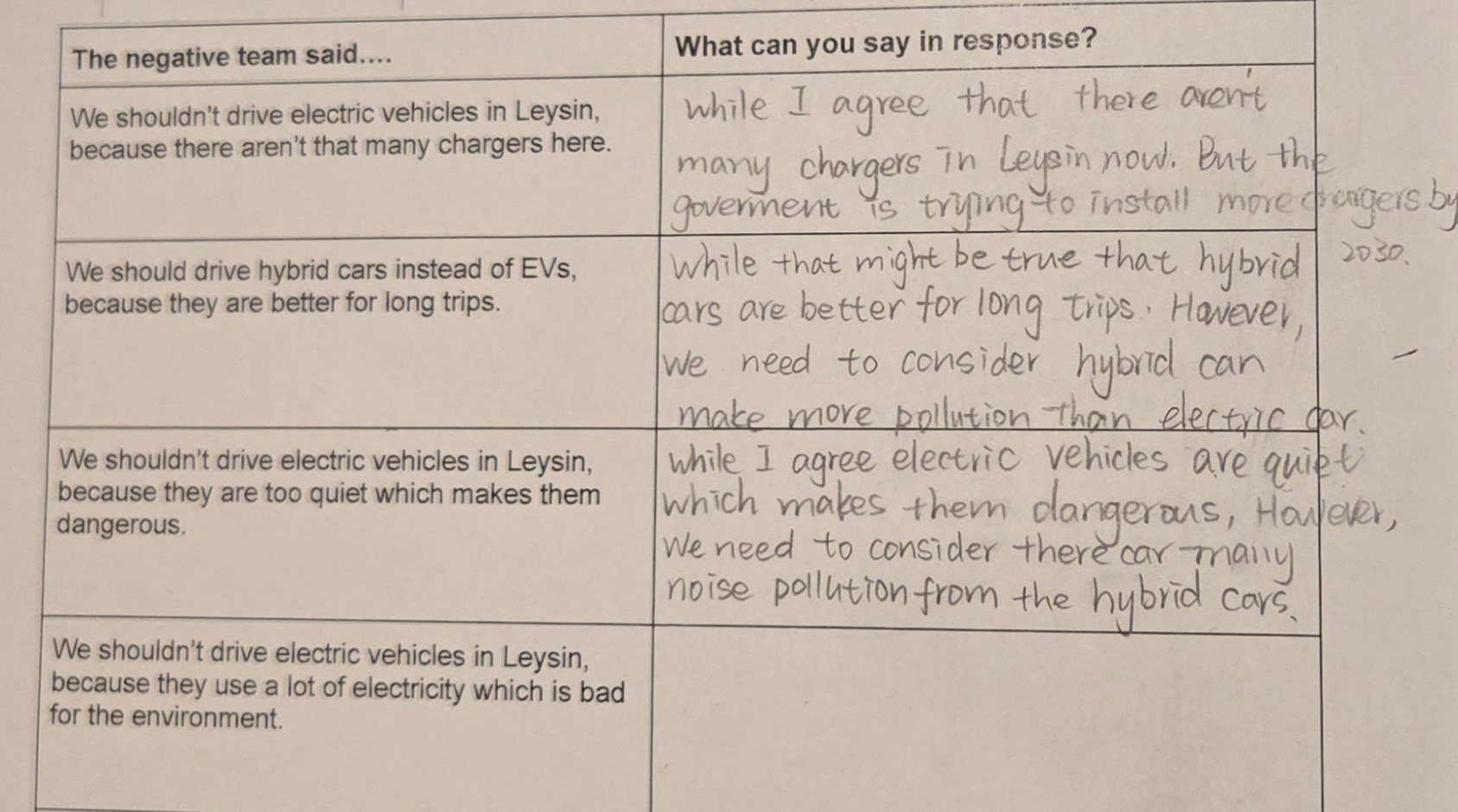
- Distribute to students the T chart with the Negative Team said… What can you say in response?
- Ask students to contribute their responses as to how we should respond. Should we just say, no you are wrong, or should we open the door to their voice for a little bit? How does that sound linguistically? What language resources do we need to do that job well? We need to say While I agree or While that may be true… (Figure 5 and 6).

BRINGING IT ALL TOGETHER
Mari’s unit can be mapped onto the Teaching and Learning Cycle in the following way as illustrated in Figure 8. Please note that the graphic does not include all of the activities designed by Mari, only a sampling from a large unit to show a representation of various learning events and how they map onto the TLC:
Planning with the End in Mind: Identify the learning goals and the cumulative assessment with the matching summative genre (debate). Mari identified reading, writing, listening and speaking skills for this unit.
- Reading Skills:
- develop phological skills of the vowel and consonant phonemes of key words;
- understand morphology of words encountered in the unit: transport, transportation, sustain, sustainability, sustainable.
- identify text connectives and how they make the development or sequence of ideas explicit for the reader, by providing signals about the logical relationships that exist between the sentences and paragraphs in a text
- Listening Skills: listen to what the other speaker is saying to know how to agree with their position and provide relevant rebuttal.
- Speaking Skills:
- use poise, voice, eye contact, posture, confidence, articulation; ask and answer questions about the topic of sustainable transport.
- debate skills of listening, agreeing, and presenting an opposing view with relevant evidence.
- Writing Skills:
- construct a rebuttal using concessive connectives while, despite, even, if, although… and contrastive connectives however, but
- construct an argument with relevant evidence on the topic of the use of electric vehicles in the town of Leysin.
- Reasoning Skills:
- understand the logical relationships that exist between the sentences and paragraphs in a text through text connectives
Building Knowledge of the Field: Students build knowledge of the topic (not just background knowledge, but the knowledge required for argumentation and evidence for their rebuttals). Students research, interview community members, read and talk about the topic, bringing the global issue of sustainable transport and connecting it to the local issue in their community.
Supported Reading: Students learn morphology of words such as transport, transportation, sustain, sustainability, sustainable.
Deconstruction: Students learn the language of concession and rebuttals as described and illustrated above. Students use their L1 to develop reasoning and thinking skills involved in concession and rebuttals.
Joint Construction: Students jointly construct written-like text to translate spoken-like language into written-like moving along the mode continuum.
Independent Writing or Presentational Speaking: students write and present their arguments.

Reflection:
Takeaway 1 from Mari: Ruslana started her first lesson by not only explaining what concession was, but also why it was important for my students now and in their future academic careers. As she explained why the lesson mattered, I could see some of my students sitting up straighter, nodding their heads, looking intently toward her, ready to face this new linguistic challenge. As I watched my students respond in this way, I realized that I often assume that students know the importance of what we are working on in class already. We’re spending time on this, so they must think it’s important, right? Wrong! I always explain what or how, but I rarely explain why, and I lose student buy-in from the start. So, going forward, I want to be explicit about the why right from the beginning. Why are we learning this material? Why are we doing this activity? Why does this work matter now and in the future?
Takeaway 2 from Mari: Ruslana explained the abstract concept of concession in a concrete way by opening the door to the classroom and closing it again. “Concession,” she said, “is like opening the door to say that you heard another person’s argument, and then you close the door again with your own argument.” This explanation allowed the students to understand the function of phrases like “While I agree that___” and “Although it might be true that___.” Rather than just giving the students chunks of language and telling them to use those phrases in their rebuttal, Ruslana got the students thinking about the purpose behind that language. This is the true magic of systemic functional linguistics. Understanding what language is doing is key to allowing students to use it!
A Word on Sentence Frames
Originally, the idea for this blog came from my conversation after school with Mari when we were planning our first lesson together. During that conversation, we realized the problems with sentence frames which are provided for students to complete. The problem with giving students sentence frames was because students would NOT have to think about the functions of the text connectives and what they do for them. In other words, when we give students ready-to-use sentence frames to create concession such as while I agree, while that may be true, despite … (concerns with the lack of charging stations)… students don’t actually have to reason their way through which concessive connective they need because the task is only to comple the sentence. I continue to raise concerns with sentence frames as “static supports” that do not lead to student autonomy.
instead,
I recommend creating a different kind of language habitus in your classrooms where students learn that LANGUAGE IS THEIR RESOURCE, not for accuracy or automaticity or fluency or completing an assignment. But it is THEIR resource to get THEIR things done, for THEIR own purposes. In this unit, I talked to students multiple times that argumentation is a life skill that humans engage in daily, and that skilled argumentation involves particular set of language and non-language skills. That conversation included questions like
- What language resources do we need to be good at argumentation?
- What kinds of meanings are we creating when we are constructing arguments? (i.e., concessive meanings, contrastive meanings, etc)
- How do we concede or give in a little bit and why?
- Why is concession important? To tell people that we heard them, and by doing so we win them over, which is the point of argumentation, isn’t it?
Then from those larger goals and concepts of language as RESOURCE, we can talk about what kind of resource it is. And because humans, first and foremost, are MEANING MAKERS, we can talk about Language as a MEANING MAKING RESOURCE which enables us to reach our meaning potential as Halliday always said.
From there, just like Mari did, we design activities to engage students with meaning-focused activities, relevant to their lives (use of electric vehicles in Lesin, the town where they live and go to school), working with authentic mentor texts connected to authentic learning goals, and creating activities where language is placed in the context of text through Deconstruction and Joint Construction as I illustrated above.
Authors:
Dr. Ruslana Westerlund is an international educational consultant with 30+ years of experience in the field of ML education whose research, writing, and training are dedicated to disciplinary literacy through Systemic Functional Linguistics for all students. She works with schools and teachers to integrate language into literacy focusing on writing through an apprenticeship pedagogy called the Teaching and Learning Cycle for Disciplinary Genres (TLC-DG). She believes that empowered teachers empower students and maintains an active blog to expand teachers’ language toolkit at https://reclaimingthelanguage.blog/
Mari McCarville teaches high school English at Leysin American School in Switzerland, and she is currently researching effective writing practices for neurodiverse multilingual learners. Before moving to Switzerland Mari earned two bachelor’s degrees in music and psychology from the University of Denver, a master’s degree in Curriculum and Instruction with a specialization in culturally and linguistically diverse learners from the Morgridge College of Education, and a master’s degree in German Studies from the University of Colorado in Boulder. Mari has worked as a language educator since 2013, and she has taught in a variety of settings including early elementary, high school, and university classrooms. Her specific areas of study include curriculum development for dually-identified students and communicative language teaching approaches.



 Making Language Visible
Leave a comment