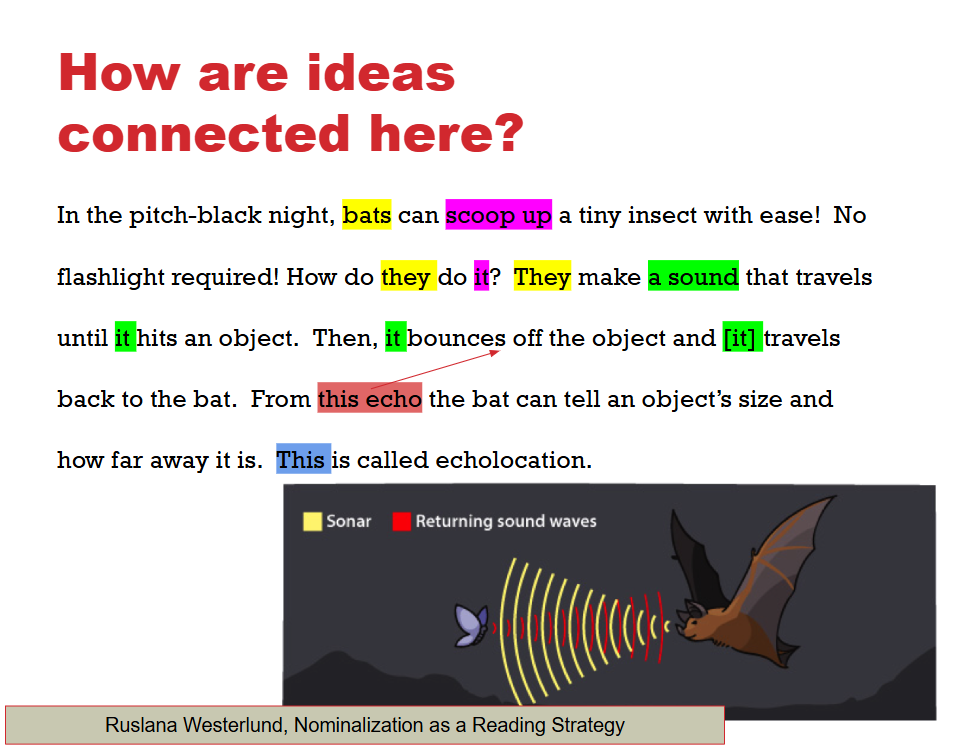
Let’s talk nominalization in the WIDA ELD Standards. Did you know that in earlier grades nominalization is just vocabulary words students use like evaporation, multiplication, revolution? However, starting in grade 5, students should be explicitly taught how to create more dense writing by nominalizing adjectives, clauses, and verbs? To find all the instances of nominalization, go to GLC 4-5 and boom there they are. Don’t forget to also look in the Proficiency Level Descriptors, end of level 6, grades 4-5. It’s a sign of a mature writer when students can replace their long clauses with one noun.
We looked at the plant, and we saw that it had a green coloring inside its leaves that helps it make its own food. → Chlorophyll helps the plant make its own food.
Nominalization is also in the Language Charts. I expressed my concern over this tool because it could potentially replace the 2020 ELD Standards, similar to how the Can Dos replaced the 2012 Edition (I wrote my dissertation on the topic). Instead, we need pedagogical tools, so my blog serves exactly that purpose.
Student language goals referring to Nominalization are mentioned in the Language Expectations as well as Proficiency Level Descriptors.
In the Language Expectations for Language Arts, Inform, Grades 4-5:
- Students will construct informational texts that develop coherence and cohesion throughout through nominalizations to represent abstract concepts (p. 115)
In the Language Expectations for Science, Explain, Grades 4-5:
- Develop reasoning to show relationships between evidence and claims through nominalizations to represent abstract concepts (condensation) (p. 123).
In the Language Expectations for Social Studies, Explain, Grades 4-5
- Generalize probable causes and effects of developments or events through… [….] nominalizations to summarize events and name abstract phenomenon (city expansion) (p. 126)
Nominalization in the Proficiency Level Descriptors
Discourse Level: Density Row: Interpretive Mode
- Understand how ideas are elaborated or condensed through…expanded noun groups with a wide variety embedded clauses and compacted noun groups (nominalization: she stood up to bullies = her courage) (p. 136)
Discourse Level: Density Row: Expressive Mode
- Elaborate or condense ideas through: Flexible range of types of elaboration that includes embedded clauses and condensed noun groups (elaborating: a sweet sap that turned into a delicious syrup after hours of boiling and condensing through nominalization: this tedious process) (p. 137)
What is Nominalization?
Nominalization is a linguistic process where verbs, adjectives, or even entire clauses are transformed into nouns or noun phrases. While it might sound technical, it’s a fundamental aspect of academic and formal writing that allows for significant condensation of meaning and increased lexical density.
Why Teach Nominalization?
For students, particularly as they progress into more complex academic and scientific texts, understanding and utilizing nominalization offers several key benefits:

Subscribe to continue reading
Subscribe to get access to the rest of this post and other subscriber-only content.




 Making Language Visible
3 responses to “Condensing Meanings Through Nominalization”