I recently had a conversation with a teacher about teaching paragraph structure in an argument (persuasive essay). She said, so why can’t we call the first sentence a topic sentence and the final sentence a concluding sentence? That conversation inspired this blog.
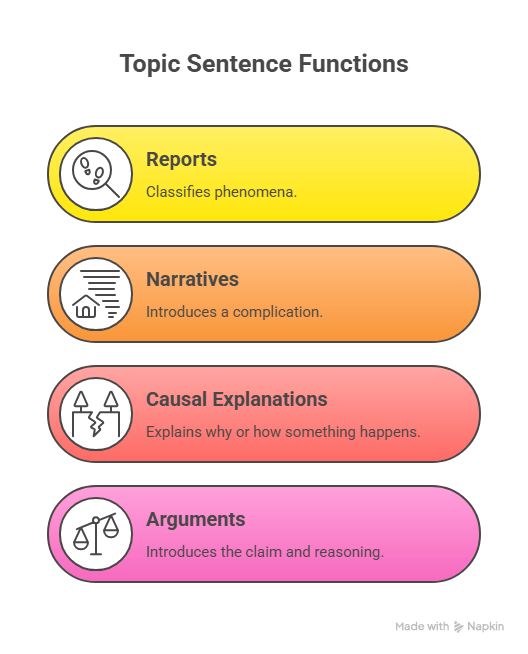
The answer is simple: the sentences that open up paragraphs (we call them Paragraph openers) serve different functions. Below is a simple list to expand your awareness of why they are not topic sentences.

In Reports – To Classify or Explain Phenomena
- Frogs are amphibians that live both on land and in water.
→ Classifies a group of organisms. - Polar bears have thick fur and a layer of fat to keep them warm.
→ Explains a function or adaptation. - A magnet is an object that attracts materials made of iron.
→ Defines and classifies a scientific concept.
In Narratives – To Introduce a Complication
- Suddenly, dark clouds covered the sky, and the wind began to howl.
→ Signals a shift or problem in the story. - Just as she reached the gate, she realized she had lost the key.
→ Introduces a new obstacle for the character. - The ground shook beneath their feet, and the villagers ran for cover.
→ Creates tension and propels the plot forward.
In Causal Explanations – To Explain Why or How Something Happens
- Because the Sun’s energy warms the Earth unevenly, wind is created.
→ The topic sentence explains the main cause–effect relationship that the rest of the paragraph will elaborate on. - When forests are cut down, animals lose their homes and food sources.
→ The topic sentence introduces the central causal idea that organizes the explanation to follow.
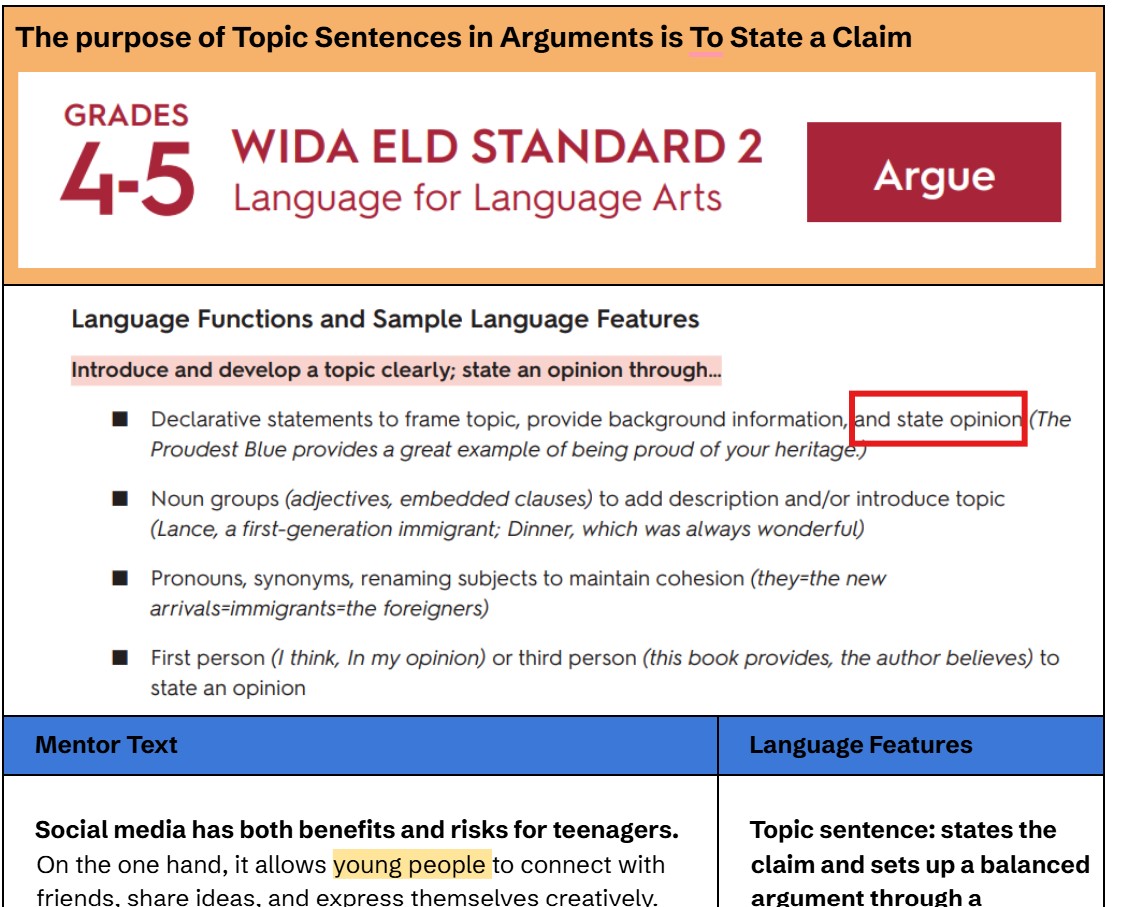
So, how about arguments ? Well, if they are one-sided exposition arguments (present your position and support it with evidence, then the first sentence of each paragraph introduces your claim). If the argument is a two-sided discussion, then one of those topic sentences will have to introduce a counter-claim. See examples of each below.
Topic Sentences in Arguments – To Introduce the Claim
Topic sentences in arguments introduce the claim (the position or judgment) the writer will support and signal how the reader should evaluate the issue. They preview the reasoning or line of justification that will follow.
Examples
Mobile devices should be limited in schools because they distract students from learning.
→ States a claim and previews the reason that will be justified with evidence.
Recycling programs are essential for communities because they reduce waste and protect natural resources.
→ Presents a position and signals the criteria for evaluation (waste reduction and environmental protection).
School uniforms improve student focus by reducing distractions and promoting equality.
→ Asserts a judgment and previews the logical reasons that will be elaborated.
Homework should not be assigned every night because it can increase stress without improving learning.
→ Takes a stance and frames the cause-effect reasoning to be supported.
Topic Sentences in Arguments – To Concede a Counterclaim
In arguments, some opening sentences acknowledge an opposing view as partially valid while still maintaining the writer’s overall position. These sentences build credibility and prepare the reader for qualification or rebuttal.
Examples
Although mobile devices can support independent learning, their frequent use in classrooms often distracts students from sustained attention.
→ Concedes a benefit while reasserting the writer’s claim.
While recycling programs require financial investment, they ultimately reduce long-term waste management costs.
→ Acknowledges a drawback but reframes it as outweighed by benefits.
It is true that homework can reinforce learning; however, assigning it every night can increase stress without improving outcomes.
→ Explicitly concedes before narrowing or qualifying the claim.
School uniforms may promote a sense of equality, but they do not address the deeper causes of student disengagement.
→ Accepts part of the opposing view while redirecting the argument.
Although technology prepares students for future careers, unrestricted screen time in schools can undermine focus and critical thinking.
→ Balances concession and critique in a single sentence.
To learn how to teach text connectives for introducing counterclaims, please read my earlier blog Opening and Closing Doors for Other Voices.
- In what ways, did this blog challenge your thinking about teaching “topic sentences” regardless of the genre?
Cheering you on,
Ruslana



 Making Language Visible
Leave a comment