By Dr. Ruslana Westerlund
Walk into almost any classroom and you will hear teachers say something like: “Today we’re working on informational writing.” Or, prominent literacy bloggers write about the importance of teaching “text structure”, e.g., informational writing is different from narrative. In this blog, I explore the nuances of “text structure” in informational texts. This has implications for teaching reading and writing, …
…. AND KNOWLEDGE BUILDING.
Before we dive deep, it’s important to say the reason we have different text structures is because genres are not just writers’ inventions, as if they all got together in some subcomittees and said, let’s organize texts in this way. Maybe some did and disconnected text structures from the purposes they serve, but for linguists like myself who talk about language in the service of learning, genres have particular text structures because that’s how discipilinary knowledge is organized. Sorry to be redundant, but I need to repackage that in an active voice: text structures exist in the way they do because that’s how disciplines organize their knowledge in their own discipline-specific ways. Sounds like disciplinary literacy so far, right?
Why this matters? It matters because when we write classification reports (I know I’m getting ahead of myself here), we need to organize information into a class–subclass hierarchy, showing how a larger category can be divided into smaller types based on shared characteristics—and that kind of classification is central to how science organizes and builds knowledge about the natural world.
When it comes to teaching writing, it could mean a whole lotta things: a report (“all about”… texts), or an explanation of how a volcano erupts (assigned and not taught), or even a biography. I’ve found it to mean anything that has to do with “nonfiction” writing. Teachers often don’t know what they are assigning and students aren’t clear either on the expectations. (The Common Core for ELA didn’t help in regard at all – they put a slash Inform/Explain.) They are told to use topic sentences and organize their writing in a clear way. (No one knows what it means because you organize classifying reports differently from explanations or from descriptive reports – see texts below). Even though the phrase “informational writing” appears everywhere: in standards, curriculum materials, and writing prompts, yet the term informational text means more than “nonfiction writing”. It suggests that all informational writing is basically the same. But it isn’t.
According to genre pedagogy (e.g., Brisk, 2023; Derewianka and Jones, 2023; de Oliveira & Westerlund, 2021; Humphrey, Westerlund, & Malin, 2026), informational texts include several different genres, each with its own purpose, structure, and language patterns. When we group them all under one label, we aren’t providing equitable access to either reading or writing “informational” texts. How do you teach the text structure of informational reports based on this information?
This is especially true for multilingual learners, who benefit when the expectations of reading and writing are made explicit. Instead of teaching “informational text,” we can teach the genres that organize knowledge in academic disciplines.
Let’s take a look at these three texts …
Three “Informational” Texts About Volcanoes
Students often read about the same topic in different ways depending on the purpose of the text. For example, a text about volcanoes might classify types of volcanoes, describe what a volcano is like, or explain how volcanoes erupt.
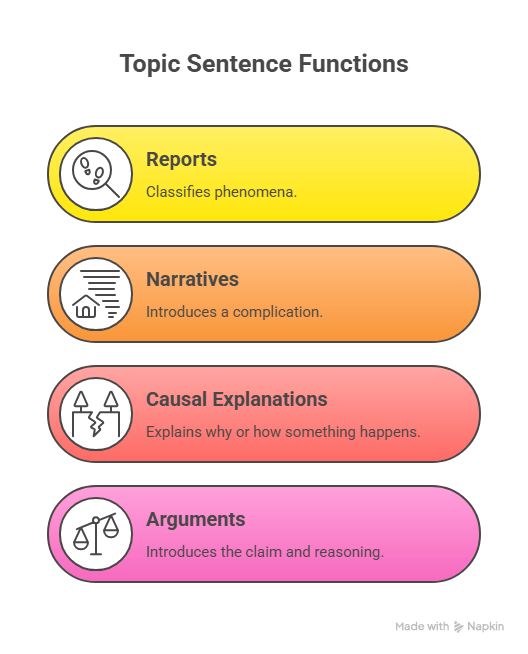
Although the topic is the same, the structure and language of the texts are different. And… while you are reading the texts, please note the visual reprsentation I created with Napkin AI. Different text structures require different graphic organizers. When we ask students to use the same organizer for every informational text—often a simple “main idea and details” chart—we don’t teach them how ideas are organized in genre-specific way. Each genre organizes information differently, so the graphic organizer should reflect that structure.
For example (see graphics below),
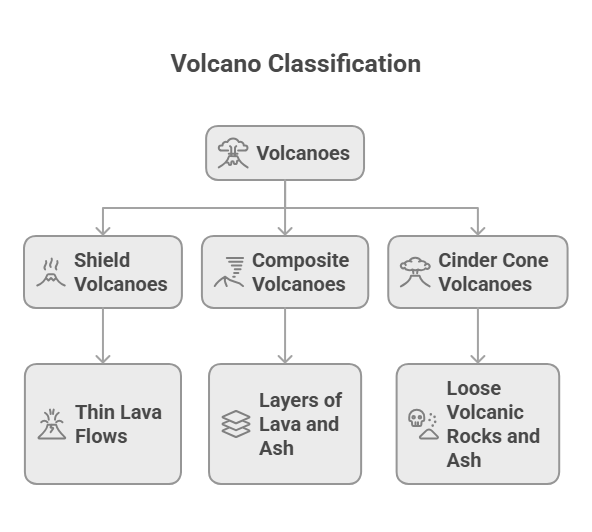
- a classification report is best represented with a tree diagram or hierarchy chart that shows class–subclass relationships (for example: volcanoes → shield volcanoes, composite volcanoes, cinder cones).
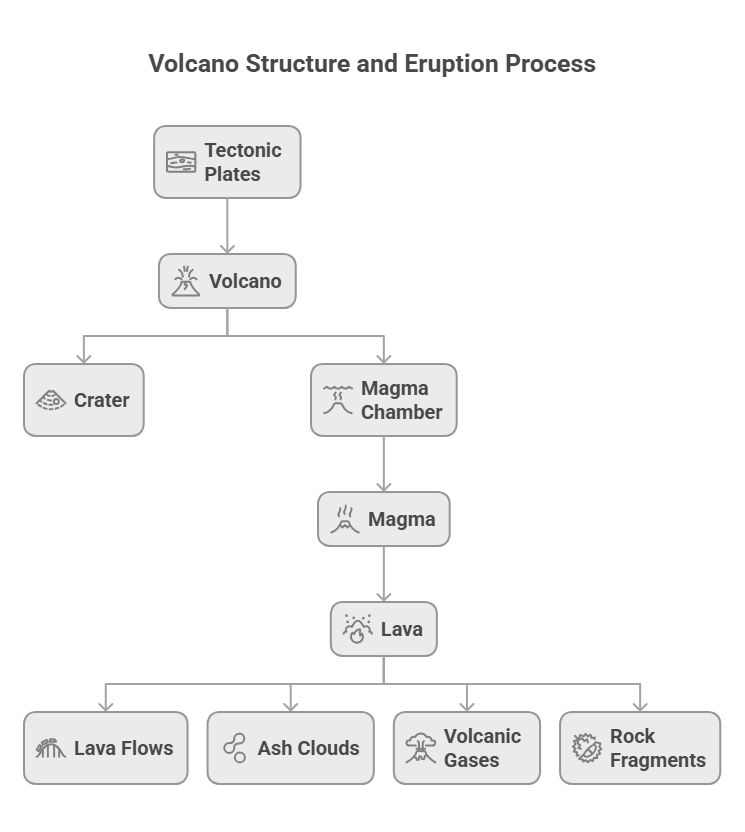
- a descriptive report works better with a web or topic–subtopic organizer that groups characteristics such as appearance, habitat, or behavior.
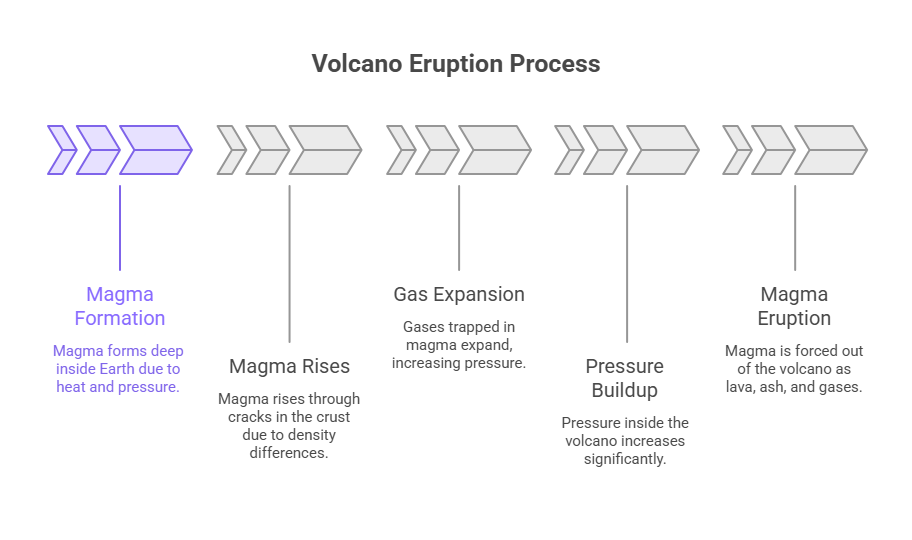
- an explanation, which shows how or why something happens, is usually represented with a flow chart or sequence diagram that highlights steps and cause–effect relationships.
When the organizer mirrors the structure of the text, students can see how knowledge is organized. The graphic organizer becomes more than a note-taking tool—it becomes a visual model of how knowledge is organized in that genre.
1. Classification Text
(Class–subclass relationships)
Volcanoes can be grouped into different types based on their shape and the way they erupt. The three main types of volcanoes are shield volcanoes, composite volcanoes, and cinder cone volcanoes.
Shield volcanoes are wide and gently sloping. They form when thin lava flows over large areas.
Composite volcanoes, also called stratovolcanoes, are tall and steep. They are built from layers of lava and ash.
Cinder cone volcanoes are smaller and are formed from loose volcanic rocks and ash that fall around a vent during eruptions.Scientists classify volcanoes into these types in order to better understand how they form and how they behave.
How to teach students to recognize “text structure” in this text
- organizes ideas into types
- uses class → subclass structure
2. Descriptive Report
(Describing characteristics and features)
A volcano is an opening in Earth’s crust where molten rock, gases, and ash can escape from deep inside the planet.
Volcanoes often form mountains with a crater at the top and a magma chamber below the surface. Inside the volcano, hot molten rock called magma collects beneath the ground. When magma reaches the surface, it becomes lava.
Volcanoes can release lava flows, ash clouds, volcanic gases, and rock fragments during eruptions. Many volcanoes are found along the edges of tectonic plates, especially around the Pacific Ocean in an area known as the Ring of Fire.
How to recognize this text
- describes features and characteristics
- organized by subtopics
- answers questions like What is it? What does it look like?
3. Explanation
(How or why something happens)
Volcanoes erupt because pressure builds beneath Earth’s surface.
First, magma forms deep inside Earth where rock melts due to high temperatures and pressure. Next, the magma rises through cracks in the crust because it is less dense than the surrounding rock.
As magma rises, gases trapped inside it expand, increasing pressure inside the volcano. Eventually, the pressure becomes so strong that the magma is forced out through an opening in the crust. When the magma reaches the surface, it erupts as lava, ash, and volcanic gases.
This process explains how volcanoes erupt and why eruptions can be explosive or gentle depending on the type of magma and the amount of gas it contains.
How to recognize this text
- explains how or why something happens
- organized by sequence and cause-and-effect
- uses causal clauses as … causal connectors: because, as a result, causal verbs: reaches, erupts, rises, increasing
Why This Matters
When students learn to recognize these differences, they begin to see that reading informational texts requires different strategies depending on the genre.
They learn to notice:
- classification → types and categories
- description → features and characteristics
- explanation → causes and processes
This awareness helps students read informational texts not as homogeneous “nonfiction” texts with the same text structures, but as disciplinary genres with different purposes and relationships such as class-subclass, whole to part, description through subtopics, causal relationships, etc. This kind of teaching leads to autonomy and student agency in reading. Instead of teaching “informational text,” we should teach the genres that organize knowledge in academic disciplines.
Ruslana Westerlund, Making Language Visible
P.S. This is by no means an exhaustive list of “informational” texts, but this is just an invitation to start thinking about texts as genres versus big buckets set up by CCSS for ELA. If you want to learn about different types of Reports and Explanations, I proudly recommend our book.
Cheering you on,
Ruslana


 Making Language Visible
Leave a comment