
By Dr. Ruslana Westerlund
I have previously written on how causal language is not always expressed through because and so in this blog.
Today, I’m going to take you to historical texts to illustrate something that needs to be taught explicit to our students: how cause and effect chains are created through language in historical texts. My husband calls this “the domino effect”.
Here’s where the metaphor came from: I was analyzing the language of disasters in various primary sources, and I was discussing my observations with my husband who often ends up becoming “the captive audience” of my linguistic analysis. I was telling him, honey, cause and effect language is never explicit through because and so, and it’s not one to one (1 cause – 1 effect), and what’s more important, it’s NOT CONTAINED IN ONE OR TWO SENTENCES!!! I went on to explain that you have to read the text and pay attention to how the causality unfolds across the entire text. He said, it’s like a domino effect – there is one major cause that causes something (becomes an effect) and then they cause other effects. So, I thought it was brilliant and, of course, it has to become a blog.
This type of multi-consequential relationship is called Consequential Explanation in Genre Pedagogy (Martin & Rose, 2018; Derewianka & Jones, 2023), and it’s connected to my previous blog on Demystifying “Informational” texts. Let’s look at the text below. We recently watched a documentary about the Whakaari Island Volcanic Explosion, so I’m going to use that topic to illustrate causal chaining of the domino effect in language.
Example: The Whakaari / White Island Volcanic Eruption
When students read informational or historical texts, they often expect clear signal words such as because, so, or therefore to indicate cause and effect. However, historians and scientists frequently build explanations in a different way. Rather than stating the relationship directly, they describe a sequence of events that unfold over time. Readers must infer how one event leads to another. But there is no mystery to this inferencing skill because it is done through language, which I will illustrate below.
This structure is often called cause-and-effect chaining. Each action in the text becomes the cause of the next action, forming a chain of connected events.
Importantly, this chain is often made explicit not through connectors like because, but through verbs that show actions and nominalizations that summarize events.
Cause-and-Effect Through Verbs
Consider a simplified explanation of the Whakaari / White Island eruption in New Zealand in 2019.
Scientists believe the eruption likely began when water reached extremely hot magma beneath the surface of the volcano. The intense heat caused the water to turn into steam, which initially could not escape because layers of dirt and debris covered the crater. As the steam continued to build, the pressure increased until it suddenly exploded, blasting rocks and toxic gases into the air. A towering plume of steam and ash rose nearly 12,000 feet (about 3,660 meters) above the island.
When students examine the verbs in this explanation, they can see the chain of actions that produced the disaster.
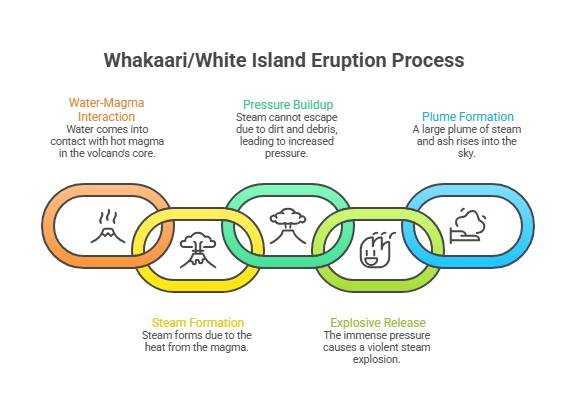
water reached hot magma
→ water turned into steam
→ steam built up beneath debris
→ pressure increased
→ steam exploded
→ ash and gases shot into the air
Each action becomes the cause of the next event, creating a domino-like sequence.
Cause-and-Effect Through Nominalization
Writers also express causal chains through nominalization—turning actions into nouns that name events or processes.
For example, the same explanation can be summarized like this:
The contact between water and magma produced a rapid buildup of steam pressure beneath the volcano. The sudden explosion of steam triggered the eruption, which sent a plume of ash and gases high into the atmosphere.
Here the actions become nouns:
contact
buildup
explosion
eruption
plume
These nominalizations allow the writer to refer to complex events as linked stages in a process.
For example:
contact of water with magma
→ buildup of steam pressure
→ explosion of steam
→ volcanic eruption
→ plume of ash rising into the atmosphere
Helping Students See the Chain
One effective classroom strategy is to ask students to identify:
- Verbs that show actions (what happened)
- Nominalizations that name those events
Students can then reconstruct the causal chain from the text.
For instance:
water reaches magma
→ steam forms
→ pressure builds
→ steam explodes
→ ash plume rises
Through this process, students learn that cause and effect in scientific and historical texts is often constructed across several sentences, not simply marked by words like because.
Why This Matters
Understanding cause-and-effect chaining helps students read complex informational texts more effectively. They begin to see that events in disasters such as volcanic eruptions, floods, or earthquakes are rarely isolated. Instead, they result from a sequence of interconnected processes.
By paying attention to verbs that describe actions and nominalizations that summarize events, students learn to trace the chain of causes and consequences that writers construct across an entire passage. In doing so, they begin to read informational texts the way historians and scientists write them—by following the unfolding logic of events.
Key Takeaways
- Events in informational and historical texts are not just events like in narratives. They function as causes and effects, where each event causes the next.
- Causality unfolds across the entire text, not within a single sentence. Readers must trace how events develop step by step to understand the full explanation.
- Authors do not always signal cause and effect with words like because or so. Instead, readers infer the relationships by following the sequence of actions and consequences.
- The language of causality often appears in verbs and nominalizations. Verbs show what happened (pressure built, steam exploded), while nominalizations name the events (buildup of pressure, eruption), helping writers connect stages in the chain of events.
Cheering you on,
Ruslana
P.S. I now work with schools and teachers and curriculum leaders to help students access complex texts in both reading and writing. So, let me know if you want any help.


 Making Language Visible
Leave a comment