By Ruslana Westerlund, also see http://ruslanawesterlund.com/
Since the first days of COVID-19, language in written communication has become more powerful and more noticed than ever before. As a person who analyzes language for a living and in my daily life and writes about it here, I have become aware of that power in my online communication. Recently I have noticed the punchiness of language in emails, my own or those of my colleagues. So, I began thinking about whether people are indeed more brave in emails or maybe email communication cannot accurately represent all the meaning intended by the writer (I am aware of “brave” jerks who show off their bravado in Facebook comments, but this post is about a different issue).
The awareness of the power of language led me to this question: does the same message sent via email have the same punch as the message delivered face to face or via video? I believe it does not. Why is that? By the way, nothing in this blog will be new to anyone who notices body language in communication. It is commonly known that facial expression, rolling of the eyes, volume, pitch, intonation all play a big role in communication. If there is nothing new in this blog, then why do I believe this message is important? It is worth repeating because it may help others, like it has aided me, to become more aware of our messages delivered via emails during COVID-19.
What is involved in communication? Of course, language, that’s the obvious one. Other meaning making systems that together create a complete meaning besides language are: voice (tone, pitch, cadence, pauses), body position, gestures, facial expression, eye movement, and other. I like using late Gunther Kress’ words, semiotician who recently passed away, who said [paraphrased], 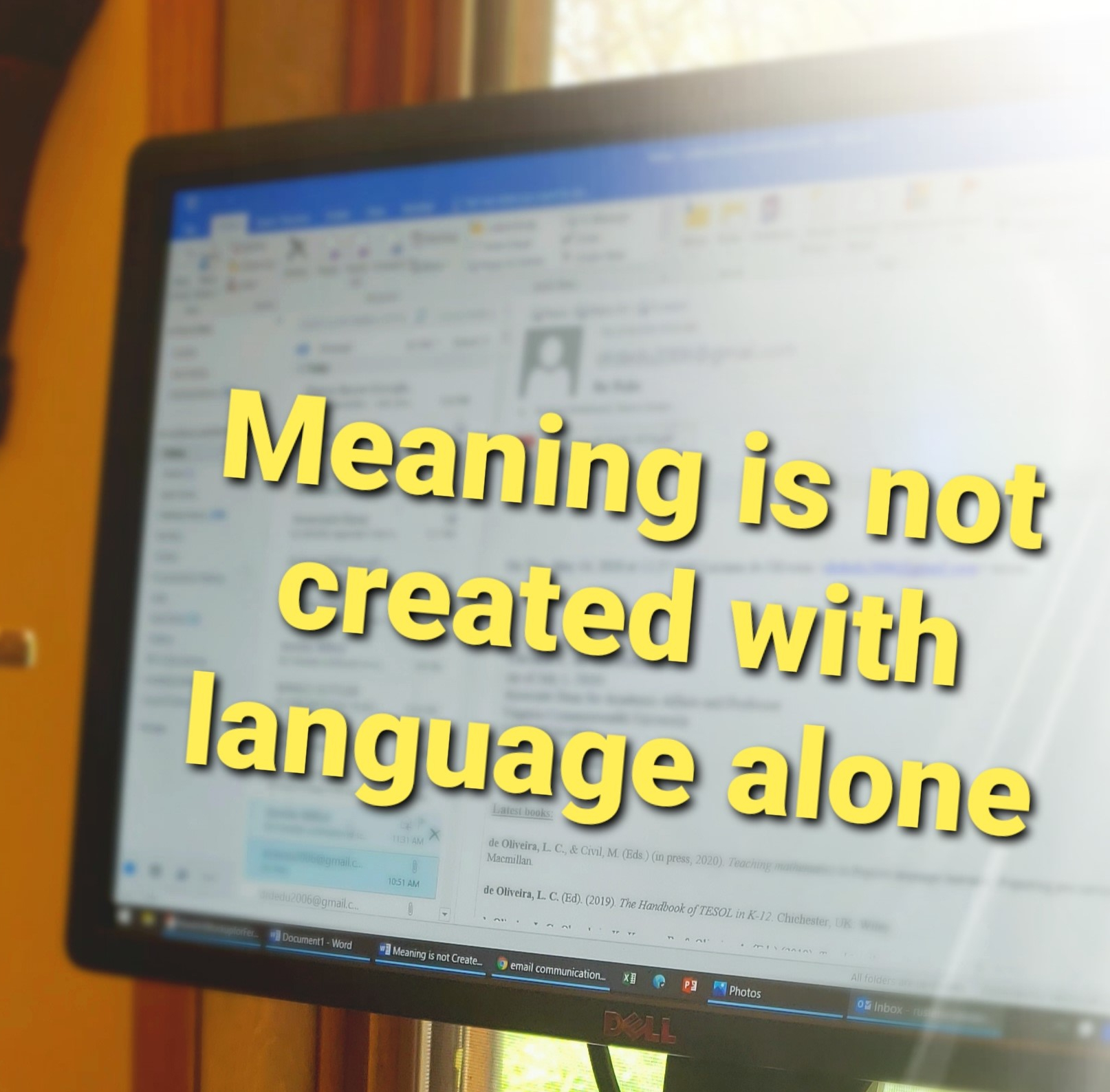 “We don’t create meaning with language alone”. Consequently, words by themselves create partial meanings in emails. That’s why emails that rely on words 100%, communicate incomplete meanings and, therefore, get more punch because other meaning making systems are not available in that mode. The reader does not have the voice, the cadence, the gestures, the pauses to fill in other meanings.
So, when composing emails, remember the absence of all those other meaning making systems and that the same message delivered in two different modes will create two different meanings, often unintended ones, leading to misunderstandings, creating lots of elephants in the room.
Implications:
- Awareness is step 1. Noticing how language works together with other communication systems can lead to being a more intentional communicator.
- Address the elephant in the room created due to miscommunication. Do not avoid it. Pick up the phone if possible and talk it out.
- Choose which emails to send and which ones to write but never send. Send only important emails. If you are writing an email under stress and feeling angry, walk away, come back to it and delete it.
- Remember that we are writing those emails to humans who can’t separate work from home when work is home and home is work from 9-5. Be mindful that the emails may impact other people in that home contributing to the health of the entire household.
- When writing emails, remember that the other semiotic systems are missing. Be careful with your words – they are the main carriers of meaning.
- Organize your information carefully knowing that if the negative is in the beginning of the email, it may impede or shut down the reader’s ability to process the rest of the information more successfully.
- Don’t write long emails. Many of us read emails all day long. When a reader receives an essay, it can lead to an overload of an already overloaded brain. Have you heard of TLDR? It’s real. It’s not just teen age attention span. Adults in 9-5 online communication are losing their attention span because of our brain capabilities. We are not robots.
- Show that you are human. Admit mistakes. Own your part. Apologize.
Bottom line: When you are writing emails, remember that other meaning making systems are missing. Use your words carefully.
For more on this topic: ‘Zoom fatigue’ is taxing the brain. Here’s why that happens.




 Making Language Visible
Leave a reply to Terri Cancel reply