By Dr. Ruslana Westerlund, a linguist, former teacher, and now sourdough maker

I admit it. I finally gave in. I finally succumbed to the ubiquitousness of sourdough and its temptation from Facebook pictures that made me drool. I joined many others in their pursuit of COVID-induced frenzy of house projects. I started with garden projects which carried me through spring, summer, and early fall. As soon as temps dropped below 32, I moved to the indoor house projects. I was not really planning on finding new projects. It was my way of regaining control over something tangible since we lost control over pretty much everything else in this pandemic.
I remember seeing the first appearances of sourdough in my Facebook feed almost the next day when the global pandemic was declared. I silently hated those people because they, obviously, were the reason for all the bread flour disappearing from the shelves March through May. I dismissed the temptation with “Nah, I’m not falling for that. I don’t eat bread. Bread is evil. Bread has carbs! Bread has gluten. Bread makes me fat. Bread has glyphosates. Bread has GMO.” So, holding my “Bread is evil” flag high, I ignored all those pictures of amazing loaves and boules, silently drooling over them.

Instead, I decided to tackle Kimchi. Kimchi is good for you. It’s not just good for you. It’s good for your gut. And the healthy gut is all the craze these days. The fermentation process turns cabbage into something magical, transforming it into good bacteria. As soon as I conquered Kimchi, and my excitement of watching the gas bubbles come up to the surface in a fermentation jar died down, I was ready for the new challenge! So, I finally followed the cult of sourdough bread makers. I was so excited, I felt like I’ve discovered the chemistry itself behind the good bacteria. My dear friend Sharon Besser gave about 100 grams of starter in a lovely Ball jar with a plastic lid and a yellow rubber band with instructions how to feed the starter. That was my new language: “sourdough starter” and the verb “feeding”. I treated it like my plants. I had to be “fed”. I learned how to feed it and the rest is history. February 16th, 2021 marks my beginning of reconciliation with bread and the new love of watching yeast devour gluten, the bad guys for me but the good guys for the starter to work.
I dove right into the process. I made a loaf, and then another, and then another. I didn’t gain weight. In fact, I lost weight. It didn’t cause stomach ache, like the store-bought sourdough did. I was hooked. I made a loaf for my neighbor. I made a loaf for my friend. I made a loaf for my son to take back to the dorm. I even made pizza!
In this process, I was learning the language of sourdough. I learned the names for different stages of the process and the tools: bulk fermentation, proofing, oven spring, banneton basket, lame, scoring, etc. But I didn’t learn it from a dictionary or translated from Ukrainian. I never had the sourdough baking experience in Ukrainian, therefore, there were no Ukrainian words attached to this experience. I only had this experience in English. I learned from excellent teachers. One was Sharon Besser, my friend who gave me the starter, and others were Facebook friends who were generous enough to comment and share their lessons and tips. I paid attention to their language because I have high metalinguistic awareness. I learned the most from Sharon. She gave me feedback, just in time, praised my work, and taught me the language I needed for each step in my learning journey. As I was sharing with her about my loaf, the process, and how it turned out, she would listen and when I stumbled for words, she would give me the language. She would say, “This step is called bulk fermentation” and “you need to do the shape-and-fold and let it rest”. (In the back of my mind I thought I’m the one who needs rest!) So, I’d learn the language several hours after the experience of watching the dough double overnight. I had the experience first and then I attached the language to it. She didn’t really pre-teach any vocabulary. And even today, she commented on my bread and said, “You achieved the perfect crumb.” She is a phenomenal language teacher. The links she shared with me were of a simple sourdough recipe, not a “glossary of terms from A-Z” list like this one. I am quite thankful she didn’t share that link with me because I would freak out and run away and let my sourdough starter die a slow agonizing death of starvation because it’s not fed.
In fact, she never gave me a list of words to match definitions with. She taught me how to make the bread, not how to use language for the sake of language. I don’t remember any repeat after me exercises and I don’t remember matching terms with their definitions. There weren’t any word walls. Sentence starters were nowhere to be found, just one jar with 100 grams of starter (pun intended). I also didn’t do any crossword puzzles. I didn’t have time for that. I had bread to bake! The words came after. The words came when I needed them, not when the teacher thought I needed them. That’s a mark of a good language teacher: to teach the words in the moment of need. Somehow I ended up back with Vygotsky and Halliday. I tell you, in my line of work, all roads lead to Vygotsky and Halliday.
Most of the words teachers assign to their students do not even get used by students. It’s because we think they need them. If you look at this sourdough glossary, there are terms from A-Z that I would never need. The reason is that I’m not a professional baker going to a culinary school or writing technical manuals on the chemistry of sourdough. That takes me to this whole notion of “they need academic language everywhere and all the time” to succeed in school dogma. It really depends on the purpose they need that language for and what they are going to do with it. For example, if students are just doing hands-on science, they may get away with everyday language to say things like push, pull, stick together. It will be artificial to force to say things like “When you rub a piece of iron along a magnet, the north-seeking poles of the atoms in the iron line up in the same direction. The force generated by the aligned atoms creates a magnetic field. ” In my case, I didn’t need the term ‘lactobacilli’, the phrase ‘good bacteria’ was sufficient for me. I don’t have to say, “Sharon, you should have seen my lactobacilli in that starter,” And “The bacteria present in many fermented foods that produce lactic acid which gives sourdough bread its characteristic tang. Lactobacilli also work to raise the bread through the production of carbon dioxide, a by-product of the fermentation process.” Talking like that in the wrong context is funny, right? But we do that to the students, we give them these technical terms regardless of the context where they’ll be used and we expect them to use those words because “we are serious about rigorous learning” and “they need academic language”. I am not against academic language. I am against teaching language devoid of context, without the experience which adds meaning to language, and the purpose in which it’s used.
Back to the glossary of technical terms. Now that I have had several experiences of making sourdough (making the dough, watch it rise, shaping it, letting it rest, scoring it and putting it in the pre-heated Dutch oven), and hearing language from my teacher Sharon Besser and my Facebook friends in their comments along the way, I looked at the glossary. Wow, so many words now made sense. And, not just words, but the process. Words like slow fermentation, shape-and-fold, rest, and oven spring, the perfect crumb, now they make sense and I understand the science behind them. Language gave voice to my experience. Language also deepened my learning of the process. It clarified the concepts behind this process, making me an informed baker, not just one who follows the process blindly, but understanding what’s really going on in the entire process from raw starter to the finished airy slice of warm bread slathered with pure Irish butter.
Implications for Teachers:
- Provide an experience first before teaching language. Language gives voice to experience.
- Introduce key vocabulary after the experience. Our experiences provide the background knowledge necessary for comprehending the reading. The vocabulary will have more meaning and relevance to students.
- Focus on 3-4 key vocabulary words, not an entire list from the textbook. In my sourdough experience, the key words were “feeding the starter”, “stretch and fold”, and “cold fermentation”. The selection of key vocabulary needs to be directly connected to what students will be doing with language and how that language will support their reasoning, or the activity.
- Create role plays where students change the audience and reflect on how different audience calls for different language choices.
- Using the metaphor of sourdough bread, focus on teaching your students how to make bread and the language in the service of a bigger goal.
- Give students multiple opportunities and modes (viewing, reading, talking) to engage with the new learning. Reading should happen after the experience.
- Teachers, especially language teachers, should reflect on how they learn to inform language teaching and not teach the way we have been taught language. Those pedagogies focused on learning language for the sake of language, devoid of context, on producing sentences, not on expanding our functional repertoire (what we can DO with language that needs to expand, not how much longer our sentences are).
Language gives voice to experience. It is not a prerequisite for experience.
Resources that Model Experience-First Approach to Science and Math Learning
Doing and Talking Math and Science
Scaffolding Learning for Multilingual Students in Math
Sources used:



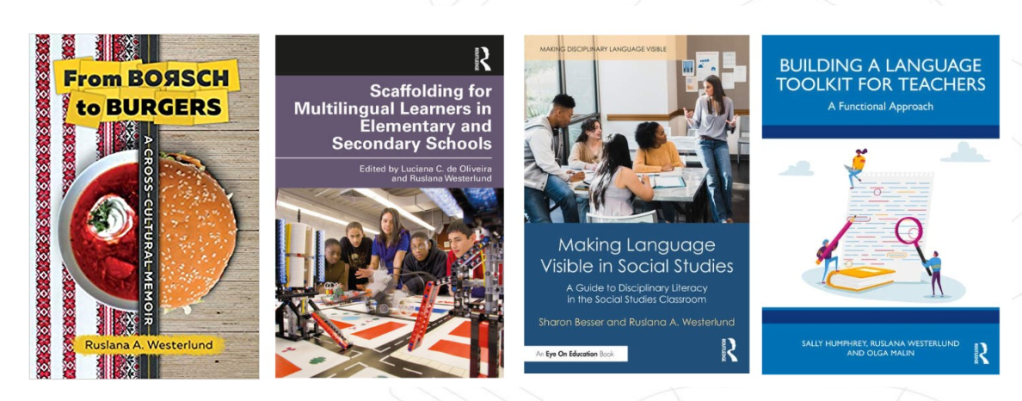
 Making Language Visible
Leave a reply to An Invitation to Rethink “Comprehensible Input” – Reclaiming The Language for Social Justice Cancel reply