by Dr. Ruslana Westerlund
Are we providing kids with language development? I’m not opposed to language supports, but it’s not the same as language development. … One of the reasons the [achievement] gap isn’t closing is because we’re not closing the language proficiency gap. Language supports provide access to content due to [students’] limited English proficiency. In theory they’re supposed to also promote English language development. I’ve not seen any really convincing evidence that they do. It’s content instruction primarily. We’ve done a not very good job promoting English language development.
Claude Goldenberg
The quote above by Claude Goldenberg is from the video here which I used in the professional development I facilitated in a district where the majority of students are identified as English Learners. My job was to introduce them to the WIDA 2020 ELD Standards not as the end in itself but a means to an end: to democratize educational outcomes for our most marginalized students through a rigorous, standards-based instruction. In addition, my task was to illustrate how to make language visible and teach language in the service of learning as a meaning making resource versus an inventory of structures (e.g., let’s learn parts of speech today). I started with a theoretical framing for teachers to get on the same page about what we mean when we say language development and, more importantly, what what we mean when we say “equity” for ELs, especially newcomers. The lens I bring to the equity work goes back to Halliday who said,
Language is the “essential condition of learning, the process by which experience becomes knowledge” (Halliday, 1993, p. 94).
So, when I train on equity, I focus on the language dimension because
In the absence of explicit focus on language, children from certain … backgrounds continue to be privileged and others to be disadvantaged in learning, assessment, and promotion, perpetuating the obvious inequalities that exist today. Mary Schleppegrell, The Language of Schooling
So, it becomes ironic because we, language teachers believe that quote above, but then we replace language with images or other static supports or grammar worksheets. Consequently, we (and myself included, true story), we run out of time to attend to the language as the central tool for learning, as our buddy Vygotsky said several decades ago. So, I work hard to remind teachers that they are language teachers first and foremost, and not homework helpers, or interventionists. My training focuses solely on a language-based pedagogy specifically designed for linguistically marginalized students which I described here and in this podcast available as video with Tan Huynh and in the Colorin Colorado article. In this particular session yesterday, some teachers described my session as “mind-blowing”, while others felt like the foundation under their feet was shaken. Most of the messages that caused the “earthquake” dealt with problematizing the notion of “comprehensible input”. Here are some key messages I communicated:
1. Can Do Descriptors are NOT Language Development Standards. From the very first edition, Can Do Descriptors were never intended for ESL/EL/ML teachers to be used to guide their instruction. Read that again. If you remember the very first version of Can Dos, they were contained to one page. That addition was designed with one goal in mind: help teachers make sense of levels 1-5 when the ACCESS scores came out. The most recent edition was aligned to the Key Language Uses. We, the authors, actually debated whether we should pursue it because we knew what would happen: teachers would use them to replace the standards (Westerlund, 2014). I wrote my dissertation on this topic. You can check it out, or if you don’t want to read 167 pages, (I hope you have better things to do), just ask other EL teachers. Most of them use them for ideas to guide their instruction. Newcomers can match pictures with words. Then at level 2 they can produce a simple sentence. Then at level 3 they can produce a compound sentence. The main reason why Can Dos should not be used to guide our instruction is that they were not aligned to any content area standards. Period. They provide examples of tasks students might be able to do at different levels of language proficiency. To summarize, their one and only function is to help classroom teachers alleviate panic, “HELP! I have a newcomer. They don’t speak any English!!! What do I do with them?”
Instead, take some time to understand the tremendous potential in the new Proficiency Level Descriptors (Figure 1). They are way more instructionally useful because they are concerned with language development. They give teachers a much better guide on how to attend to language development, not just “understanding concepts and content” but to be empowered with language resources to construct explanations about cool things like earth as a system of system consisting of four spheres (see examples in point #4).

Figure 1. Proficiency Level Descriptors, grade level band 4-5, WIDA ELD Standards Framework, p. 137.
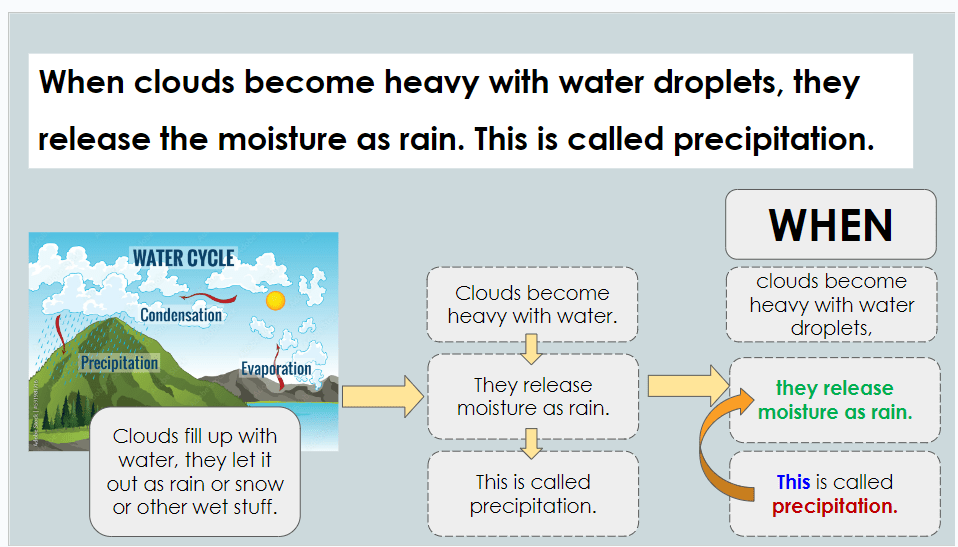
2. Providing Visuals to ELs to Learn the Concept is Not Enough. This one also shook the foundation for many teachers yesterday. We were discussing how teachers typically teach the water cycle. Many teachers said through pictures and oral language activities. Then I put this slide up (Figure 2) and asked, “after we provide a visual to help students understand the precipitation, then what?” Some teachers said, we go outside and experience sleet, rain, or snow. Fantastic, I said, experience before vocabulary! Love it! Then what? Then we draw a picture and one teacher said and we write about it. But the question I kept pushing for is do we teach our ELs to read when the pictures are gone?
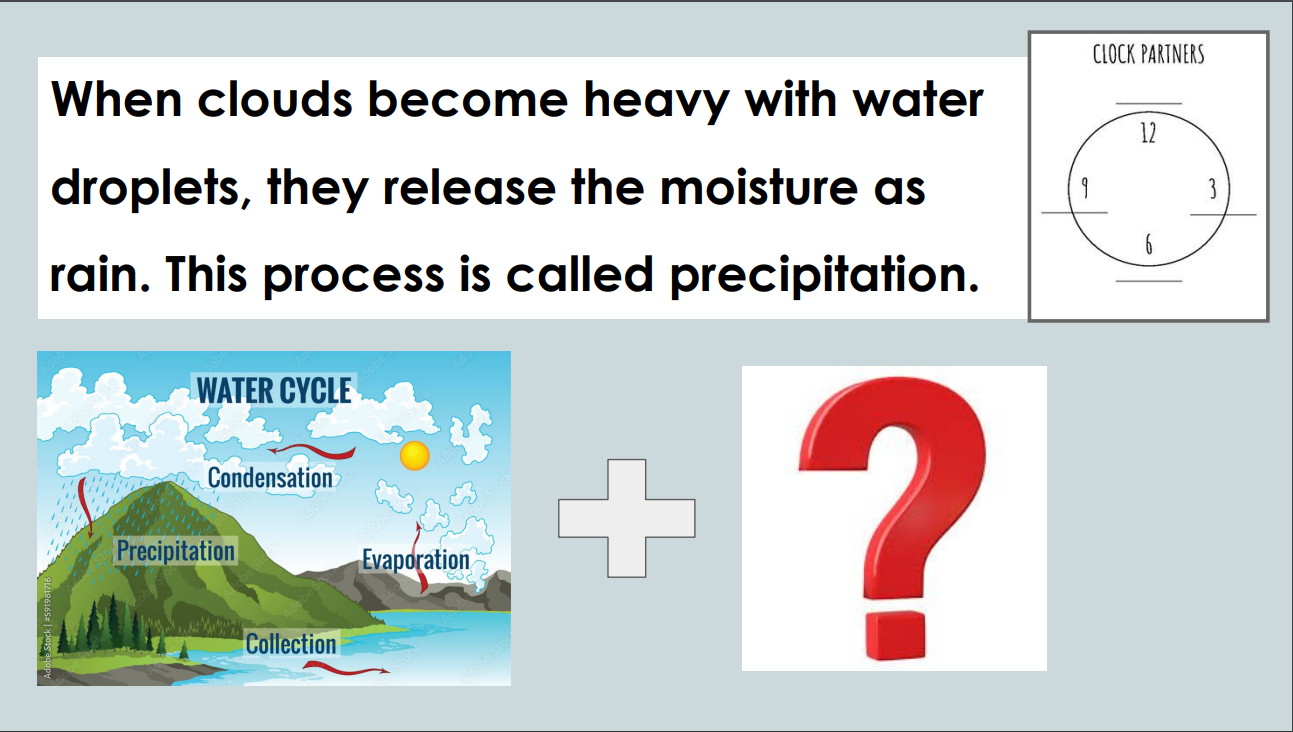
Figure 2. What Do We Do After We Provide Visuals?
We discussed how typically we teach students with pictures to be able to understand what the classroom teacher is talking about, i.e., provide “comprehensible input” because we can’t learn if we don’t understand, as Krashen said in his Comprehensible Input Hypothesis about 40 years ago which spread like wildfire in the 90s! Wow, this ages me – when I started teaching in 1996, I thought CI was the best invention after sliced bread (did I get that idiom right?).
We all started giving students images, graphic organizers, and word banks and that’s pretty much the summary of how ESL/EL/ML education has been going since the 90s. In fact, when I ask Chat GPT to create an activity for EL students, the robot spewed out what was out there on the interwebs: provide word banks, sentence starters, and visuals. Chat GPT just repeats what is most commonly associated with the “EL best practices: word banks, graphic organizers, images, and sentence frames”. Ouch!
So, 4 years ago, smack dab in the middle of the global pandemic, the WIDA ELD Standards came out, and Yikes! As if the pandemic wasn’t enough to navigate! We put out the new edition of the standards, as I call them “unapologetically ambitious” language standards. According to the Language Expectations in the WIDA ELD Standards, our newcomers are expected to interpret and construct science explanations. I’m afraid we can’t really meet those Language Expectations with visuals, sentence frames and graphic organizers. Look at the slide below. How do we support ELs to be able to “interpret science explanations” – WIDA words, not mine (well, they are actually mine, because I was one of the authors who defined Explanations as a genre family consisting of causal, sequential, cyclical, systems, factorial, consequential and math explanations as I described in Figure 3 in Section 4 of the WIDA ELD Standards).
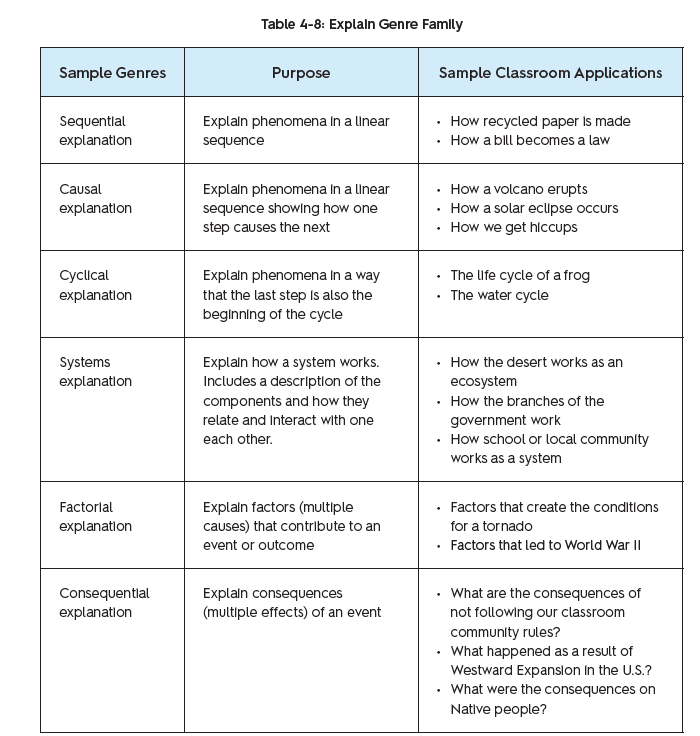
Figure 3. Explain Genre Family, Section 4: Key Language Uses, A Closer Look
WIDA ELD Standards, p. 228
Again, my question to the group was What do students do after the pictures and videos and oral discussions? Can our ELs read and understand a two-sentence long science explanation when the visual support is gone (Figure 4)? As my SFL colleague and friend Sally Humphrey says, “don’t send kids to YouTube, teach them how to read!”. I would say, after they watch a video of the water cycle on YouTube, teach them how to read! This question has huge ramifications on students termed as Long Term ELs.
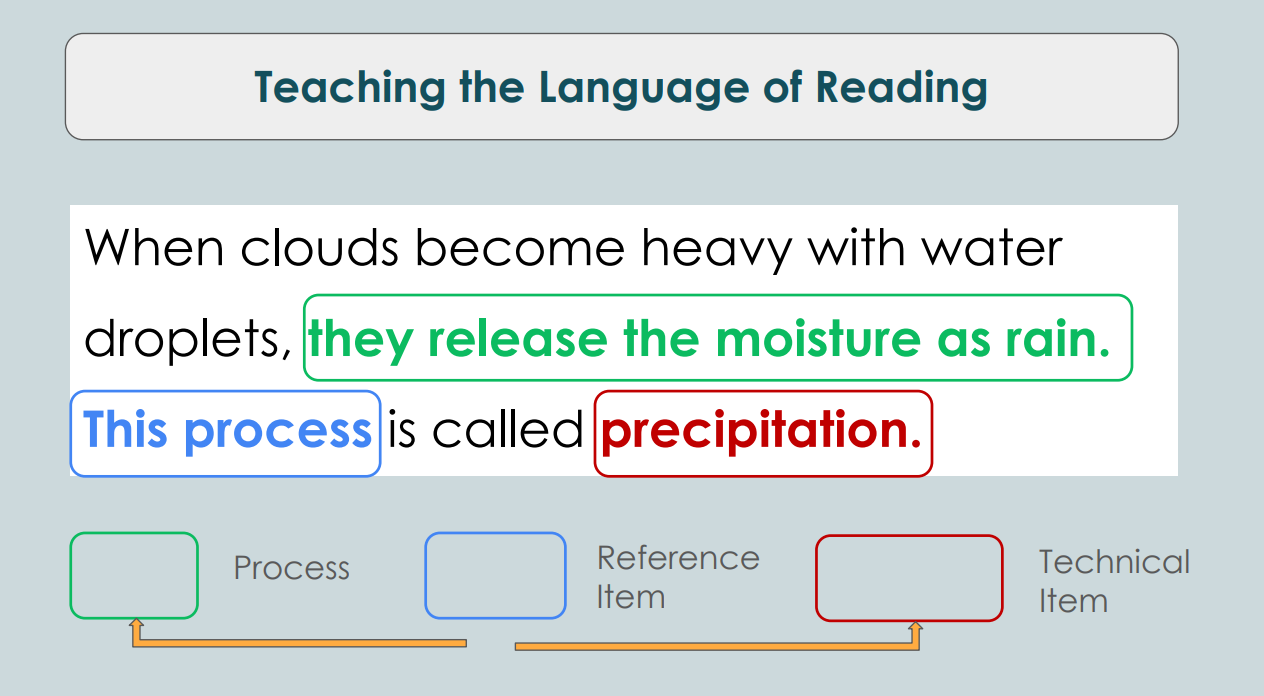
Figure 4. Teaching the Language of Reading When the Visuals Are Gone
Dr. Ruslana Westerlund’s Presentation, August 28, 2024
Inspired by the Exploring Explanations PETAA paper 219
The explanation above is usually taught through oral activities, as the quote below says. But we have to teach the language of reading! We need to teach students how to find the meaning of text by tracking the reference words “this” to what it was referred to above, and connecting ideas across sentences. Comprehension often breaks down not because kids don’t know vocabulary, but because they can’t track the meaning across a paragraph or whole text.
“Comprehension of explanations requires a reader to understand the technical vocabulary used to describe aspects of the phenomenon being explained; stages of the process; or causal components. We can build technical language orally through activities. But often the meaning clues are in the explanation itself, through a
‘defining sentence’. “
Source: Exploring Explanations: The why and how of things. PETAA PAPER 219
Instead of just teaching the vocabulary word, the technical item, "evaporation", teach students how to track the word This across the text.
- Find a good mentor text (1 paragraph) with an explanation or a factual book with a number of defining sentences.
- Highlight the word ‘This’ at the beginning of the sentence.
- Ask students to track with you what the word is referring to – can they find the meaning of the word ‘this’ from going backwards in the written text?
- Ask How many sentences does the word refer to?
- Circle the ‘This’, circle the words or process it is referring to and draw arrows from one to the other.
- Look at the words that come after the ‘This’ in the sentence. Do they define something and provide a technical word? (Source: Exploring Explanations: The why and how of things. PETAA PAPER 219)
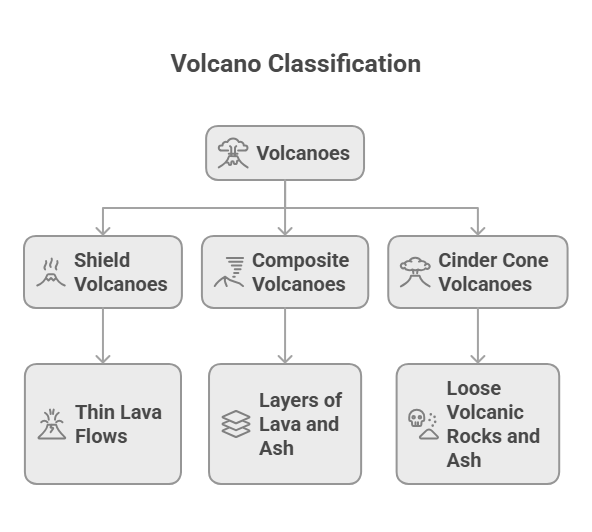
3. Simplifying a Complex Sentence into Simple Ones is not What Newcomers Need.
Another way we make input comprehensible is by simplifying complex sentences for newcomers because they can’t handle complex ones (according to the Can Do Descriptors, right?). But when you break up the sentence, you mess with the logic. Let’s take the sentence. Then read the simplified version in the second column.
As the water vapor cools down, it condenses into tiny droplets, forming clouds. This is called condensation.
The water vapor cools. It condenses into tiny droplets. Clouds form. This is called condensation.
Instead, use everyday language to talk about the pictures (don’t force the technical language here until the students grasped the concept). Then introduce technical language in simple sentences, but DON’T STOP WITH SIMPLE SENTENCES. Move along the continuum and teach how to connect ideas and create causality by introducing WHEN. But most importantly, teach how to extract meaning from all the words, not just the technical vocabulary. Teach students how the word THIS connects back up to the previous process as described above in the bullet points. When you cut up sentences, cut them up into meaningful chunks and talk about the language in the text to help students put it back together, read it together, and then jointly construct a sentence like that about the next phase in the water cycle (Figure 5).
Figure 5. Process for moving along the continuum from everyday to technical and specialized language.
Dr. Ruslana Westerlund’s Presentation, August 28, 2024
For more on this topic of the damage of simplifying complex sentences, please read Lily Wong Fillmore’s super practical article Do Leveled Readers Hurt of Help My ELs?
4. Not All Images Are Created Equal or Teaching Newcomers How to Read Satellite Data. In preparation for integrating the WIDA ELD Standards into Amplify Science, grade 6, I discovered that you can see Mars from Google Maps (here‘s how) and I couldn’t stop geeking out over looking at the Satellite data. But the point I’m trying to make is that we can’t assume that just because it’s a picture, it’s easy. Science or any discipline is replete with complex diagrams and visual data that must be explicitly taught. The indentations in the Mercury’s surface indicate craters. Dried-up creeks may point to the previous existence of water. The bumps indicate hills or mountains. Teach newcomers how to read science diagrams, including the meaning of arrows or dots or lines. Don’t assume those visuals are easy because there is no language. Then overlay language on top of the images as I illustrate below, using the Amplify Science curriculum for grade 6, Unit 1 Geology on Mars, Lesson 1.1 (Figures 6 and 7).

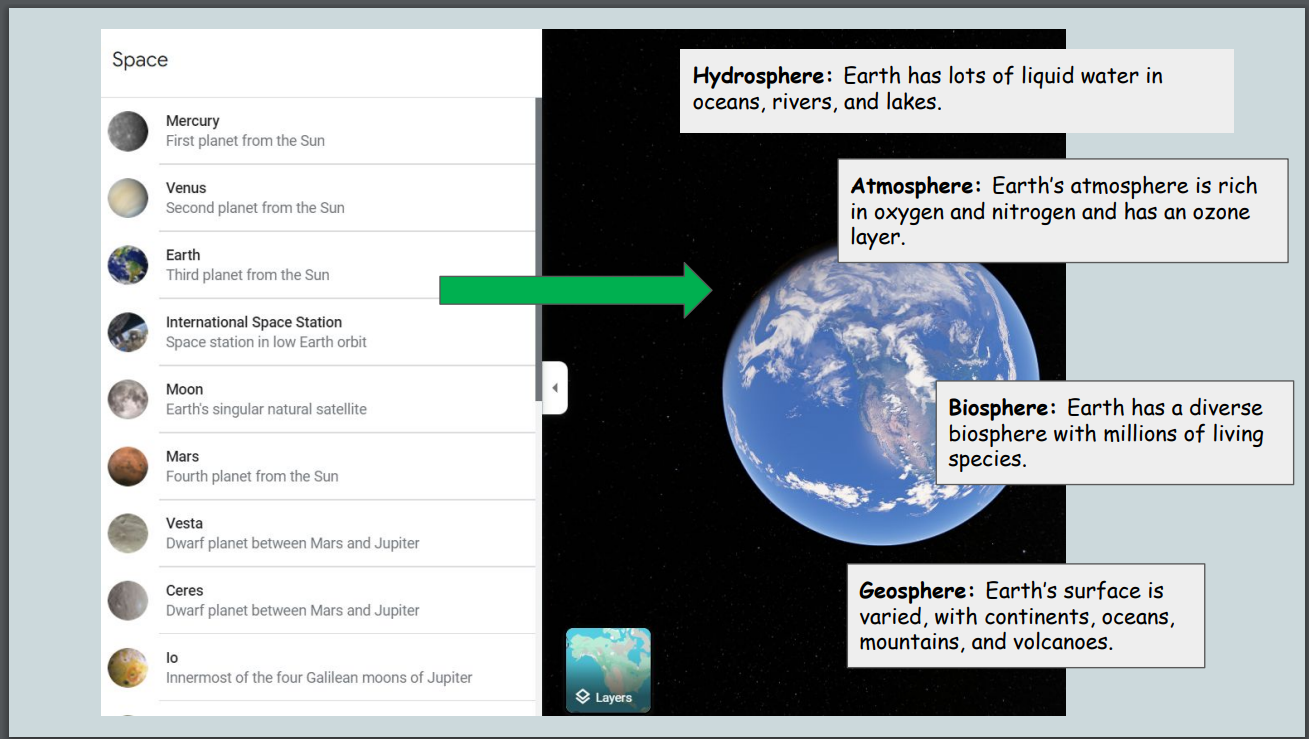
Figures 6 and 7. Examples of overlaying language onto satellite images, based on the lesson in Amplify Science, grade 6, Lesson 1.1. Sentences were generated by Chat GPT.
In summary, I have argued that…
- We need to replace the use of Can Do Descriptors as our instructional guide and be guided by the standards like our content teacher partners. I have recommended replacing our over-reliance on Can Dos with the Proficiency Level Descriptors. Science teachers are guided by NGSS, ELA – by CCSS ELA, Social Studies by state social studies standards, etc. It is our time to stand on the authority of the language standards and be guided by them. Yes, they are ambitious, yes, they may be intimidating at first, but those who have discovered their power now have moved over to the “other side”.
- While there is a tendency to simplify language and reduce text complexity in the name of “comprehensible input”, in this article I problematized the over-reliance on visuals, graphic organizers, and word banks as static supports. Instead of replacing text with visuals, we need to teach students how to extract meaning from texts by teaching them the language explicitly as illustrated with the arrows and color coding in Figure 5.
- Instead of simplifying sentences, we need to teach how ideas are connected within and across sentences through various language-rich activities.
Other Resources by Dr. Westerlund To Explore:
1. What Does Sourdough Have to Do with Pre-Teaching Vocabulary?
2. Teaching Writing in a Content-Area Classroom: article for Coloring Colorado by Dr. Westerlund focusing on the Mode Continuum and the Teaching and Learning Cycle.
3. The Apprenticeship Pedagogy to Writing Instruction with Dr. Ruslana Westerlund (YouTube)
4. The Apprenticeship Pedagogy to Writing Instruction with Dr. Ruslana Westerlund (Podcast)



 Making Language Visible
Leave a reply to Your Favorite Making Language Visible Blogs of 2024 – Making Language Visible Cancel reply