Cohesion is the glue that holds the text together. Collaborative teams have cohesion. They may have members with different ideas but they are united by the common vision and mission. In some families, there is that one person who holds the family together and knows how to work around the dysfunction. Water has cohesion (that’s for you science geeks). Cohesion in text is often referred to as “flow” or “clarity” of ideas. Unfortunately, students mostly experience it in the red (or purple) pen marks on the margins of their papers that say “your ideas aren’t clear” and “your text doesn’t flow” or “fix the flow” or “doesn’t make sense”. When students receive those papers with those markings, they don’t know what to do with that because “writing is assigned, and not taught” as we, genre pedagogy people have said a million times. In the process writing pedagogy (so ubiqutious, it’s invisible to the naked eye), cohesion is addressed in the editing, revision, and more revision but not in the actual teaching (Westerlund & Besser, 2021).
In the WIDA ELD Standards, cohesion is defined as:
cohesion: how parts of text interconnect and flow with help from cohesive devices. cohesive devices: words, phrases, clauses, and organizational patterns that tie ideas together so they become unified in the whole text. Given/new is an organizational pattern; linguistic resources include lexical cohesion, substitution or omission (also known as ellipsis), and reference devices (e.g., personal pronouns, demonstrative pronouns, qualifiers).
Recently, I was reviewing a brand new curricular materials that hit all the checkboxes on “equity” like we have culturally relevant texts and other great buzz words, but the teaching of writing was relegated to “draft, edit, revise, rinse and repeat”. When I reviewed it for the explicit teaching of writing (which belongs in my definition of equity as in “providing equitable access to the genres of power”), I got super thrilled when I saw a header “cohesion and clarity” only to be later disappointed that there was no teaching of it. The publisher provided a mentor text and a checklist but not much teaching of cohesion in arguments, only a checklist with things like ‘clarity of ideas’ and ‘ideas flow well together’ and ‘use of transition words’. It’s like me seeing a picture of gorgeous sourdough loaf with a checklist of what great sourdough should have, and then, boom, go your make loaf by looking at the picture and following the checklist of all the important characteristics like a hardy crust, lots of small bubbles inside spread all over evenly, blisters on the crust, etc. No matter how many detailed checklists I get, I would never learn how to make sourdough by studying the checklist and the beautiful photo. But I digress and do so with so much fun because I am a sourdough nerd.
Back to cohesion.
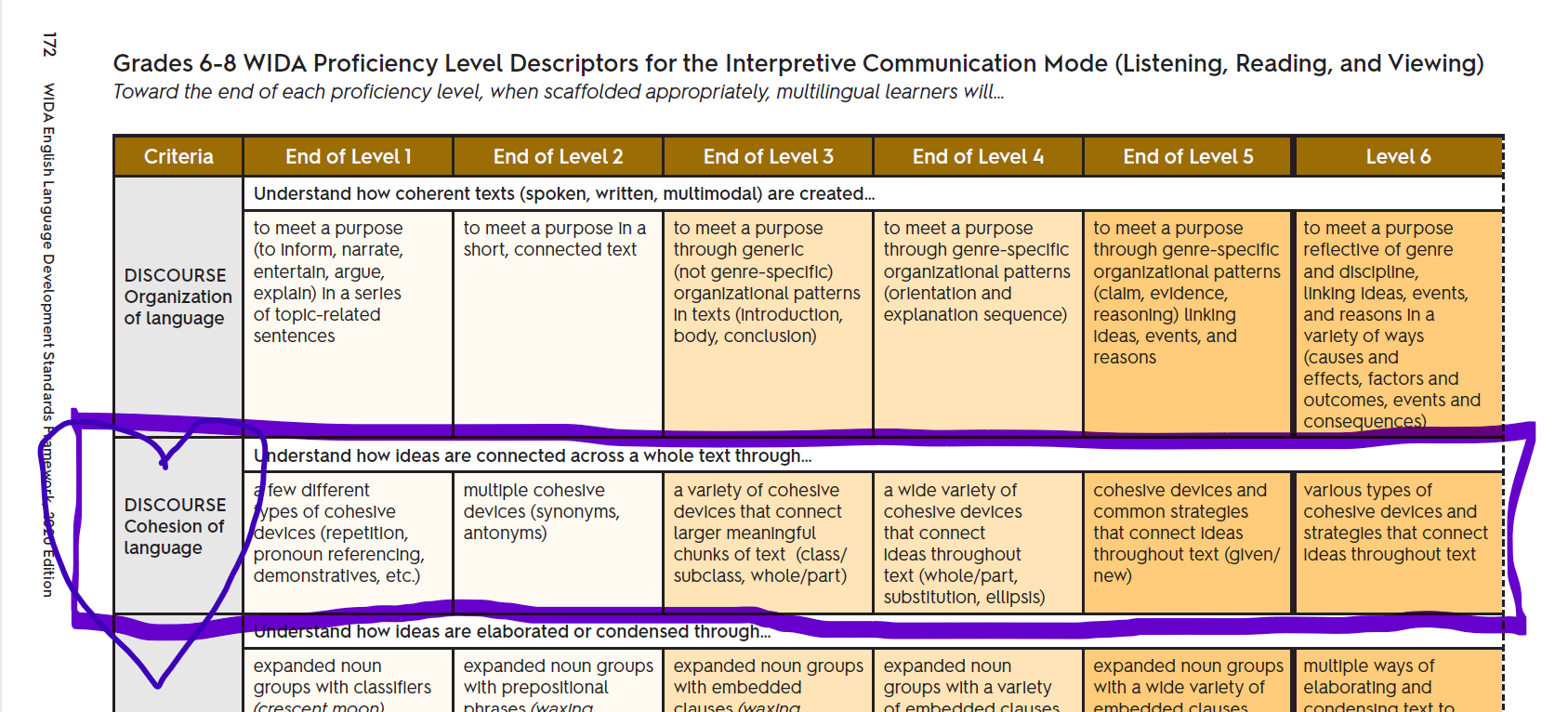
Did you know that an entire row is dedicated to COHESION in the Proficiency Level Descriptors in the WIDA 2020 ELD Standards?
Excerpt from the WIDA Proficiency Level Descriptors, 2020 edition, grades 6-8, p. 172
Cohesion is the glue that holds the text together (repeating for emphasis). But it’s not magic. It’s not like pixy dust, poof, and the text has a flow and the ideas are clear and writing makes sense. Good writers actually study cohesion as both art and science. They know that there are special devices that make the text flow. When I was a teacher, I only knew pronoun reference as a cohesive device but there are at least 6 or 8 different devices (Humphrey, Droga, and Feez, 2012). I won’t try to overcomplicate it and instead, I created a student checklist just focusing on cohesion.
Note: there are more cohesive devices that are in this checklist, so please review the WIDA glossary (pp. 251-259) and some more devices with more elaboration below this checklist.
Student Cohesion Checklist for Argument Writing
Cohesion Element
Checklist Question
Example
Pronounsand other reference devices (see below this table fore more)
Have I used pronouns to refer back to nouns and avoid repetition? (including demonstrative pronouns this, those, these)
Example: “Social media can cause stress. It can also lead to anxiety.“
Synonyms, Antonyms, and Repetition of Key Terms
Have I used synonyms or related terms to reinforce my main points without repeating the same word too often?
Example: “Teens use social media a lot. These platforms help them stay connected.”
Text Connectives
Have I used transition words to show relationships between my ideas (e.g., cause/effect, contrast, addition, sequence)?
Example: “Social media is fun. However, it can also be harmful to mental health.”
Referencing Back to Previous Ideas
Do my sentences clearly refer back to previous ideas to help the reader follow my argument?
Example: “Frequent use of social media can cause stress. This issue needs attention.”
Cause and Effect Connections
Have I used cause-and-effect connectors to explain how one idea leads to another?
Example: “Teens use social media excessively; as a result, their sleep is disrupted.”
Nominalization
Have I used nominalization to turn actions or processes into abstract nouns to create cohesion between sentences?
Example: “Teens use social media excessively. That overuse leads to several problems…”
Substitution
Have I used words like “do” to replace the verb in the previous clause or “too” or “as well” or “also” to avoid repeating the phrase before?
Many teenagers use social media daily, and many adults do too. (The phrase “use social media daily” is omitted after “adults” to avoid repetition.)
More from the WIDA ELD Standards Glossary
Reference devices: words that bridge back or forward to people, things, or sections of a text. For example:
personal pronouns: such as you, she, they that refer to living and non-living things (e.g., People use maps to find where they need to go.)
articles: as in a, an, the. For example, in “Can you hold the pencil?,” “the” refers to a pencil thatthe speaker or writer mentioned previously.
demonstrative pronouns: such as this/these, that/those, there that refer to living and nonlivingthings, places, or actions mentioned previously (e.g., Once you decide where you want to go,you need to find out how to get there.)
qualifiers: such as many/some/several (e.g., Maps used to be drawn by hand. Many hadpictures of fantastic beasts and other decorations.)
comparatives: such as same/different, other, bigger/est, more/less (e.g., This map has a lot ofdetail, but that one has more.)
text reference: where a pronoun (such as this/these or that/those) works a substitute for anidea or phenomenon previously described in the text (e.g., Maps are flat, but the world isround. This is why globes are so useful.). (WIDA 2020, P. 257).
Lexical cohesion: refers to the use of word association to tie together meanings in a text, such as through
repetition: e.g., Dolphins have fins. Dolphins use fins to swim.
synonyms: phrases with similar meanings: parallel lines = lines that never meet
antonyms: phrases with contrastive meanings: hot air goes up, cold air comes down
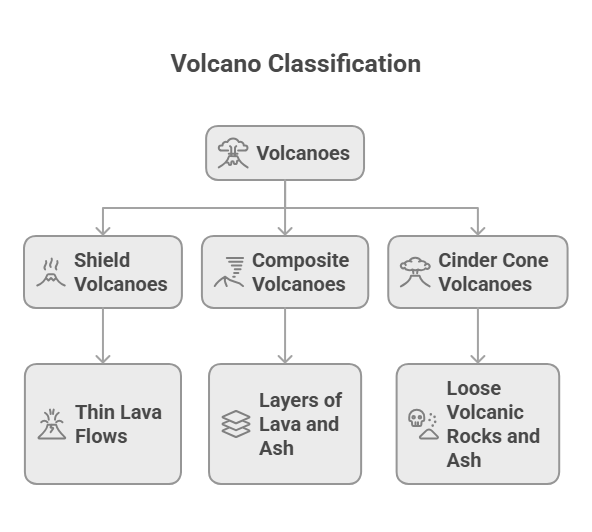
hyponyms: words that identify a general class and a subclass: nations: Algeria, China, Haiti
classifications that are more general or specific: mammals: monotremes, marsupials, andplacentals
compositions that identify a whole and its parts: earth: mantle, outer core, inner core (WIDA 2020, P. 255)
Please comment if you want to learn more about cohesion and which cohesive device you’d like to learn more about.
[…] I ran into a teacher who stopped me and said, Hi! My name is Alex and I loved your blog on Cohesion, and I was the one who asked please create a blog for every language feature in the WIDA ELD […]
“Good writers actually study cohesion as both art and science.” As much as I love this and your reference to the PLDs, I would love to see how this translates to the classroom, and as you mentioned, not just through the use of a solid mentor text.
Additionally, as I was tasked with identifying my students’ levels based on the PLDs, I pulled some essays they had written for their ELA class, and a couple response paragraphs. I realized that students had relied so heavily on the given essay frame, that the papers were nearly identical, with no originality or authentic writing. The same for the paragraphs. So how is the best way to identify where the student is genuinely, on the desriptors? I have been to a couple of your PDs on the WIDA standards, and I keep coming back to your remarks regarding sentence frames and sentence starters. Of course, I can’t remember it all, but in essence, in the past students were given such highly structured sentence frames that the students were_____? (I would love to know what you had said-that’s my real question!) But, sentence starters are a great scaffold that can be a jumping off point.
Hi! Thanks for the questions. To see where students are in their cohesion, I recommend doing an uncoached writing of a genre you are teaching. You’ll see that most students over-rely on pronoun reference as cohesive devices or it’s not clear who or what the referent is. So, that’s one pattern to teach explicitly. Or there is too much repetition (that’s my issue as a second language writer – I often repeat words 3-4 times in a paragraph). So if that’s a pattern you see in your students’ writing, then teach renaming as a cohesive device through synonyms. In terms of sentence frames and starters, I think I might have said that students come confident users of sentences starters, but they don’t become writers. They just know how to finish the sentence starters. Yes, sentence starters can be a jumping off point, but they become a crutch. Are sentence starters varied? Do they learn how to connect sentences across a paragraph using sentence starters? Do they know that every sentence has a job and needs to earn its place in the paragraph (quoting my Australian friends)? I would study authentic texts and find how authors write and mimic how they open their sentences and paragraphs. Choose a genre, for example a biography or a memoir (see WIDA Standards Annotated Sample Mentor Texts). Bring three or four of them and have students compare how each author started the bio. They can create their own sentence frames from those mentor texts. Does this answer your questions?
Thank you very much, yes this is very helpful. I am going to try a couple of your ideas. I especially like the idea of students creating their own sentence frames.
Thank you very much, yes this is very helpful. I am going to try a couple of your ideas. I especially like the idea of students creating their own sentence frames.
[…] left for them. So, in my blog, I am going to demystify most of those things. In my cohesion blog, I illustrated several cohesive devices (beyond pronoun reference and transition words). In […]




 Making Language Visible
Leave a reply to Ruslana Westerlund Cancel reply