I love going to conferences and feel that I have a privilege to go because so many teachers can’t take time off from teaching. My favorite part is meeting teachers face to face whom I know from Facebook. This time, at the WIDA Conference in Pittsburgh, I ran into a teacher who stopped me and said, Hi! My name is Alex and I loved your blog on Cohesion, and I was the one who asked please create a blog for every language feature in the WIDA ELD Standards. In addition, I promised 599 educators who attended Carolina TESOL where I did a keynote address on the topic of Rethinking Comprehensible Input as Simplification of Complex Language. So, this blog is for you (and other teachers who work hard every day and too busy or exhausted to write blogs and who can’t attend conferences, where I presented this content). I am at your service! This blog highlights the Language of Causality.
Let’s take a look at this text
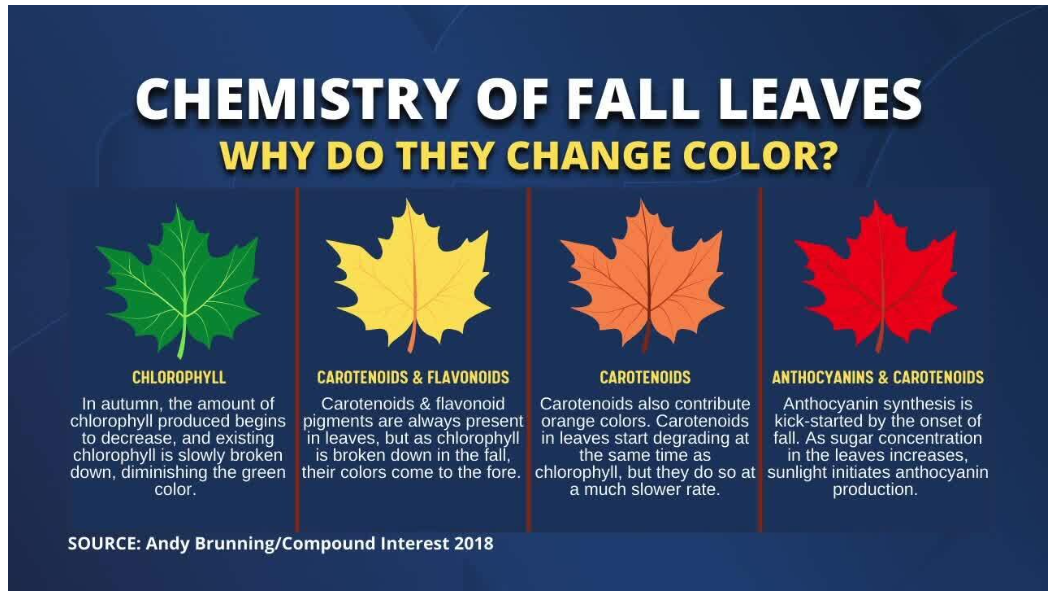
Typically, we would teach vocab words in that text – all the technical terms, the obvious ones such as “chlorophyl”, “pigments”, “carotenoids and anthocyanins” which are important, no doubt. But what should you teach in addition to vocabulary?
However, for students to understand this text, it is not enough to teach vocabulary. For students to understand the process behind the change in leaf color, we need to learn the language of that process, often expressed through a genre called a causal explanation and the associated language features that express causality (both causes and effects)
Causal explanations are exactly that: they explain the how or why of a phenomenon. So when you are teaching students how to read science texts, (and we absolutely must), pay attention to the explanations and teach the language of causality. Give them highlighters and highlight all the instances as identified below. As they do that, their understanding of the phenomenon will deepen.
Causal Verbs (passive and active voice):
- begins to decrease: Indicates the initiation of a cause that affects chlorophyll levels.
- is broken down: Describes a process where chlorophyll is decomposed, leading to a change.
- contribute: Indicates the role of carotenoids in causing the orange color.
- is kick-started: Suggests the initiation of anthocyanin synthesis due to fall’s onset.
- initiates: Describes the action of sunlight starting anthocyanin production.
Causal Clauses:
- as chlorophyll is broken down: Indicates the reason or condition under which carotenoid and flavonoid colors become visible.
- as sugar concentration in the leaves increases: Describes the condition that triggers anthocyanin production.
Nouns Expressing Causality:
- production: Refers to the outcome caused by increased sugar and sunlight.
- synthesis: Indicates the process caused by the onset of fall.
- onset: Refers to the cause or beginning of a process affecting anthocyanins.

Let’s look at another text (not a multimodal this time) because I believe students need to learn how to read all kinds of texts in science: diagrams, infographics with a combination of text, language and photos. And we must teach students how to read text with complex sentences which communicate causality.
Leaves change color in the fall due to a combination of environmental and biological processes. As days become shorter and temperatures drop, trees receive signals to prepare for winter, prompting a reduction in chlorophyll production, which causes the green pigment in leaves to fade. Because chlorophyll breaks down, other pigments—such as carotenoids and anthocyanins—become visible, resulting in the vibrant yellow, orange, and red hues associated with autumn foliage. The decrease in chlorophyll, in turn, triggers a shift in the dominance of these pigments, thus revealing the underlying colors. Additionally, changes in temperature and light influence the intensity of these colors; for instance, cool nights and sunny days often lead to more vivid reds. Ultimately, it is this series of natural responses to seasonal shifts that leads to the spectacular display of fall leaves.
Here are all the instances of causality identified in the paragraph:
Nouns Expressing Causality:
- Reduction: Refers to the decrease in chlorophyll production.
- Breakdown: Indicates the process causing other pigments to become visible.
- Shift: Describes the change in pigment dominance.
- Influence: Represents the effect of temperature and light on color intensity.
- Responses: Refers to natural reactions to seasonal shifts.
Verbs Indicating Causality:
- Prompting: Describes how signals cause a reduction in chlorophyll.
- Causes: Directly links reduction in chlorophyll to pigment fading.
- Triggers: Indicates that the decrease in chlorophyll initiates a shift in pigment dominance.
- Influence: Describes how external factors affect color intensity.
- Lead to: Shows the causal connection between environmental conditions and the colors’ intensity.
- Leads to: Connects natural responses to the colorful autumn display.
- Resulting in: Explains the outcome of chlorophyll breakdown.
Clauses Expressing Causality:
- As days become shorter and temperatures drop: Introduces the reason for trees preparing for winter.
- Because chlorophyll breaks down: States the cause for the visibility of other pigments.
WIDA glossary defines causal language as (you don’t have to be in the WIDA State to benefit from these resources)
causal language:
- words, phrases, and clauses that express causes and effects. Typical spoken language connectors are because and so.
- Additional connectors used mainly in writing include therefore, consequently, as a result,
- nouns such as the result, the effects, and entire clauses (e.g., Unable to grow or repair themselves, the corals eventually die),
- verbs lead to, are caused by, resulting in, and prepositions such as as, for, through (WIDA, p. 251).
When we were writing the WIDA Standards, we drew on Systemic Functional Linguistics. According to SFL, language can be viewed on a continuum from everyday to specialized, from here and now, you and me to language as reflection, from concrete to specific, from emotional to objective, from familial to distant.
When it comes to causal language, you can also put it on a continuum from more everyday to more abstract. I want to give credit to Lexis Education where I originally saw this post by Marie Laubie on their LinkedIn page.
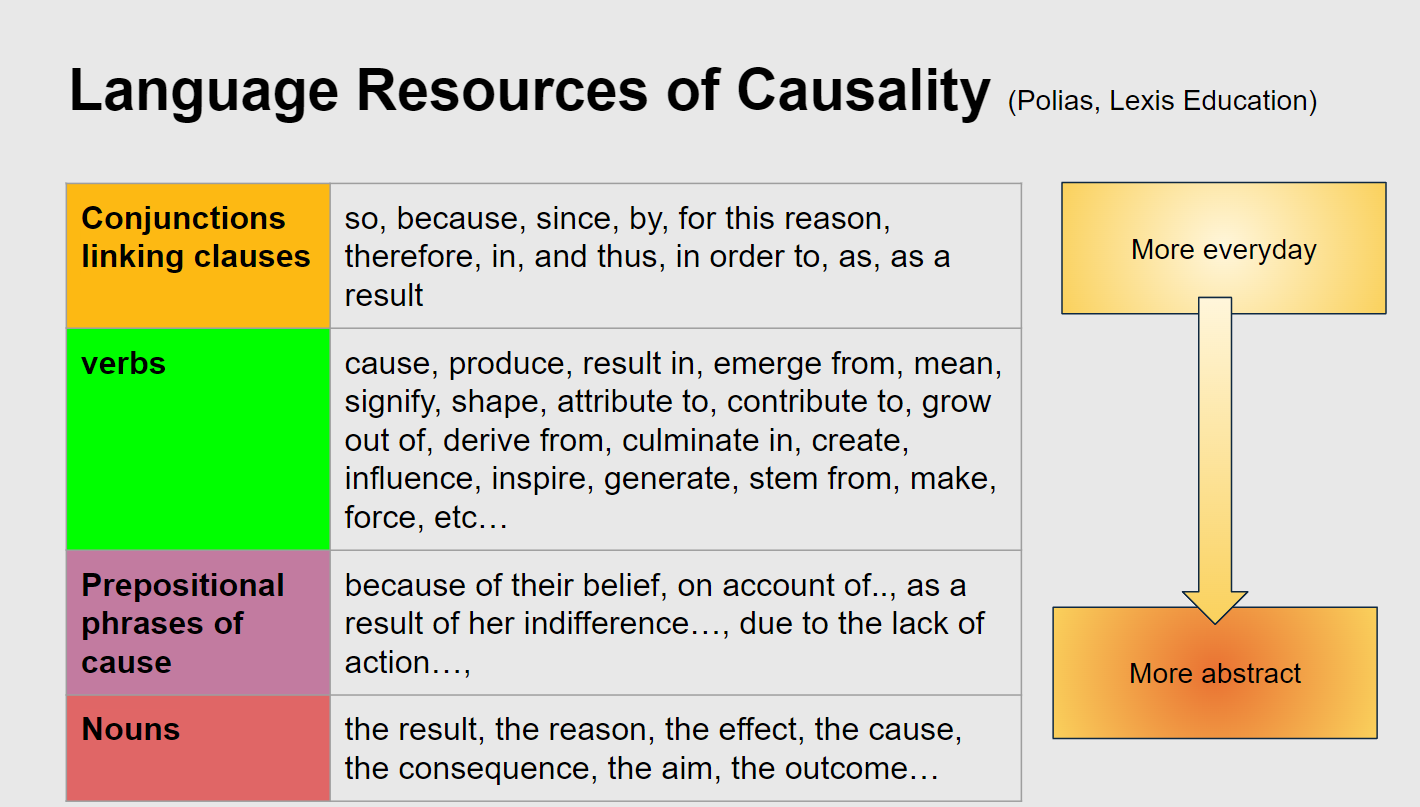
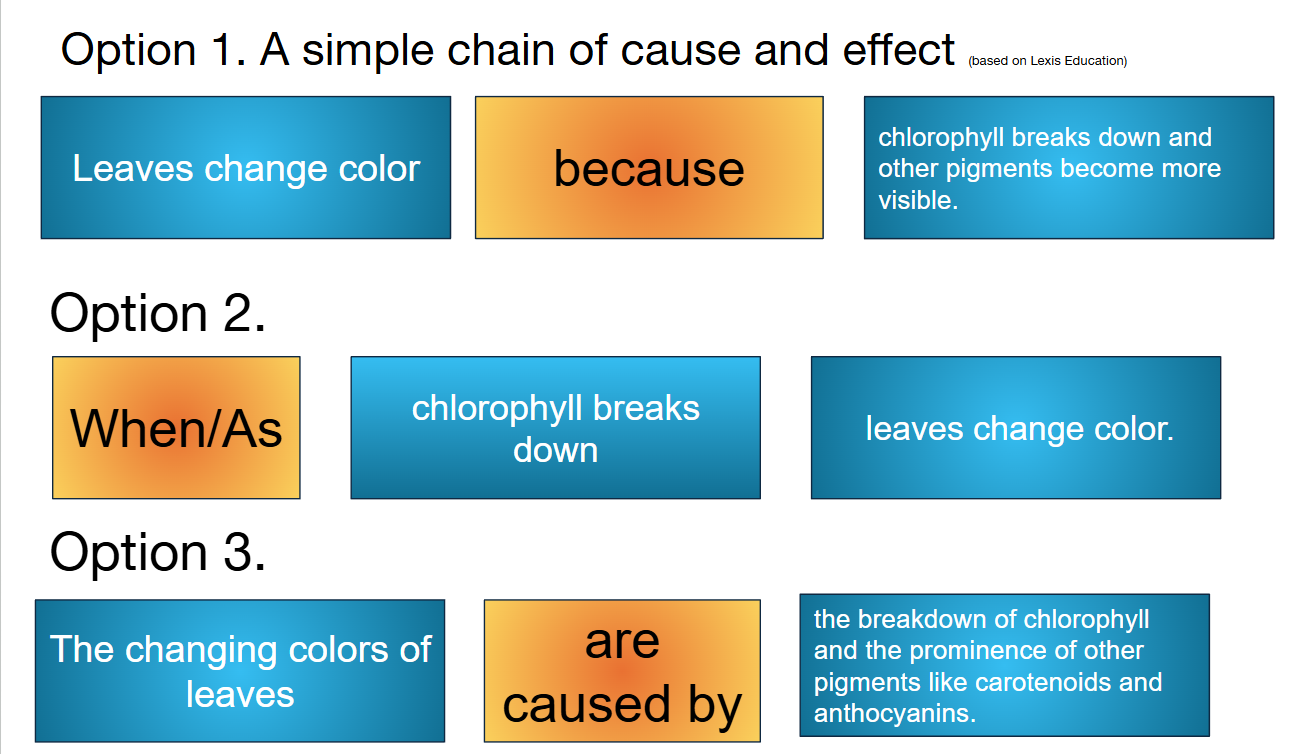
So, in summary: expand YOUR OWN UNDERSTANDING of the language of causality and then make that knowledge explicit to your students by teaching language of causality beyond because and so.
At your service,
Ruslana Westerlund




 Making Language Visible
Leave a reply to Dr. Westerlund’s Blog Organized by Categories – Making Language Visible Cancel reply