I’ve recently been reviewing research on teaching vocabulary and one research article I found talked about the dangers of pre-teaching vocabulary because it doesn’t lead to student agency (Ramos, 2015). (For a phenomenal synthesis of research on learning vocab incidentally or intentionally, please see Molle et al, 2021). However, I want to take it further and suggest that it doesn’t lead to learner autonomy. It caused a light bulb moment for me when it connected it to the notion of scaffolding versus help.
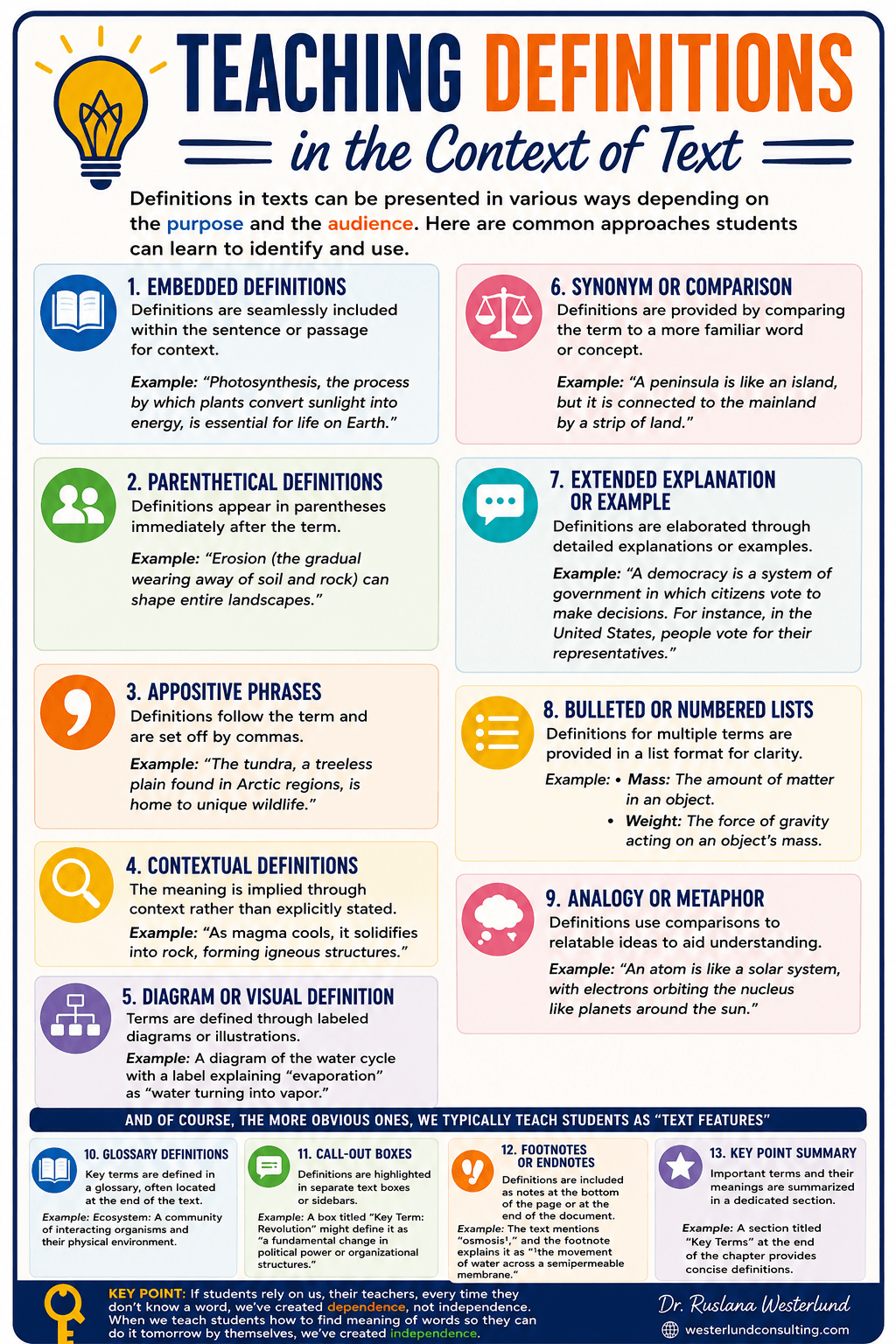
Scaffolding is not any type of help, but a specific kind that of what students cannot do without now but tomorrow they can do independently. This is my best paraphrase of Vygotsky who has been misunderstood, misapplied with scaffolding being reduced to static supports which simplify complex language, and lower expectations (de Oliveira & Westerlund, 2023). Scaffolding that leads to learner autonomy when it comes to teaching vocabulary cannot always rely on the teacher being there to pre-teach or illustrate or draw it out or act it out. Scaffolding that leads to indepedence involves showing students those instances where key vocabulary is defined in the text itself. This led me to research different ways how authors skillfully write definitions into the texts. So, here’s the list followed by examples through two texts.
Teaching Definitions in the Context of Text
Definitions in texts can be presented in various ways depending on the purpose and the audience. Here are some common approaches:
- Embedded Definitions
Definitions are seamlessly included within the sentence or passage for context.
Example: “Photosynthesis, the process by which plants convert sunlight into energy, is essential for life on Earth.” - Parenthetical Definitions
Definitions appear in parentheses immediately after the term.
Example: “Erosion (the gradual wearing away of soil and rock) can shape entire landscapes.” - Appositive Phrases
Definitions follow the term and are set off by commas.
Example: “The tundra, a treeless plain found in Arctic regions, is home to unique wildlife.” - Contextual Definitions
The meaning is implied through context rather than explicitly stated.
Example: “As magma cools, it solidifies into rock, forming igneous structures.” - Diagram or Visual Definition
Terms are defined through labeled diagrams or illustrations.
Example: A diagram of the water cycle with a label explaining “evaporation” as “water turning into vapor.” - Synonym or Comparison
Definitions are provided by comparing the term to a more familiar word or concept.
Example: “A peninsula is like an island, but it is connected to the mainland by a strip of land.” - Extended Explanation or Example
Definitions are elaborated through detailed explanations or specific examples.
Example: “A democracy is a system of government in which citizens vote to make decisions. For instance, in the United States, people vote for their representatives.” - Bulleted or Numbered Lists
Definitions for multiple terms are provided in a list format for clarity.
Example:- Mass: The amount of matter in an object.
- Weight: The force of gravity acting on an object’s mass.
- Analogy or Metaphor
Definitions use comparisons to relatable ideas to aid understanding.
Example: “An atom is like a solar system, with electrons orbiting the nucleus like planets around the sun.”
And of course, the more obvious ones, we typically teach students as “TEXT FEATURES”
- Glossary Definitions
Key terms are defined in a glossary, often located at the end of the text.
Example: Ecosystem: A community of interacting organisms and their physical environment. - Call-Out Boxes
Definitions are highlighted in separate text boxes or sidebars to draw attention.
Example: A box titled “Key Term: Revolution” might define it as “a fundamental change in political power or organizational structures.” - Footnotes or Endnotes
Definitions are included as notes at the bottom of the page or at the end of the document.
Example: The text mentions “osmosis¹,” and the footnote explains it as “¹the movement of water across a semipermeable membrane.”
Key point summary:
If students rely on us, their teachers, every time they don’t know a word, we’ve created dependence, not independence. When we teach students how to find meaning of words so they can do it tomorrow by themselves, we’ve created independence.
In the text below (Figure 1), the words Identity and Menominee Nation are defined in the text. Of course, we can talk about those words and create concept maps to broaden or deepen students’ knowledge of that concept by building semantic networks.
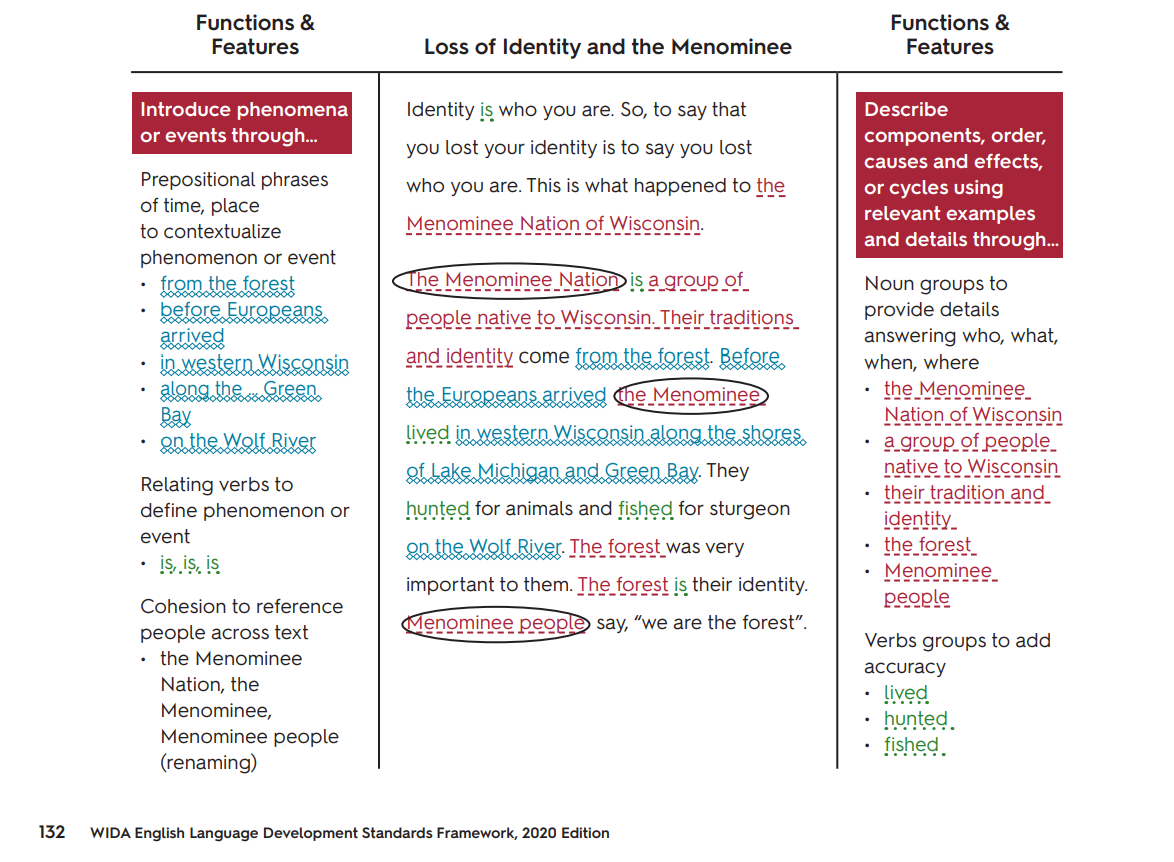
Let’s take a look at this text again (first, it was mentioned in my blog on Reconsidering Comprehensible Input).
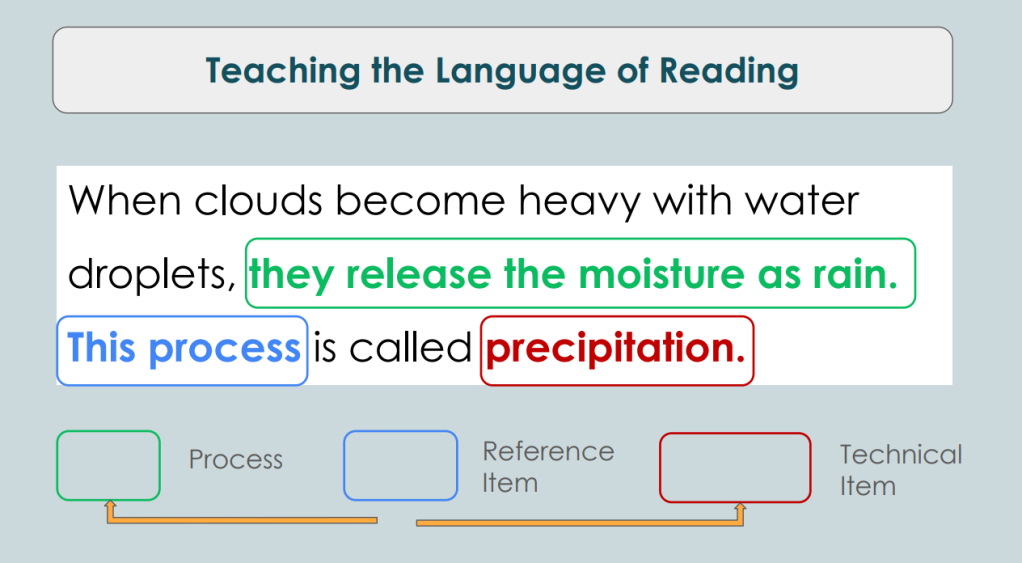
In Text 2, scaffolding that leads to independence and autonomy involves teaching that shows students how to find the definition of the word precipitation right there in the text. It is in the process clause in green, then a referent “this process” (or sometimes just the word “this”) which connects the green with the red (our key vocab word).
I definitely hope this blog was useful and can lead to your students’ autonomy when they read complex texts.
What other ways have you found how definitions are written into the text? Please chime in!
At your service,
Ruslana
References:
Molle, D., de Oliveira, L. C., MacDonald, R., & Bhasin, A. Leveraging incidental and intentional vocabulary learning to support multilingual students’ participation in disciplinary practices and discourses. TESOL J. 2021;12:e616. https://doi.org/10.1002/tesj.616
Ramos, F. (2015). Incidental vocabulary learning in second language acquisition: A literature review. PROFILE Issues in Teachers’ Professional Development, 17(1), 157–166. https://doi.org/10.15446/profile.v17n1.43957






Leave a Reply