Today a teacher reached out to me with a question about an entry point into language features in narratives. I asked her what goals she had for her lesson which was to develop character interactions. In this short blog, I’ll answer her question as well as provide some background on how verbs are viewed from a functional perspective.
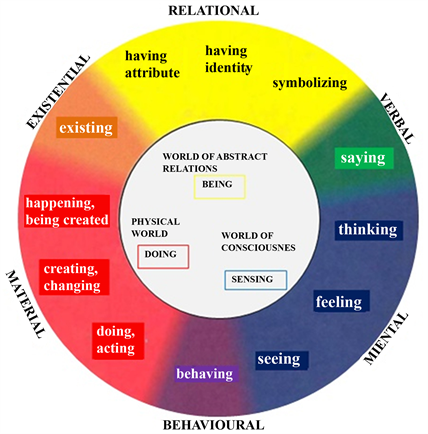
When it comes to life, verbs are more than a regular/irregular, modal, auxiliary stuff we learned in grammar books, but they represent physical/material, mental/sensing worlds we inhabit corresponding to various life activities in categories such as Relational, Verbal, Mental, Behavioral, Material, Existential (Figure 1). My favorite part of the wheel in Figure 1 is the three worlds inside: verbs represent three worlds: the world of abstract relations (BEING processes), the world of consciousness (SENSING), and the physical world (DOING processes). I love this wheel because it truly brings the processes we engage in daily and the grammar together. This should satisfy my geeky readers. In this blog, I’ll just focus on the green fragment of the Transitivity “wheel”. If I lost you already, please scroll down but don’t leave yet. The practical classroom-level stuff is coming.
When it comes to narratives, there are Actions, Reactions, Interactions, and Descriptions (Humphrey, 2017). The ARID blog is coming soon. The ARID phases of simple narratives require saying, sensing, doing, relating, feeling verbs/processes. Let’s take a look at the saying verbs (Figure 2).

You could try some of the following classroom activities:
1. BE INTENTIONAL ABOUT THE GENRE. Argument saying verbs (more precisely, reporting verbs) will be different. A quick google search brought up this result. The saying verbs illustrated in this blog are for building interactions between characters in narratives.
2. Do A SAYING VERBS SCAVENGER HUNT. Bring students favorite stories they know and love. Ask them to focus only on the saying verbs and have them write them on posted it notes. This will help focus on one thing only and it will tune their eyes to zoom in on one language feature critical for creating character interactions. They could group those verbs by the characters.
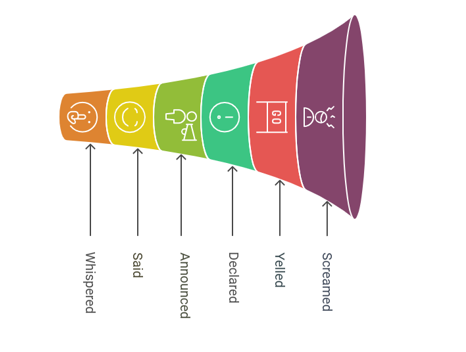
3. SAYING VERBS MEGAPHONE: Tell the kids to take all those verbs from a scavenger hunt (have them pick 6 of their favorite ones) and have them put them on post it notes. Then they can arrange them from softest to loudest. My image below is a graphic representation done Napkin AI, and I had to rotate it because for some reason, it creates vertical funnels and not horizontal.
However, don’t stop with only lining up verbs but discuss how those “shades of meaning” contribute to the character development. In other words, don’t only teach students how to identify the shade of meaning, but ask the very important question WHY? Why did the author make that choice over the other myriad of choices? What will it do to my character if I choose “announced” versus “said”?
3. CHARACTER DEVELOPMENT THROUGH SAYING VERBS. Did you know that character development happens through verbs in stories? difference of use “yell” v “whisper” reveals the character’s dispositions, feelings, etc. For practice, take a look at the famous children’s book Peter’s Chair by Jack Keats. I’m only focusing on a few select saying verbs that belong to Peter.
| Sentence | Saying Verb | Meaning Conveyed |
|---|---|---|
| “It’s my high chair,” Peter whispered. | Whispered | Quiet tone, Peter saying it to himself. |
| He saw his crib and muttered, “My crib. It’s painted pink too,” | Muttered | Grumpy tone, showing Peter feeling upset. |
| Peter shouted, “It’s too small!” | Shouted | Loud and emotional tone, emphasizing frustration or strong feelings. |
| “Daddy,” said Peter, “let’s paint the little chair pink for Susie”. | Said | Neutral and calm showing Peter made peace with the fact that his chair going to his sister. |
This table highlights how the different saying verbs influence the tone and mood of the dialogue in the story.
4. After this, teach students when repeating “said” is appropriate (as my writer husband says it’s the invisible verb) and when it should be replaced with a synonym and what effect it has on what it says about the character. Some examples are in Figure 4.

I’d love to see pictures of the megaphones with saying verbs your students make.
At your service,
Ruslana



 Making Language Visible
Leave a reply to Dr. Westerlund’s Blog Organized by Categories – Making Language Visible Cancel reply