
Typically, I write blogs in response to a teacher question, this time, I wrote a blog in response to my own question: what exactly is the language of perspectives? Which system in Systemic Functional Linguistics is the most useful to help us detangle the language of our opinions, feelings, and judgments? If this is a question you ask, read on.
I don’t know how you teach perspective, but ever since I discovered the SFL appraisal theory (please promise me you’ll return after you click on the appraisal hyperlink), I reached a new level of enlightenment. Appraisal in SFL is how we evaluate things, people’s character, and their feelings (Martin & Rose, 2007).
Affect (our feelings): Language that expresses our feelings or emotions (positive or negative).
Judgment (people’s character): Language that evaluates behavior or character (positive or negative).
Appreciation (the value of things): Language that evaluates the quality of objects, events, or environments (positive or negative).
Another word for the appraisal system is the language of evaluation. Evaluation is the way we establish perspective and state opinions about things, people, art, books, etc. We establish perspective through a very careful (and sometimes careless) choice of words. They can be nouns (urgency, tension, joy, love, troublemaker), verbs (adore, admire, detest, can’t stand), adjectives (pretty, ugly, lovely), and adverbs (slowly, clumsily). They can be neutral, negative, and positive. The context of text and the context of culture determine the meanings.
Teaching evaluative language will not only help students identify or establish perspective, but also it will expand their language resources beyond “awesome, great! as in this is an awesome book, the movie was boring, or the game was fun” – a small range of evaluative language choices students tend to repeat in their writing or speaking. Keep both the reading and the writing applications in mind as you continue reading.
Evaluative Language from the WIDA Glossary, p. 253
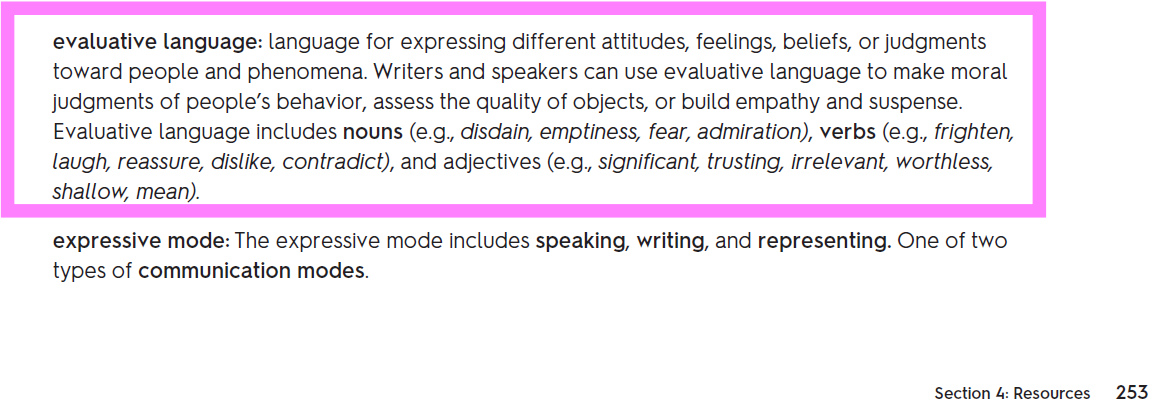
In the WIDA ELD Standards, evaluative language is one of the key language features in the argument and narratives genre family in ELA represented as a Key Language Use Argue and Narrate, respectively (see grades 4-5, p. 113 and 117, Figure 2 and 3 below). If you are looking at the Proficiency Level Descriptors, evaluation is termed as “nuanced meanings” and lives at the word level.
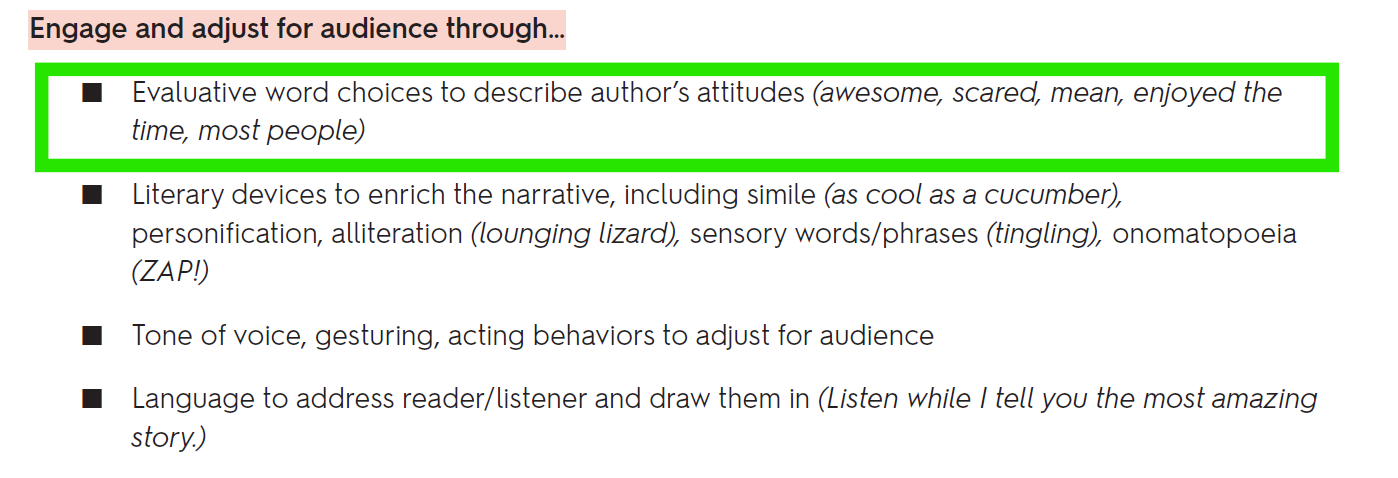

Figure 3. Argue ELA Grade 4-5, p. 117
To illustrate evaluative language in narratives and how it establishes perspective, I’m going to use one of my favorite children’s books Dear Mrs LaRue, Letters from an Obedience School by Mark Teague. I learned about this book by reading the Argument chapter in Maria Estella Brisk’s book that sits on my desk next to the WIDA ELD Standard. Recently, it has become my favorite book because I can both relate to the dog and the owner. We just got a Bernedoodle puppy for Christmas and I’m ready to send her to an obedience school!

How exactly is perspective established here?
Before you get into the language, show kids the use of the contrasting color: bright, sunny, and colorful which shows the dog’s life before the obedience school; and grey, stormy, and dull shows all the pages of his life in the obedience school. Teach kids how color and weather are semiotic (meaning making) resources. Take them through the pages and examine spots of color which show his memories of his life at home while he is sitting in “prison”.

One way for students to learn how perspective is established here is by explicitly teaching the evaluative language the dog uses. Point out the obvious words like “prison” for “obedience school”, “warden” for “teacher, “bark out orders” for “giving directions” etc. Then move to a more nuanced understanding of language choices made in this book through the Appraisal system defined above.
Category Labels: Affect, Judgment, and Appreciation
Please keep in mind that some phrases might cross over categories. It’s not as important to get all them right, as it is to have the conversation about language choices and how people use language to express their emotions, make judgments of people’s behavior or character, and express qualities of objects, books, movies, etc.
Affect (Emotion):
- “I feel lonely here.”
- “I miss you terribly.”
- “I’m not disobedient; I’m misunderstood.”
Judgment (Behavior):
- “They blame me for everything.”
- “The teacher is strict but fair.”
Appreciation (Qualities):
- “The food is terrible.”
- “The other dogs are no fun.”
- “Life here is miserable.”
Discussion Prompts
Prepare a list of questions to guide student discussions:
- Why did you place this phrase in that category?
- How does this phrase affect the reader’s perspective of the situation or character?
- What happens if we rewrite this phrase with a different evaluative tone?
How This Establishes Perspective:
- Positive Perspective:
When the dog uses words like “fair” or “learning a lot”, it gives the reader a glimpse of optimism or progress, even in a challenging situation. - Negative Perspective:
Negative phrases like “miserable” or “terrible” express the dog’s dissatisfaction and create sympathy for its plight.
Perspective Role-Play: Write a Letter
Objective: Students use evaluative language to craft a perspective in writing.
Activity Steps:
- Assign each student a role (e.g., the obedience school teacher, another dog, or the owner receiving the letter).
- Students write their own version of a letter from obedience school, using the language of evaluation (affect, judgment, and appreciation) to create a distinct perspective.
- Example: The teacher might write, “Rover is enthusiastic but needs structure to thrive,” while another dog might write, “Rover is a troublemaker who never listens.”
- Share letters aloud and discuss how the choice of evaluative language changes the perspective.
Perspective Flip: Create a “Double Voice” Story
Objective: Students explore multiple perspectives by contrasting evaluative language.
Activity Steps:
- Pair students and assign them two characters with opposing views (e.g., the obedience school teacher vs. the dog).
- Students create a dialogue or split-narrative story where each character describes the same event differently using evaluative language.
- Example: The dog says, “The food is awful,” while the teacher says, “We provide nutritious meals.”
- Reflect as a class: How do different evaluations influence our understanding of the event?
Transform the Setting: Appreciation Rewrites
Objective: Students analyze how evaluative language shapes perspective on objects or settings.
Activity Steps:
- Provide students with a passage that describes the obedience school environment (e.g., “The food is terrible. The other dogs are no fun.”).
- Challenge students to rewrite the description using positive appreciation (e.g., “The food is delicious. The other dogs are playful.”).
- Discuss: How does the evaluative language change the dog’s perspective on obedience school?
Table 1. Contrasting Perspectives for the Transform the Setting: Appreciation Rewrites activity. This shows how evaluative language shapes perspective on the obedience school environment.
| Negative Appreciation | Positive Appreciation |
|---|---|
| “The journey here was a horror.“ | “The journey here was an adventure.” |
| “This place is a prison!” | “This place feels like a summer camp!” |
| “The Warden barks orders at us all day!” | “The teacher guides us with clear directions.” |
| “The food here is inedible.” | “The food here is unique and interesting.“ |
| “This place is dreadful!” | “This place is full of surprises!” |
| “The guards are cruel.” | “The trainers are firm but fair.“ |
| “I am suffering beyond words.” | “I am learning new things every day.” |
| “I miss my warm bed.” | “This experience helps me appreciate home.” |
How to Use This Table in Class:
- Analyze:
- Discuss how the negative descriptions create a sense of discomfort, dissatisfaction, or resistance to the setting.
- Contrast with how the positive descriptions create a sense of optimism, enthusiasm, or belonging.
- Rewriting Practice:
- Provide students with neutral or negative descriptions and challenge them to rewrite them positively. For example:
- Neutral: “The beds are small and basic.”
- Positive Rewrite: “The beds are compact but surprisingly comfortable.”
- Provide students with neutral or negative descriptions and challenge them to rewrite them positively. For example:
- Personal Application:
- Have students describe their own school environment using both positive and negative appreciation.
- Negative: “The hallways are crowded and noisy.”
- Positive: “The hallways are bustling with energy and excitement.”
- Have students describe their own school environment using both positive and negative appreciation.
- Class Discussion:
- Reflect on how evaluative language changes the tone and perspective of a text.
- Ask: How would the dog’s story feel different if it had been written with more positive language?
An Entry Point Into Evaluative Language
If the whole appraisal is too much, here’s an entry point into evaluative language:
Table of evaluative nouns, verbs, adjectives, and adverbs grouped into positive and negative categories. This will help students see ho
w evaluative language can create contrasting perspectives.
| Category | Positive Examples | Negative Examples |
|---|---|---|
| Evaluative Nouns | joy, kindness, bravery, beauty, satisfaction, loyalty, fairness | misery, cruelty, dishonesty, chaos, disappointment, loneliness, unfairness |
| Evaluative Verbs | admire, praise, cherish, appreciate, enjoy, encourage, respect | despise, blame, criticize, misunderstand, condemn, reject, neglect |
| Evaluative Adjectives | delightful, playful, friendly, delicious, cozy, fair, kind, comfortable | terrible, boring, unfriendly, miserable, harsh, unfair, uncomfortable, strict |
| Evaluative Adverbs | joyfully, kindly, thoughtfully, playfully, pleasantly, warmly, fairly, comfortably | miserably, harshly, terribly, unfriendly, carelessly, unfairly, coldly, rudely |
Activity Ideas to Teach Evaluative Nouns
1. Noun Transformation
Provide students with neutral nouns (e.g., “emotion,” “behavior,” “object”) and challenge them to replace them with evaluative nouns to create specific effects.
For example:
- Neutral: “He showed good behavior.”
- Transform: “He showed great bravery.”
2. Rewrite for Perspective
Give students a sentence with a neutral or negative evaluative noun and ask them to rewrite it with a positive one, or vice versa.
For example:
- Negative: “Her dishonesty ruined the project.”
- Positive: “Her honesty saved the project.”
In this blog, I’ve gotten courageous by exploring my last frontier in SFL: Appraisal Theory. I’ve attempted to explain it through a children’s book where perspective of the dog who wrote letters from an obedience school that his owner sent him too entertained us all.
*Some of these activities were generated by Chat GPT but I have to train the robot to know appraisal theory. I had to keep revising prompts to help the chatbot to understand the language of perspective using Appraisal system, not just random text annotation looking for adjectives.
I’d love to hear if this is helpful,
At your service,
Ruslana
*P.S. As I was writing this blog, I was dealing with the developing news impacting immigrant communities. After calling my representatives and sending out Know Your Rights Documents to the immigrant communities I know and love, I decided to take time for therapy. So, I played with my dog (who needs to go to an obedience school) and then I wrote this blog as a way of coping and staying productive and staying sane. I invite you to do the same. Act and Take Care of Yourselves and Each Other!





 Making Language Visible
Leave a reply to Dr. Westerlund’s Blog Organized by Categories – Making Language Visible Cancel reply