Lesson Prepared by Ruslana Westerlund, Former WIDA Researcher, co-author of the WIDA ELD Standards, Systemic Functional Linguist
Grade: 3rd Grade
Text: My Papi Has a Motorcycle by Isabel Quintero
Time: 45 minutes
Learning Objectives
- Students will identify different ways authors show sequence in authentic texts.
- Students will practice sequencing events using time markers, action verbs, and places instead of only “first, next, then, finally.”
- Students will write their own short community story with authentic sequencing.
Standards Alignment
- CCSS.ELA-LITERACY.W.3.3.A: Establish a situation and introduce a narrator and/or characters; organize an event sequence that unfolds naturally.
- CCSS.ELA-LITERACY.L.3.6: Acquire and use grade-appropriate vocabulary, including transition words and phrases.
- CCSS.ELA-LITERACY.RL.3.3: Describe characters in a story (e.g., their traits, motivations, or feelings) and explain how their actions contribute to the sequence of events.
- WIDA ELD Standards (Key Language Use: Narrate):
- Orient audience to context through…
- […]
- Adverbials and prepositional phrases to establish time and location (a hundred years ago, when I was six, on the playground, around the corner)
- Develop story with time and event sequences, complication, resolution, or ending through…
- […]
- Verbs to describe what characters do, think, and feel
- […]
- Connectors to sequence time (first, next, and then) and events (before, after, later), and to combine and link event details (and, but, so)
- […]
- Declarative statements to provide closure (The End, It was over for good.)
Materials
- Mentor text excerpts from My Papi Has a Motorcycle (printed or projected).
- Chart paper / whiteboard.
- Sentence strip cards with excerpts from the book.
- Graphic organizer (timeline or event chain with space for “How did the author show sequence?”).
- Student notebooks.
Lesson Sequence
- Ask: “What order do you think these events go in?”
- Point out: They didn’t need first, next, finally — they used clues from the pictures and actions to order the story.
- Students arrange pictures and share reasoning.
- Show 4 picture cards from My Papi Has a Motorcycle.
1. Hook / Engage (5 minutes)
2. Mini-Lesson 1: Deconstruction + Anchor Chart (15 minutes)
- Students open their favorite books.
- Task: “Look for how the author shows what happens next. Do they use ‘first, next, then, finally’ — or do they use other clues, like time, action, or places?”
- Students record examples in their organizer.
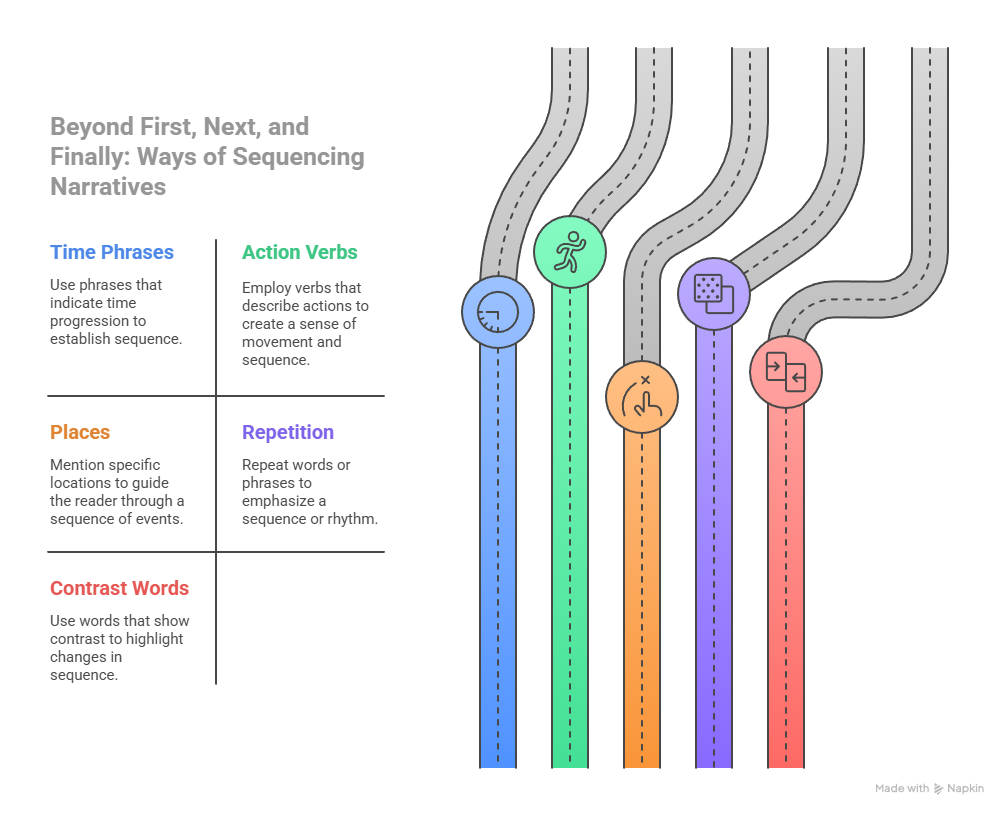
- Add their findings to the anchor chart with categories:
- Time Phrases ⏰
- Action Verbs 🏃
- Places 🏠
- Repetition 🔁
- Contrast ⚖️
- Exciting Connectors 🎉
2. Mini-Lesson 2: Sequencing in the Mentor Text (15 minutes)
Display 4–5 excerpts that show sequencing.
Excerpts & Discussion Points:
- “When I hear his gray truck pull into our driveway, I run outside with both of our helmets.”
- How does “When I hear…” show sequence? (time clue)
- “And then… we take off!”
- The word then feels exciting, not boring — why? (paired with action)
- “We pass Joy’s Market where Mami buys my gummy bears. Mr. García, our librarian, is walking out the door and nods at us. We nod back.
- The places show sequence (we know what comes first, next, because of the ride).
- “We ride, ride, ride until the blue glow from the motorcycle begins to dim…”
- Repetition of verbs shows the passage of time.
- “But as we near the shop, we see that it’s empty and out of business.”
- Contrast word but shows change/shift in the story.
- Contrast word but shows change/shift in the story.
Chart them on a poster:
Ways Authors Show Sequence:
- Time phrases (When our city is winding down…)
- Action verbs (zigzags, roar, ride, ride, ride)
- Places (We pass Joy’s Market, We cruise by Abuelito’s house)
- Repetition (We ride, ride, ride…)
- Contrast words (But as we near…)
3. Guided Practice: Sequencing Activity (10 minutes)
- Give students sentence strips with events from My Papi Has a Motorcycle. Example strips:
- “We pass Joy’s Market where Mami buys my gummy bears.”
- “When I hear his gray truck pull into our driveway…”
- “We roar past murals that tell our history…”
- Students work in pairs to put them in order.
- For each, they must underline or circle how the author showed sequence (time word, action verb, place, repetition, contrast).
4. Independent Practice: Write Your Own Community Sequence (10 minutes)
Prompt: “Think about a ride, a walk, or a trip you’ve taken in your community. Write 4 sentences that tell the sequence, but do NOT use ‘first, next, then, finally.’ Instead, use time words, action verbs, and places like the author does.”
Provide sentence starters (inspired by mentor text):
- When I hear…
- We pass…
- And then…
- But as we…
- We ride/walk/run until…
5. Share & Reflect (5 minutes)
- Invite a few students to share their short sequences.
- Reflection questions:
- “Which sequencing words felt most real?”
- “How did places and actions help the reader know what came first and next?”
Assessment
- Formative: Observe students during strip sequencing and annotation.
- Summative: Collect student writing to check if they used authentic sequencing resources (time phrases, action verbs, places, repetition, contrast) rather than just “first, next, then, finally.”
Anchor Chart: Cool Ways to Show Sequence (Like Authors Do!)
Authors don’t just say first, next, then, finally. They use authentic clues to help the reader follow the story. Here are ways YOU can do it too:
1. Time Phrases
- When I hear his gray truck pull into our driveway…
- When our city is winding down…
Use when, today, as, until to show time.
2. Action Verbs
- Papi zigzags through the streets.
- We ride, ride, ride until the blue glow begins to dim.
Use movement verbs to show what happens next.
3. Places in the Community
- We pass Joy’s Market where Mami buys my gummy bears.
- We cruise by Abuelita’s old yellow house.
Use places to show the order of events.
4. Repetition
- We ride, ride, ride…
Repeat verbs or phrases to show time passing.
5. Contrast Words
- But as we near the shop, we see it’s empty.
Use but, even though, instead to show a change in the story.
6. Exciting Connectors
- And then… we take off!
Use words like and then, suddenly, at last with action to make the story flow.
Remember: Sequencing doesn’t have to be boring. You can move your story forward with time, action, places, repetition, contrast, and excitement — just like Isabel Quintero!
Cheering you on,
Ruslana
About the Author
Dr. Ruslana Westerlund is an educational consultant, researcher, and professional learning facilitator specializing in disciplinary literacy, multilingual education, and Systemic Functional Linguistics (SFL). She works with schools, districts, universities, and educational organizations across the United States and internationally to support the implementation of high-quality instruction that integrates language, literacy, and disciplinary learning. Her work focuses on making language visible through the Teaching and Learning Cycle, the WIDA ELD Standards Framework (which she co-authored), and evidence-based approaches that provide multilingual learners with high challenge and high support.
Westerlund Consulting LLC is a certified Woman-Owned Business Enterprise (WBE) providing professional learning, curriculum design, instructional coaching, keynote presentations, and strategic consultation in disciplinary literacy, multilingual education, and language-focused instructional design. The company partners with educational organizations to build educator capacity and improve equitable access to rigorous, language-rich learning for all students.



 Making Language Visible
Leave a comment