This blog has been sitting in my drafts since February – time for these ideas to see the light of day. Curious to know if it was worth publishing this – please chime in below.
We often teach connectives like little glue words—“because,” “however,” “for example”—as if they’re interchangeable tools that just help ideas stick together. But if we want our students, especially multilingual learners, to become powerful writers of argument, then we need to go deeper. We need to show them that argument writing communicates a unique set of relationships between ideas—and that means it requires a special set of connectives to signal cause and effect, contrast, evidence, concession, etc.
In Systemic Functional Linguistics, these connectives are part of the textual metafunction—they help the writer guide the reader through the flow of meaning. But these language choices don’t float in isolation. They work because they serve a specific purpose in a specific genre. In argument writing, that purpose is to persuade through logic and evidence, and that logic needs to be visible in the language.
Students might use words like “because” or “however,” but unless they understand what kind of thinking each word is meant to show, their writing can feel more like filling in blanks than building an argument.
And that’s not just a writing issue—it’s a learning one. According to research from the Science of Learning, “The transfer of knowledge or skills to a novel problem requires both knowledge of the problem’s context and a deep understanding of the problem’s underlying structure.” In other words, if students don’t understand how language structures thinking, they can’t flexibly apply it in new writing tasks or disciplines.
That’s where explicit teaching comes in. Especially in high school, and particularly for “struggling” writers or students termed as Long Term ELs (LTELs), where demands ramp up and expectations for coherence and reasoning deepen, students need support to recognize the logical relationships that connect claims, evidence, and reasoning—and then choose connectives purposefully to express them.
This blog offers strategies, tools, and activities to teach connectives in context, with intention and clarity. It’s a small shift that can make a big difference in helping students become not just better writers, but more powerful thinkers.
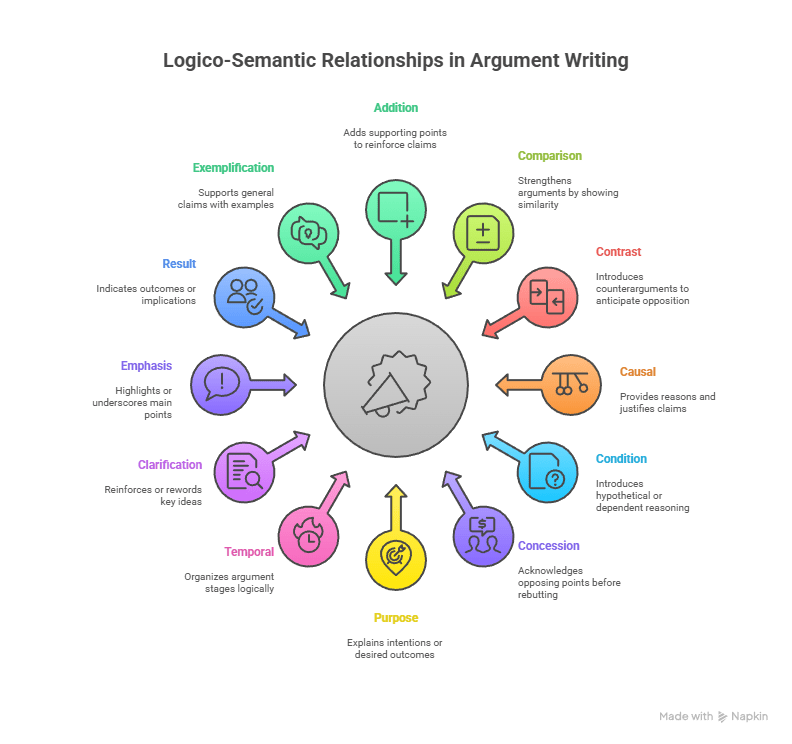
Let’s get into it. First, here is the table of the various connectives students need to communicate different relationships. Below it is a set of interactive and engaging activities for students to have fun before they start writing.
Cohesive Connectives in Persuasive Writing
| Logico-semantic Relation | Function in Persuasion | Examples of Connectives |
| Addition (Elaboration) | Add supporting points or reinforce claims | furthermore, in addition, also, moreover |
| Comparison | Strengthen argument by showing similarity | similarly, likewise, just as |
| Contrast | Anticipate or introduce counterarguments | however, on the other hand, whereas, nevertheless |
| Causal (Cause–Effect) | Provide reasons and justify claims | because, since, therefore, thus, as a result |
| Condition | Introduce hypothetical or dependent reasoning | if, unless, provided that, in case |
| Concession | Acknowledge opposing points before rebutting | although, even though, while it is true that |
| Purpose | Explain intentions or desired outcomes | so that, in order to, for this reason |
| Temporal (Sequential) | Organize argument stages logically | first, next, then, finally, ultimately |
| Clarification / Restatement | Reinforce or reword key ideas | in other words, that is, to put it another way |
| Emphasis | Highlight or underscore main points | indeed, in fact, most importantly |
| Result / Consequence | Indicate outcomes or implications | hence, therefore, consequently, accordingly |
| Exemplification | Support general claims with examples | for example, for instance, such as |
Student Activities to Learn Connectives for Argument Writing
Activity 1: Connective Sorting Challenge
Goal: Distinguish types of connectives based on their function (e.g., cause, contrast, addition)
Materials:
- Cards or slips of paper with connectives (e.g., “however”, “because”, “for example”)
- Headers: “To Add”, “To Contrast”, “To Show Cause”, “To Emphasize”, “To Clarify”, etc.
Instructions:
- In small groups, students sort the connective cards into categories based on function.
- Groups share and defend one sorting decision using metalanguage (e.g., “We put ‘on the other hand’ under contrast because it introduces an opposing view.”).
- As a class, refine and build a collective anchor chart.
Why this works (SFL link): Helps students understand textual metafunction by explicitly connecting lexicogrammatical choices (connectives) to discourse meaning.
Activity 2: Upgrade the Paragraph
Goal: Revise underdeveloped arguments using precise and varied connectives.
Instructions:
- Provide students with a weak persuasive paragraph filled with vague or repetitive connectives (e.g., many uses of “and” or “because”).
- Students work in pairs to revise the paragraph using a variety of purposeful connectives (from a class chart or handout).
- Students annotate their revisions with sticky notes explaining why they chose each new connective.
Extension: Have students identify the logical relation they intended (e.g., contrast, result, purpose).
Activity 3: Connective Hunt in Mentor Texts
Goal: Identify and analyze connective use in published arguments or student exemplars.
Instructions:
- Provide persuasive articles, op-eds, or argument essays.
- Students highlight all connectives and label their function (using color codes or margin notes).
- In groups, students discuss which connectives were most effective and why.
- Create a “Top 5 Connectives Used by Real Writers” wall chart.
Why this works (SFL link): Helps students see how writers manage logical flow and cohesion to persuade audiences.
Activity 4: Connective Dice: Persuade on the Spot
Goal: Practice flexible use of connectives in speaking and writing.
Setup:
Create a 6-sided die (physical or digital) where each side represents a type of connective:
- Add
- Contrast
- Cause
- Result
- Example
- Clarify
Instructions:
- Give students a debate prompt (e.g., “Should school start later?”).
- In pairs, one student rolls the die and must respond using a connective from that category.
- Example: Rolled “Result”? → “Therefore, later start times would increase student focus.”
- Example: Rolled “Result”? → “Therefore, later start times would increase student focus.”
- Swap roles and continue building the argument collaboratively.
Cheering you on,
Ruslana
About the Author
Dr. Ruslana Westerlund is an educational consultant, researcher, and professional learning facilitator specializing in disciplinary literacy, multilingual education, and Systemic Functional Linguistics (SFL). She works with schools, districts, universities, and educational organizations across the United States and internationally to support the implementation of high-quality instruction that integrates language, literacy, and disciplinary learning. Her work focuses on making language visible through the Teaching and Learning Cycle, the WIDA ELD Standards Framework (which she co-authored), and evidence-based approaches that provide multilingual learners with high challenge and high support.
Westerlund Consulting LLC is a certified Woman-Owned Business Enterprise (WBE) providing professional learning, curriculum design, instructional coaching, keynote presentations, and strategic consultation in disciplinary literacy, multilingual education, and language-focused instructional design. The company partners with educational organizations to build educator capacity and improve equitable access to rigorous, language-rich learning for all students.



 Making Language Visible
Leave a comment