By Dr. Ruslana Westerlund
“I think…”
“I agree because…”
“I disagree with…”
These sentence starters appear on classroom walls, taped to classroom desks, and are stuffed into students’ binders or handed out to Multilingual Learners because we want students to participate, listen, and respond to one another. They can help students enter a conversation. But entering a conversation and constructing a mathematical argument require different kinds of support.
Consider this statement:
I think the angles look equal.
The student has offered a judgment (theri opinion) about a geometric shape. What remains unstated is the mathematical reasoning: Why must the angles have equal measures? Would that relationship hold for any two intersecting straight lines?
Adding “because” will not automatically resolve the problem:
I think the angles are equal because they look the same.
The sentence is longer, but the justification still depends on appearance. To support mathematical argument, we need to make visible the language that connects a claim to mathematical facts and valid inferences. Mathematical reasoning is realized through mathematical language. Making thinking visible means making language visible.
What is a mathematical argument?
A mathematical argument is a disciplinary genre: a text that can be spoken, written, and multimodal that states or challenges a claim through mathematical evidence and connected reasoning. Students may draw on definitions, state properties, representations, calculations, or counterexamples. What counts as sufficient justification depends on the claim and the mathematical context. This is consistent with Mathematical Practice 3, which emphasizes using assumptions, definitions, and the results to develop logical reasoning and examine others’ arguments.
A successful argument does more than announce an answer or express confidence. It makes the connection between the evidence and the conclusion available for someone else to examine.
Look at what the argument actually does
Illustrative Mathematics’ geometry lesson Evidence, Angles, and Proof asks students to justify why vertical angles are congruent and emphasizes the flow of reasoning in written proofs. The following is an original model addressing that relationship.
Imagine two intersecting straight lines. Angles A and B are opposite each other. Angle C lies between them and is adjacent to both.
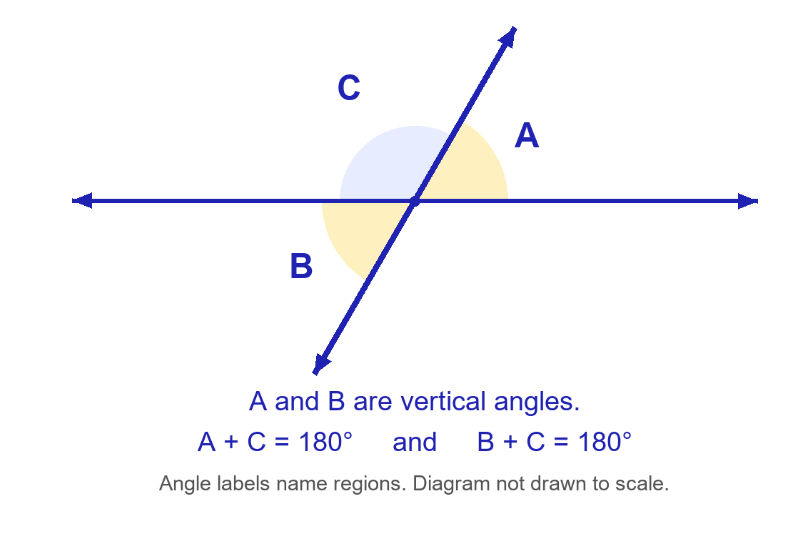
Curriculum task in brief: Make conjectures and write a justification that vertical angles are congruent.
Possible Response: Vertical angles are congruent. To see why, let angles A and B be a vertical pair, and let C be an angle adjacent to both. A and C form a straight angle, so their measures sum to 180 degrees. B and C also form a straight angle, so their measures sum to 180 degrees. Subtracting the measure of C from both sums gives A = B. Therefore, the vertical angles have equal measures.
To achieve its purpose, math arguments unfold through specific stages (organizational structure).
| Genre stage | Model argument |
| Claim | Vertical angles are congruent. |
| Setup | Let angles A and B be a vertical pair, and let C be an angle adjacent to both. |
| Evidence (known math facts) | A and C form a straight angle, so A + C = 180°. B and C also form a straight angle, so B + C = 180°. |
| Justification/ Reasoning | Since both sums equal 180°, A + C = B + C. Subtracting C from both sides gives A = B. |
| Conclusion | Therefore, the vertical angles have equal measures and are congruent. |
These stages help us see how this particular argument works. They are a resource for teaching its organization, rather than a rigid template for every mathematical argument.
Notice what makes the conclusion mathematically solid or “convincing”. Both angles form a straight angle with the same adjacent angle. Their measures therefore equal the same quantity: 180° minus the measure of C.
The reasoning shows a relationship that extends beyond the appearance of one drawing.
The language builds mathematical relationships
From a functional perspective, we ask: What is the language doing for the mathematics?
This proof relies heavily on relational meanings—attributing properties and expressing equivalence:
- “Vertical angles are congruent” attributes a mathematical property.
- “Both sums equal 180°” states equality.
- “The vertical angles have equal measures” expresses the relationship reached through the reasoning.
Here is how language features do the mathematical work:
- The noun groups also carry substantial mathematical meaning.
- “An angle adjacent to both” specifies which angle is relevant.
- “Both sums” gathers the preceding equations into a compact expression so the argument can move forward.
- “The measure of C” names the shared quantity being subtracted.
- Connectors organize the inferences.
- “So” links a straight-angle relationship to a sum of 180°.
- “Also” signals corresponding reasoning for the second pair.
- “Since” introduces a reason.
- “Therefore” marks the conclusion.
These words matter because of the relationships they express. Inserting “therefore” into an unsupported statement does not make it a proof.
Where does “I think” fit?
In “I think the angles are congruent,” think is a mental process: it represents a person’s judgment. It can be useful when students propose conjectures, express uncertainty, or evaluate an emerging argument.
Likewise, a teacher might ask: Do you think this states the claim? Which step supports your judgment?
That prompt invites students to examine the reasoning. The mathematical validity, however, comes from the justification they identify—not from the mental process (that’s the SFL term for verbs like “think”, “wonder”, “guess”) itself.
“I disagree” serves another useful purpose: it positions a speaker in relation to someone else’s contribution. But disagreement still needs mathematical substance.
Compare: I disagree with your answer.
with:
Measuring one pair shows that the angles are equal in this drawing. It does not prove that all vertical angles are congruent.
The problem is not the presence of “I think” or “I disagree.” The problem is treating these openings as sufficient scaffolding for the argument.
Dr. Ruslana Westerlund
Scaffold the mathematical work each sentence needs to do
Instead of offering only general participation sentence starters, connect language support to the stages and reasoning demands of the task.
| Mathematical work | More focused language support |
| State the claim | “For any two intersecting straight lines, …” |
| Provide reasoning | “Because A and C form a straight angle, …” |
| Connect two relationships | “Both expressions equal …, so …” |
| Justify an operation | “Subtracting the same quantity from both sides preserves …” |
| Evaluate the sufficiency of evidence | “This example shows …, but the claim concerns …” |
| Identify a gap | “The step from … to … needs justification because …” |
| Draw the conclusion | “Therefore, … must …” |
These supports direct attention to mathematical relationships. Students still need to understand those relationships and decide whether the language fits.
For the vertical-angles argument, “Both expressions equal …, so …” is productive only when students can identify the expressions, explain their equality, and connect them to the diagram.
Student Discussion
1. Trace the reasoning from claim to conclusion. Which step depends on a mathematical fact, and which on an equality-preserving operation?
2. Remove “so,” “also,” “since,” and “therefore.” What becomes harder for a reader to follow? Restore each connector and explain its job.
3. How do the labels, equations, and a diagram work together with the prose? What must be stated for a reader who did not share the classroom discussion?
4. Choose one noun group and one process to make visible during deconstruction. Rehearse the explanation orally, then jointly construct a new proof with students.
Teach the bridge from sense-making to written argument
Students need experiences that give them something to reason about before they are asked to write a polished proof. Providing sentence frames without doing mathematical sense-making gives students a false sense of what it means to do mathematics.
- Begin with setting up talk protocols for students to have structured, timed opportunities for mathematical sense-making through talk to state tentative claims, move to mathematical modeling, new learning, and more talk to revise their tentative claims.
- Then move to intersecting lines students can draw, rotate, label, and discuss. Measuring several examples can help them conjecture that vertical angles have equal measures. Then raise the question that measurement leaves open: How can we prove that this must happen?
- Use the diagram to investigate the straight-angle relationships. Let students explain those relationships to a partner, using gestures, labels, equations, and their available languages.
- Next, examine a model argument together. Trace how each sentence advances the reasoning. Make selected language choices visible: the noun group that identifies the shared angle, the relational clause that states equality, and the connector that links a fact to an inference.
- Jointly construct an argument before asking students to write independently. During that construction, ask:
- What is a claim sentence in math?
- What comes next after the claim sentence? Why?
- How do we connect claim to evidence?
- Which words from the anchor chart can we use?
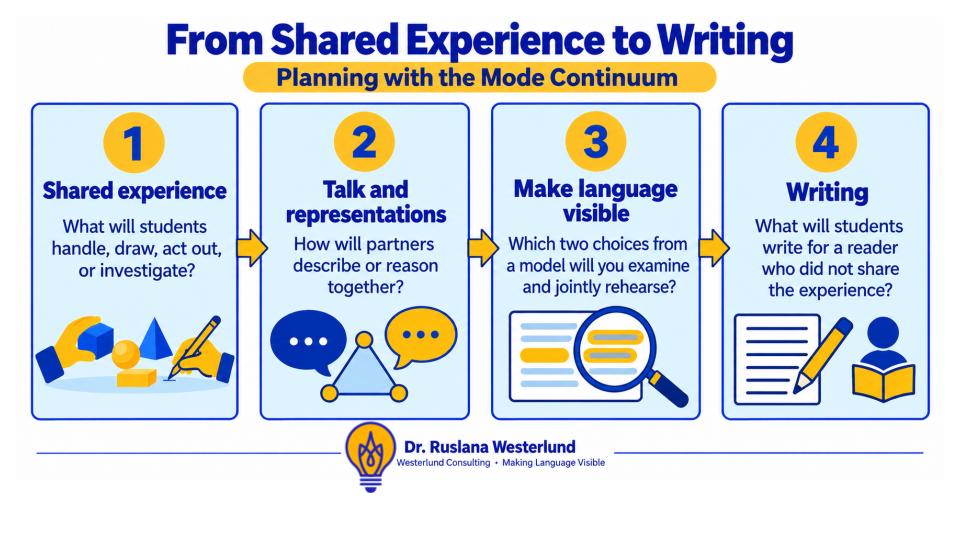
This movement along the Mode Continuum (I have an asynchronous course coming up soon on this topic – please check here) situates language in the service of learning. Students move from reasoning within a shared experience toward constructing a text that carries the reasoning for a reader who was not part of that experience.
Our goal is to help students do more than sound like participants in a mathematical discussion. We want them to recognize what a claim requires, select relevant evidence, and use language and representations to make their reasoning visible.
About the Author
Dr. Ruslana Westerlund is a researcher of disciplinary literacy and CEO at Westerlund Consulting, LLC. She works with schools, districts, and educational organizations across the globe to support the implementation of high-quality instruction that integrates language, literacy, and disciplinary learning through Systemic Functional Linguistics. She is also an Executive Officer at LLEN North America (LLENA). Her work focuses on making language visible through the Teaching and Learning Cycle, the WIDA ELD Standards Framework (which she co-authored), and evidence-based approaches that provide multilingual learners with high challenge and high support.
Westerlund Consulting LLC is a certified Woman-Owned Business Enterprise (WBE) providing professional learning, curriculum design, instructional coaching, keynote presentations, and strategic consultation in disciplinary literacy, multilingual education, and language-focused instructional design. The company partners with educational organizations to build educator capacity and improve equitable access to rigorous, language-rich learning for all students.





Leave a Reply