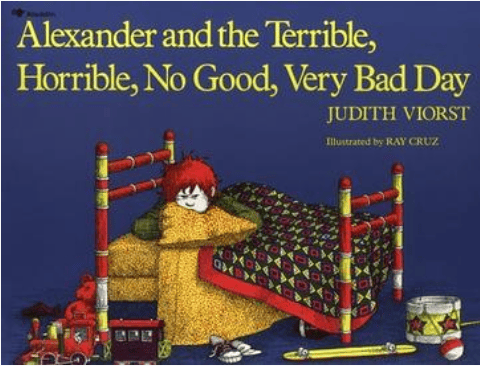
Explore how long sentences enhance emotional impact and storytelling in children’s literature, using Alexander’s bad day as a mentor text.
By Dr. Ruslana Westerlund
This is part 2/2 blog dedicated to the artful writing in Alexander, the Terrible, No Good Very Bad Days. Part 1 on using the language of place to create a sense of time was here. In that same training I delivered to teachers, when we were deconstructing how the author was using the language of place to sequence events written about here, we also discovered her intentional use of using “long-winded” sentences. I use them as a writer for a variety of purposes. One is when I want to say something emotional, all in one breath, because if I pause, I will start crying. Writers of emotional stories (parenting or grief) know what I’m talking about.
For years, students have been warned against long-winded sentences. Teachers circle them, divide them with red lines, and ask students to replace some of the ands with periods. The message is usually straightforward: long sentences are confusing, and good writers keep their sentences under control.
But what if a long, rushing sentence is exactly what a writer needs?
Judith Viorst’s Alexander and the Terrible, Horrible, No Good, Very Bad Day gives us a wonderful mentor text for examining this question. The book opens with Alexander recounting one mishap after another:
“I went to sleep with gum in my mouth and now there’s gum in my hair and when I got out of bed this morning, I tripped on the skateboard…”
The sentence continues as another problem follows, and then another, until Alexander reaches his familiar judgment: it is going to be a “terrible, horrible, no good, very bad day.”
A traditional grammar lesson might treat this sentence as something to fix. A functional approach asks a more useful question:
What work is this long sentence doing?
The sentence does not simply report several events. Its structure creates Alexander’s experience for the reader. Each new clause adds another frustration before we have time to recover from the previous one. The repeated and pushes us forward. The sentence gathers speed, pressure, and emotional weight. By the time Alexander declares what kind of day it will be, the reader understands why he feels overwhelmed.
Long sentences can create accumulation
The opening sentence builds through a chain of events:
gum in his mouth → gum in his hair → getting out of bed → tripping on a skateboard → dropping his sweater → water running in the sink
Each event contributes to the next stage of Alexander’s terrible morning. The repeated coordination creates accumulation: one difficulty is piled on top of another.
If every clause were separated into a short sentence, the information would remain, but the experience would change:
There was gum in Alexander’s hair. He got out of bed. He tripped on a skateboard. He dropped his sweater in the sink. The water was running.
This version is grammatically acceptable, but it feels controlled and distant. The events sit beside one another as separate facts. We no longer experience the breathless momentum of a child who cannot believe how many things have already gone wrong.
Sentence boundaries are therefore not merely rules of correctness. They are resources for making meaning.
Repetition creates a child’s voice
Viorst repeatedly uses and to connect Alexander’s experiences:
“Anthony found a Corvette Sting Ray car kit… and Nick found a Junior Undercover Agent code ring…, but… all I found was breakfast cereal.”
The pattern allows Alexander to compare what happens to everyone else with what happens to him. His brothers receive prizes; he receives only cereal. The coordinating conjunction but marks the unfair contrast as Alexander sees it.
The language sounds like a child speaking directly to us. Alexander does not calmly summarize the evidence and then announce a conclusion. He relives every injustice, often adding the details that matter most to him. The long sentences preserve the rhythm of oral storytelling: this happened, and then this happened, and do you know what happened next?
When students are told to eliminate repeated and automatically, they may produce shorter sentences, but they can also lose voice, rhythm, and emphasis.
The teaching here question is “What effect does the repetition create here?”
Sentence length controls pacing
Writers make choices about how quickly or slowly readers move through an experience. Short sentences can stop us. They can make an event feel final, sharp, or important. Long sentences can carry us rapidly through connected actions, stretch a moment, or make a situation feel overwhelming.
Viorst uses both.
Some portions of Alexander’s day unfold through accumulating clauses. Elsewhere, shorter statements create a different rhythm:
I said I was being scrunched. I said I was being smushed.
The repeated sentence opening slows the sequence and places emphasis on Alexander’s complaints. The variation between long and short sentences is part of the craft. Neither kind of sentence is inherently better. Each creates a different effect.
Students need opportunities to investigate that variation. They should ask:
- Where does the writer speed up the story?
- Where does the writer slow it down?
- Which experiences are accumulated in one sentence?
- Which ideas receive sentences of their own?
- How do coordination and repetition help create the narrator’s voice?
Of course, students still need to learn conventional sentence boundaries. They need to recognize when readers may lose track of an idea and when punctuation or restructuring would improve clarity. But control does not mean writing only short sentences. Control means making choices that fit the purpose.
Why this matters for multilingual writers
This instruction is especially important for multilingual writers, who are often encouraged to produce short, “safe” sentences as evidence of control. Although short sentences may reduce grammatical errors, relying on them can limit students’ ability to express relationships among events and develop a distinctive narrative voice. Studying Viorst’s clause chains gives multilingual learners meaningful reasons to use resources such as and, but, when, while, because, and so. These connectors help students show addition, contrast, time, overlap, cause, and result. Through oral rehearsal, joint construction, and imitation of the mentor text, multilingual writers can expand simple clauses into longer, purposeful sentences without having their ideas or language simplified. The goal is not error-free brevity; it is increasing students’ capacity to connect ideas, control pacing, and communicate complex experiences with clarity and voice.
Teach students to imitate the effect
After reading the opening of Alexander and the Terrible, Horrible, No Good, Very Bad Day, invite students to write about a morning when one thing after another went wrong, or went wonderfully right.
Begin by building an oral chain together:
I missed my alarm, and when I finally woke up…
Students can add events using resources such as:
- and
- and then
- but
- when
- while
- because
Next, jointly construct a sentence in which several events accumulate toward a final judgment:
I missed my alarm and when I finally woke up my dog was sleeping on my backpack and I couldn’t find my other shoe and the bus was already turning the corner, so I knew this morning was going to be a disaster.
Then compare it with a version made entirely of short sentences. Ask students which version better communicates the experience and why.
The goal is not for students to copy Viorst’s sentence structure in every piece of writing. It is to add a new resource to their language toolkit.
Move from imitation to conscious choice
Students can experiment with the same content in three forms:
- Separate sentences to present events as distinct facts.
- A coordinated sentence to accumulate connected experiences.
- A mixture of long and short sentences to control pacing and emphasis.
After composing each version, students can explain their choice:
- I joined the events because I wanted the problems to feel as though they were happening without a break.
- I used a short final sentence to make the character’s realization stand out.
- I repeated “I said” to emphasize that no one was listening.
- I used “but” to show the contrast between what the other children received and what Alexander received.
This reflection moves students beyond following a rule. They begin to understand themselves as writers who can select language according to purpose.
From correctness to choice
When we teach writing only through prohibited forms: Don’t begin with and. Don’t repeat words. Don’t write long sentences. Don’t write run-ons, we can unintentionally remove some of the resources published authors use most effectively.
Students need more than rules for avoiding error. They need to see how writers stretch, combine, repeat, interrupt, and punctuate language to create particular effects.
Language is About Choice, Not Rules
Alexander and the Terrible, Horrible, No Good, Very Bad Day shows us that a long sentence can do more than hold information. It can accumulate experience, accelerate the pace, create a recognizable voice, and make readers feel the pressure of a day in which everything seems to go wrong.
So yes, we should teach students how to write long-winded sentences, but purposefully. We should teach them when to let ideas tumble forward, when to interrupt the flow, and when to stop.
That is not abandoning grammar.
That is teaching students that grammar is a meaning-making resource.
Cheering you on,
Ruslana
About the Author
Dr. Ruslana Westerlund is CEO at Westerlund Consulting, LLC. She works with schools, districts, and educational organizations across the globe to support the implementation of high-quality instruction that integrates language, literacy, and disciplinary learning. She is also an Executive Officer at LLEN North America (LLENA). Her work focuses on making language visible through the Teaching and Learning Cycle, the WIDA ELD Standards Framework (which she co-authored), and evidence-based approaches that provide multilingual learners with high challenge and high support.
Westerlund Consulting LLC is a certified Woman-Owned Business Enterprise (WBE) providing professional learning, curriculum design, instructional coaching, keynote presentations, and strategic consultation in disciplinary literacy, multilingual education, and language-focused instructional design. The company partners with educational organizations to build educator capacity and improve equitable access to rigorous, language-rich learning for all students.

 Making Language Visible
Leave a comment