By Dr. Ruslana Westerlund
There is a tendency in some teacher circles to say, “My job is to teach language, not reading.” I used to hold that view back in 1996 as an ESL Teacher because my job was to “develop language”. Yes, you are absolutely right – our job as ESL/ELL/EL/EAL/ML (take your pick) is indeed to teach language.
I do understand the desire to clarify our roles and there is a lot of justifiable and real confusion on the role of the ESL teacher. ESL Teachers have been reduced to homework helpers, decoding teachers, highly paid aides, and stand-bys when the content-area teachers teach, and we are supposed to push in and do what, exactly? I can, and at the same time cannot, imagine the stress ESL teachers experience daily as program models change and new policies swoop in to replace the old ones, adding stress to already overworked and burned-out teachers. I hear you; I am on the same mission as you: to eradicate educational inequities that cause harm to our students we all care about and fight for.
In this blog, I am here to talk about language. I bring 30 years of expertise to this blog. And I have been meaning to write it for many, many years.
What do we mean by language?
I’ll start with simple and move up to complex and then go down to practical – that’s the semantic wave that organizes the rest of my writing.
Typically, in the context of teaching reading, I hear ESL teachers defending oral language. If we mean conversation, pronunciation, or vocabulary practice, then language instruction might appear separate from reading instruction during sense-making activities, picture walks, making predictions, retelling stories, etc. 100% with you! We need to let kids talk about books they read because literacy is not to develop fluency but to act on and in the world with!
But language in reading is different from spoken language. When students read, they interpret meanings expressed through written language on a page.
What happens to language when it’s frozen in time and stuck to a page? Spoken language is different from written language is not because it’s my opinion, but because they do different things. See my earlier blog from 2018 on this topic.
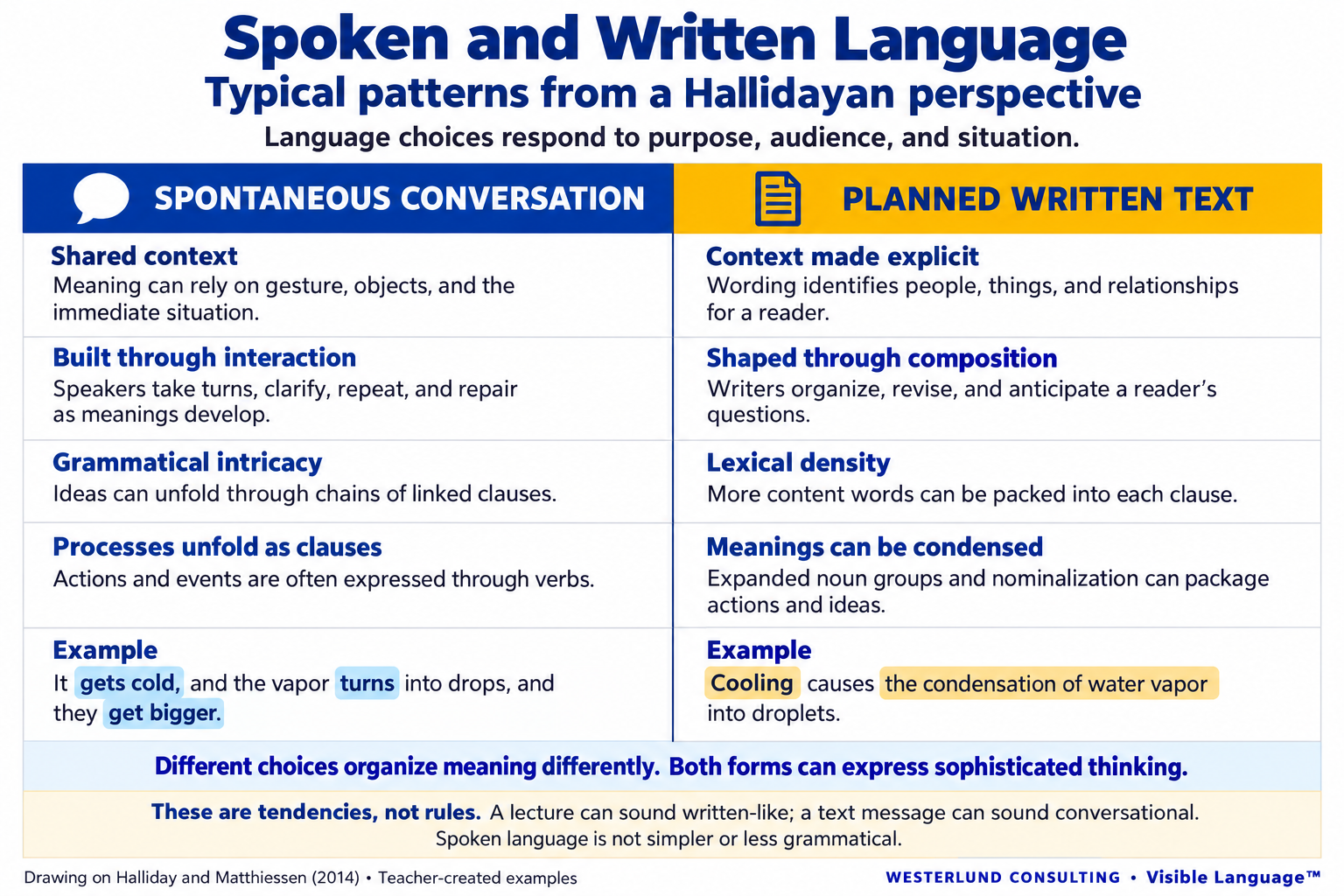
*On the topic of lexical density, read here and here.
Reading and language development are interdependent. Even the Simple View of Reading identifies both decoding and language comprehension as necessary for reading comprehension. Distinguishing these components helps us understand what readers need; it does not make reading separate from language.
What becomes visible when we broaden our definition of language?
From a systemic functional linguistics perspective, language is a meaning-making system: a resource for making choices in context.
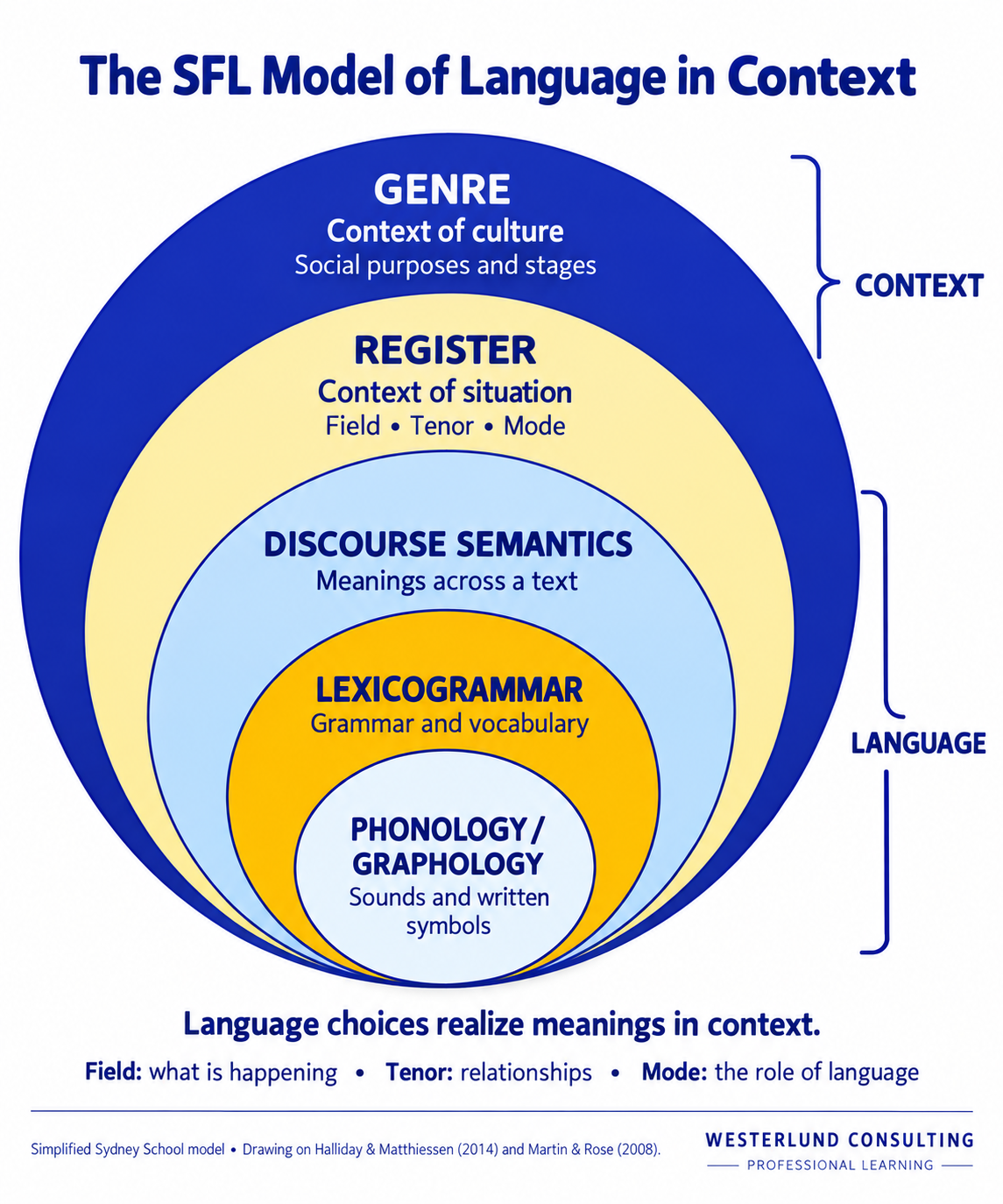
The model pictured here helps us examine those choices at several connected levels. At the level of genre, we consider the text’s social purpose and how it unfolds. At the level of register, we consider what is happening, the relationships involved, and the role language plays. Within language, we examine meanings across a text, choices in grammar and vocabulary, and their realization through sounds or written symbols.
These levels help us connect a reader’s experience of a whole text with the particular wording that creates that experience.
Consider a student reading a scientific explanation. The student needs to recognize words, but also to understand how the explanation introduces a phenomenon, develops causal relationships, and carries ideas from one sentence into the next. The relationship between grammar, meaning, and discourse is central to a functional account of language.
Language is working throughout the text—not only in the unfamiliar vocabulary.
Following an idea across a paragraph
Read this short explanation:
Warm air contains water vapor. This vapor cools against the cold surface of a glass. It condenses into tiny droplets. These droplets join together. They form larger drops on the outside of the glass.
A reader might recognize every word and still need help following what happens to the water.
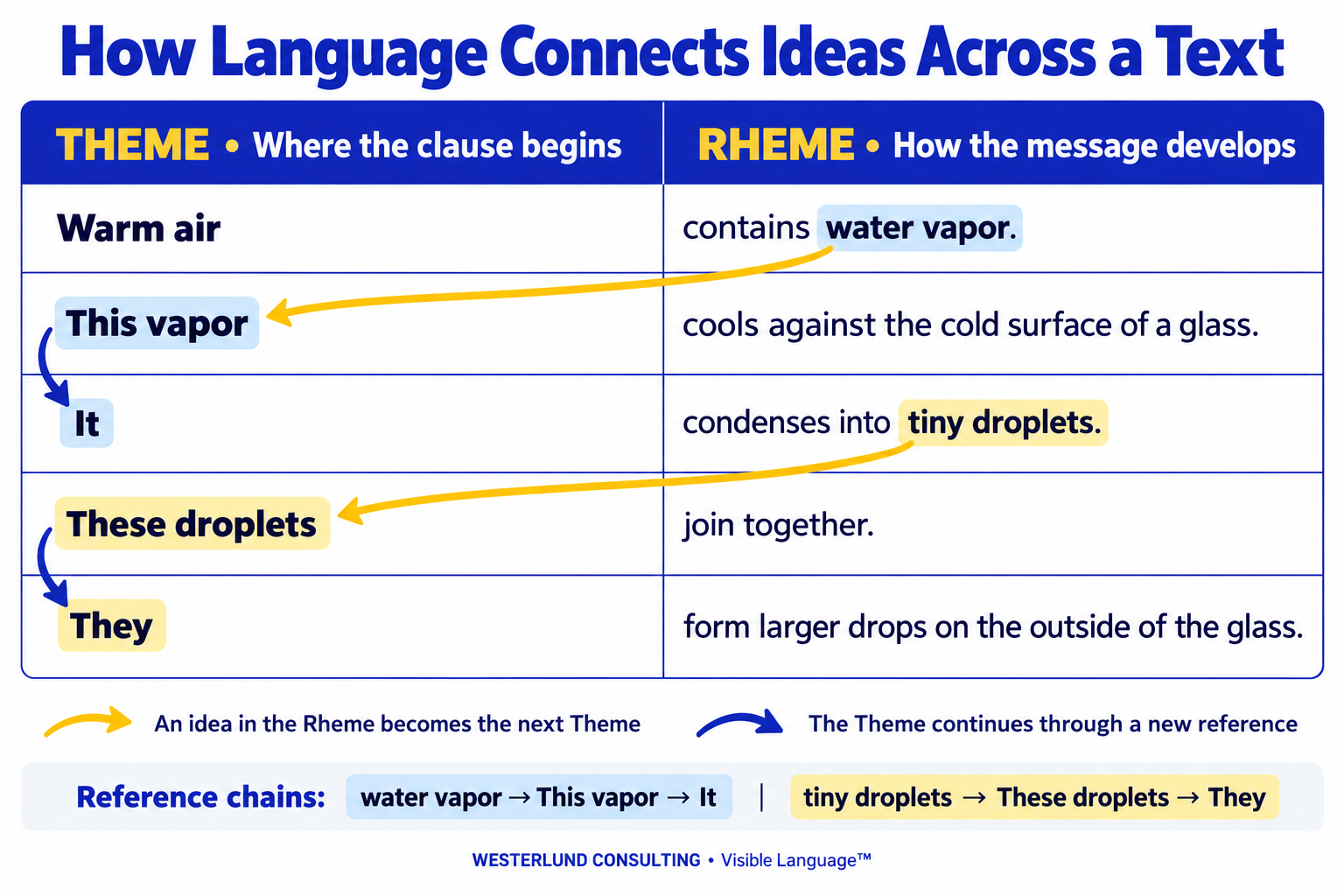
One useful way to make the paragraph’s organization visible is to examine Theme and Rheme. Theme is the point of departure of the clause as a message; Rheme is the remainder, where that message develops. Theme is not the same as a story’s central message, and it is not always identical to the subject. In this deliberately simple paragraph, however, each Theme is also the grammatical subject.
| Theme — where the clause begins | Rheme — how the message develops |
|---|---|
| Warm air | contains water vapor. |
| This vapor | cools against the cold surface of a glass. |
| It | condenses into tiny droplets. |
| These droplets | join together. |
| They | form larger drops on the outside of the glass. |
Notice the movement.
The first sentence introduces water vapor in the Rheme. The next sentence takes up that idea as its Theme: This vapor. The third sentence maintains that starting point through It.
Then the explanation introduces tiny droplets. The next sentence picks up that meaning as These droplets, followed by They.
The paragraph combines two patterns: an idea introduced in one Rheme becomes a subsequent Theme, and a Theme is maintained across clauses through different references. Readers follow these patterns as they build an understanding of the explanation.
The small words carry important meaning
Now look specifically at the paragraph’s reference system:
- This vapor refers back to water vapor.
- It refers to this vapor.
- These droplets refers back to tiny droplets.
- They refers to these droplets.
These are examples of grammatical cohesion through reference. Demonstratives and pronouns help readers connect meanings across sentences without repeating the full noun group every time.
The paragraph also uses lexical cohesion: water vapor and vapor repeat a key term, while droplets and drops maintain a related chain of meaning.
Theme–Rheme organization and reference work together here, but they are different resources. Theme–Rheme concerns how clauses organize their messages. Reference concerns how readers identify the people, things, or ideas being referred to.
This distinction matters instructionally. A student may understand the word droplets but lose track of what they refers to. Another student may resolve each pronoun yet struggle to recognize how the explanation develops from vapor to droplets to larger drops.
Both difficulties call for attention to language.
What might teaching look like?
We can place the paragraph beside a cold glass and a diagram of condensation. Students observe and discuss the phenomenon while we explicitly connect it to the written explanation.
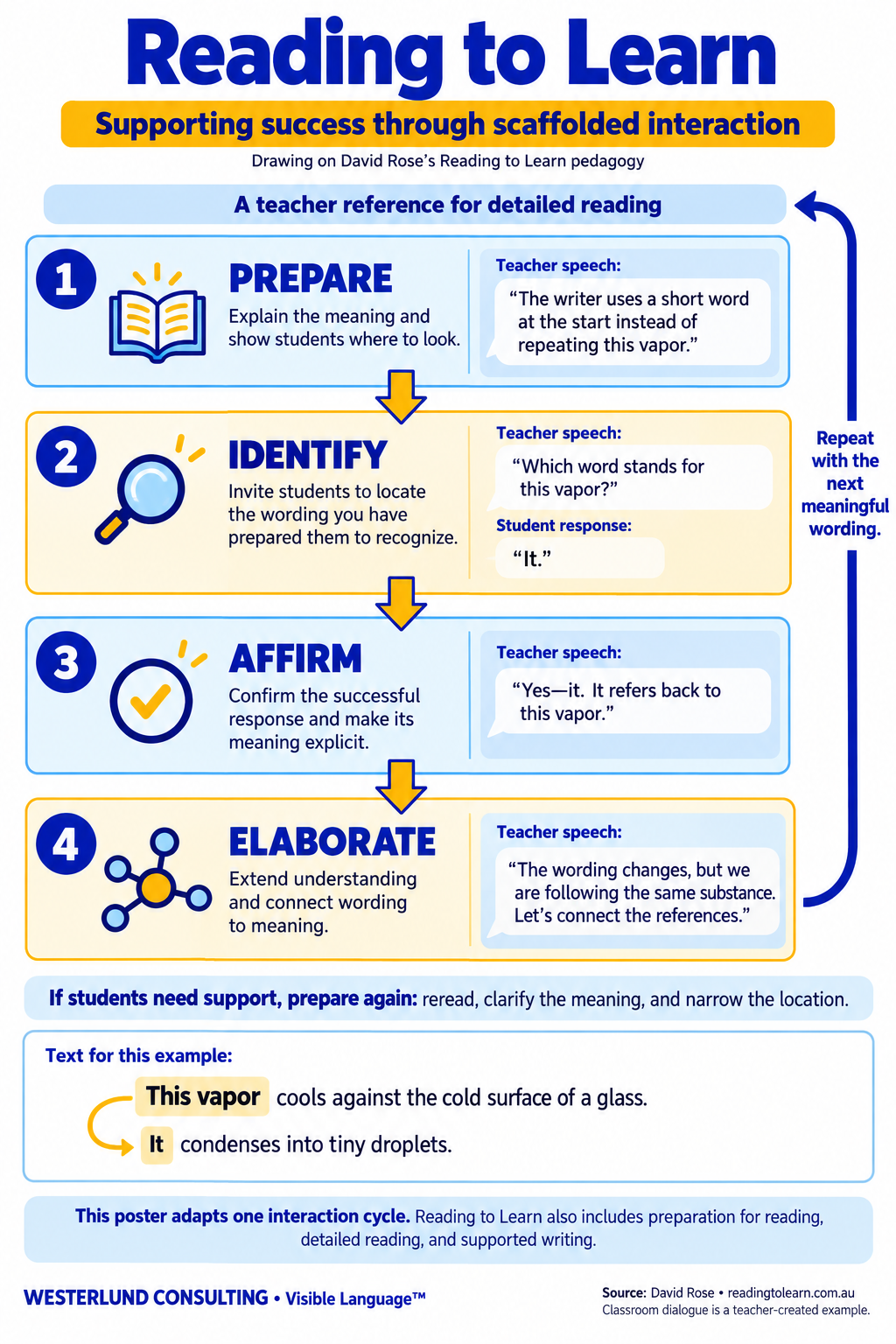
Drawing on David Rose’s Reading to Learn, we prepare students to identify important wording, affirm their responses, and elaborate on its meaning. Questions become part of a carefully supported teaching interaction. The following exchange illustrates how we might apply that approach.
Before asking students to identify a reference, we provide its meaning and location:
Prepare: “This sentence tells us what happens to the water vapor. The writer uses a short word at the beginning instead of repeating this vapor.”
Invite identification: “Which word stands for this vapor?”
Student: “It.”
Affirm: “Yes—it. You’ve found the word that refers back to this vapor.”
Elaborate: “The wording changes, but we are still following the same substance. Let’s draw an arrow from this vapor to it.”
We can then prepare students to notice how an idea moves between sentences:
Prepare: “At the end of this sentence, the writer introduces tiny droplets. The next sentence begins by picking up those same droplets.”
Invite identification: “Which words at the beginning name them again?”
Student: “These droplets.”
Affirm: “Exactly—these droplets. Those words pick up the tiny droplets we have just read about.”
Elaborate: “The writer makes the droplets the starting point of the next message. This helps us follow what happens to them.”
Students highlight the wording and draw the connections as we teach. If they need more support, we narrow the location, reread, and clarify the meaning before inviting another response.
Through these exchanges, students learn how reference and Theme–Rheme patterns help a reader follow an explanation. We can then draw on that shared understanding to jointly construct a new paragraph, deliberately choosing how to introduce ideas, refer to them again, and carry them forward.
What does this mean for language teachers?
Language teachers bring essential expertise to reading instruction: how texts build meanings, how grammatical choices express relationships, and how readers connect information across clauses and paragraphs.
That expertise complements instruction in decoding and fluent word recognition. A functional approach does not replace those areas of instruction. It helps us examine the language students must interpret as they read.
For multilingual learners, this means making the language of disciplinary texts available for close examination: the references that track a scientific entity, the conditional clauses that establish a mathematical relationship, or the shifts in sentence beginnings that guide a historical explanation.
When we say that we teach language, our work includes helping students interpret these choices in written texts.
Reading asks students to follow meanings realized through language. Making that language visible is part of teaching students to read.
Related blogs
- The Point of Departure: How Writers Guide Their Readers
- Cohesion: The Glue That Holds the Text Together
- Unlocking Noun Groups: Packing Meaning in One Phrase
- Teaching Students to Stay on Topic Using the SFL Concept of Theme
About the Author
Dr. Ruslana Westerlund is a researcher of disciplinary literacy and CEO at Westerlund Consulting, LLC. She works with schools, districts, and educational organizations across the globe to support the implementation of high-quality instruction that integrates language, literacy, and disciplinary learning through Systemic Functional Linguistics. She is also an Executive Officer at LLEN North America (LLENA). Her work focuses on making language visible through the Teaching and Learning Cycle, the WIDA ELD Standards Framework (which she co-authored), and evidence-based approaches that provide multilingual learners with high challenge and high support.
Westerlund Consulting LLC is a certified Woman-Owned Business Enterprise (WBE) providing professional learning, curriculum design, instructional coaching, keynote presentations, and strategic consultation in disciplinary literacy, multilingual education, and language-focused instructional design. The company partners with educational organizations to build educator capacity and improve equitable access to rigorous, language-rich learning for all students.
*7 pages of references by SFL and non-SFL scholars organized by categoires are available as part of my consultation package. Sorry friends, I pay my own health insurance (I live in the US, thank you for your empathy, and thank you for not expecting me to give away everything for free – with love, immigrant-woman small business owner).





Leave a Reply