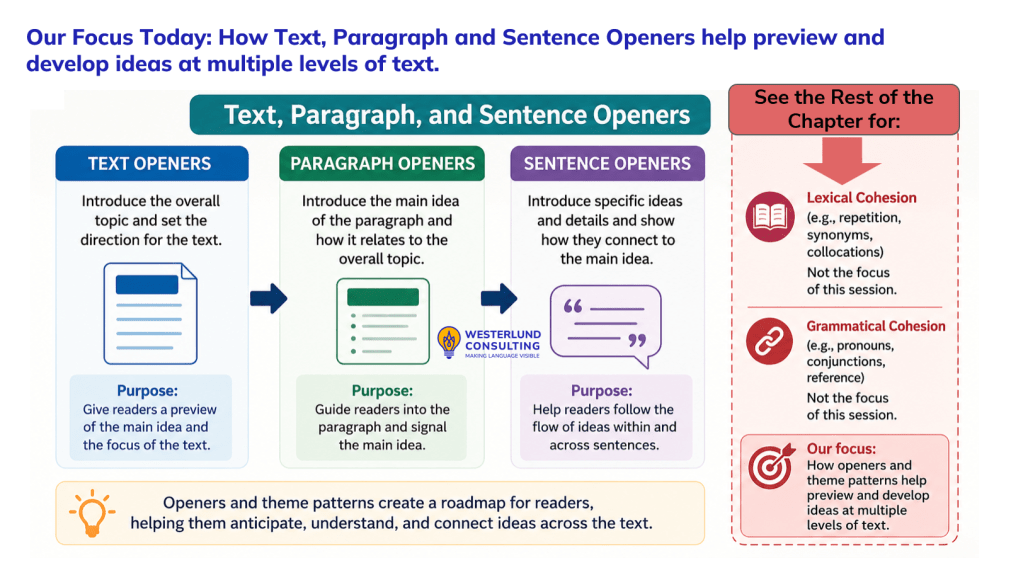
We are having so much fun in our summer book study unpacking key ideas from our book Building a Language Toolkit for Teachers: A Functional Approach. Sally Humphrey and I co-lead the sessions. To reflect on some of my favorite moments, I’ve been writing blogs. In Session 1, we talked about the power of the Mode as one of the context variables that influences language choices, and I wrote an entire Kinder lesson ready for classroom use. In session 3, we talked about Narrative phases (Actions, Reactions, Interactions, Descriptions) teaching students how to make Complications complicating and how to teach students inferencing by focusing on the verbs. Last week (Session 4), we tackled cohesion, focusing on how writers create flow by thoughtfully varying the beginnings of their sentences.
The beginning of a sentence is called the grammatical Theme – the point of departure for the message. It tells the reader, “This is where I push off. These are the meanings I want to foreground.” (I’ve written earlier on how teaching students Theme helps students stay on topic)
In our discussions, participants experimented with different ways of organizing the same information. Rather than always beginning with the subject, they explored starting with time, place, cause, contrast, evaluation, or circumstance as shown in the Language Summary in Figure 2.
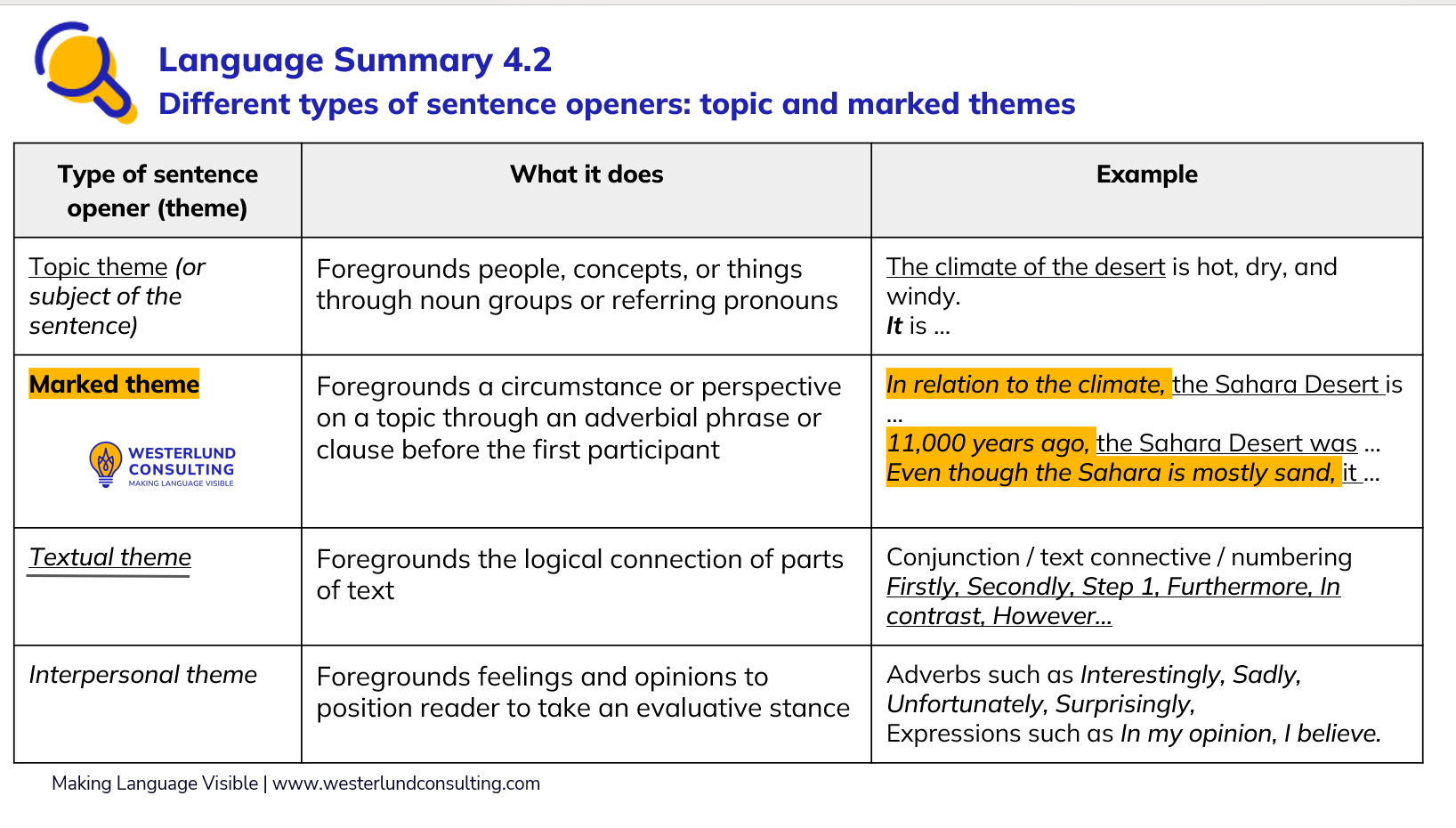
Using the Language Summary in Figure 2, we first learned to identify the four different kinds of Themes—topic, marked, textual, and interpersonal—and discussed the unique role each one plays in organizing meaning. We then challenged ourselves not only to use each Theme individually, but also to combine multiple Themes at the beginning of a sentence. For example:
- Over the course of the past two days, the skies of Cape Cod have been tinged yellow…
- Due to the ongoing wildfires in Canada, the skies of Cape Cod have been tinged yellow…
- Sadly, because of the ongoing wildfires in Canada, we have spent the day inside due to poor air quality.
- Interestingly, 11,000 years ago, the climate of the desert was not so hot and dry.
- Surprisingly, despite their imposing size, panda bears are docile and prefer to eat bamboo.
- Surprisingly, earlier today, even though England came to play, Argentina beat them 2-1 in the World Cup semi-final game.
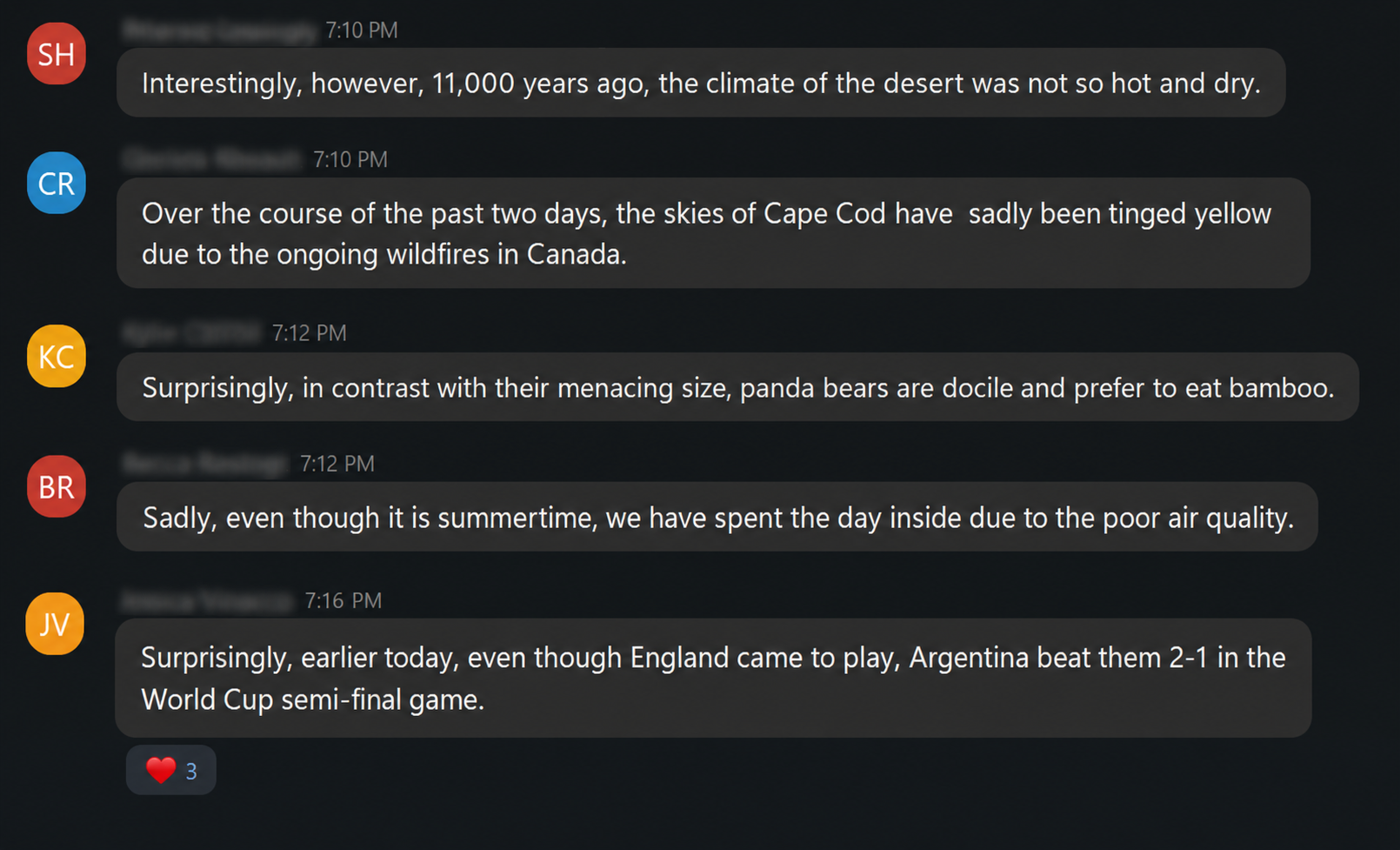
These combinations illustrate that writers layer interpersonal, textual, and marked Themes before arriving at the topic. Each Theme contributes something different: an evaluation (Interestingly), a logical connection (however), a circumstance of time (over the past two days), and finally the topic itself.
As a group, we really had fun writing. Sally emphasized that instead of varying sentence starters simply for variety, we should think of how intentional use of themes helps us make purposeful choices about how to guide our readers through the text. That’s exactly why teaching cohesion is so important: it can help students’ ideas flow naturally by carefully choosing, and sometimes strategically layering, the point of departure for each sentence.
That’s exactly why teaching cohesion is so important: it can help students’ ideas flow naturally by carefully choosing, and sometimes strategically layering, the point of departure for each sentence.
When students understand grammatical Theme, they are learning how expert writers organize meaning and lead readers through increasingly sophisticated texts. It is those students that teachers often describe as “she is a writer!”. Well, if we teach this explicitly to all students, then all students regardless of their English proficiency level, can be deemed as “writers”.
This is why cohesion is so much more than adding transition words. It is about helping readers follow the flow of ideas as each sentence builds on the previous one. When students learn to make intentional choices about their points of departure, they begin writing texts that are not only more varied, but also more coherent and purposeful.
Key Takeaways
- Cohesion is about more than transitions. Writers create cohesive texts by making intentional choices about how each sentence begins and connects to what came before.
- The grammatical Theme is the point of departure of the message. It tells readers where to begin and what the writer wants to foreground.
- There are different types of Themes. Topic, marked, textual, and interpersonal Themes each serve a distinct purpose in organizing meaning.
- Sentence beginnings shape meaning. Starting with time, place, cause, contrast, evaluation, or the topic itself changes the perspective from which readers interpret the information.
- Themes can be layered. Skilled writers often combine multiple Themes (e.g., Interestingly, however, or Sadly, over the past two days,) before introducing the topic, creating richer and more nuanced meanings.
- Theme choices support disciplinary writing. Scientific, historical, and literary texts each use different thematic patterns to organize information and guide readers through increasingly complex ideas.
- Teaching Theme moves beyond “vary your sentence starters.” Instead of encouraging random variety, we can teach students to make purposeful choices that improve cohesion, emphasize key ideas, and support the overall flow of the text.
- Making language visible empowers writers. When students understand how expert writers organize information through grammatical Theme, they gain another powerful resource for crafting clear, cohesive, and effective texts.
Cheering you on,
Ruslana
About the Author
Dr. Ruslana Westerlund is an educational consultant, researcher, and professional learning facilitator specializing in disciplinary literacy, multilingual education, and Systemic Functional Linguistics (SFL). She works with schools, districts, universities, and educational organizations across the United States and internationally to support the implementation of high-quality instruction that integrates language, literacy, and disciplinary learning. Her work focuses on making language visible through the Teaching and Learning Cycle, the WIDA ELD Standards Framework (which she co-authored), and evidence-based approaches that provide multilingual learners with high challenge and high support.
Westerlund Consulting LLC is a certified Woman-Owned Business Enterprise (WBE) providing professional learning, curriculum design, instructional coaching, keynote presentations, and strategic consultation in disciplinary literacy, multilingual education, and language-focused instructional design. The company partners with educational organizations to build educator capacity and improve equitable access to rigorous, language-rich learning for all students.





Leave a Reply