By Dr. Ruslana Westerlund
I recently delivered training for instructional leaders from various learning areas – from environmental science to early years to math and science, and yes, health and physical education (HPE). (In the following weeks, I will be training social studies, literacy, art & music instructional leaders).
Being relevant to all disciplines was a challenge for the designer of the learning experience, but it was a huge success as measured by the high levels of engagement, where one day participants didn’t want to leave and stayed past the scheduled time to continue the conversations that ensued.
One particular group of instructional leaders that impressed the most was a group of HPE guys. I thought to myself, if I can reach these leaders and convince them that language matters in such a movement-oriented discipline, then I have succeeded. By the end of the 3-day training, they were more excited about language than I’ve ever imagined, and all learned the role of language in the service of learning, doing, and being in HPE. This blog is a shoutout to them!
When I ask my boys, they loved PhyEd. They loved all the movement and the fun and games they got to play. Many Multilingual learners are highly successful in PhyEd because they get to use their bodies to communicate meaning or watch and mimic others to learn. However, in this blog, I’ll talk about the role of language that supports that movement.
In Health and Physical Education, meaning is made not only through words, but through multimodal and embodied experiences where the body becomes a central tool for learning. Students interpret and express meaning through a combination of movement, gesture, visual cues, spatial awareness, and language, working together rather than in isolation. For example, a student may understand how to pivot or follow through by seeing a demonstration (visual), attempting the movement (kinesthetic), listening to feedback (oral language), and naming the action (linguistic).
This integration allows students to connect physical experience with disciplinary language, making learning more concrete and accessible. For multilingual learners in particular, embodied learning provides an entry point into understanding, while multimodal supports—such as visuals, modeling, and peer interaction—help attach precise language to action. In this way, HPE classrooms become rich spaces where meaning is constructed through the coordination of body, language, and environment.
This is where language becomes essential: it helps students name, refine, and communicate what their bodies are doing, turning movement into shared, disciplinary understanding. Students have to use their listening and watching skills to learn how to perform various physical activities accurately and successfully.
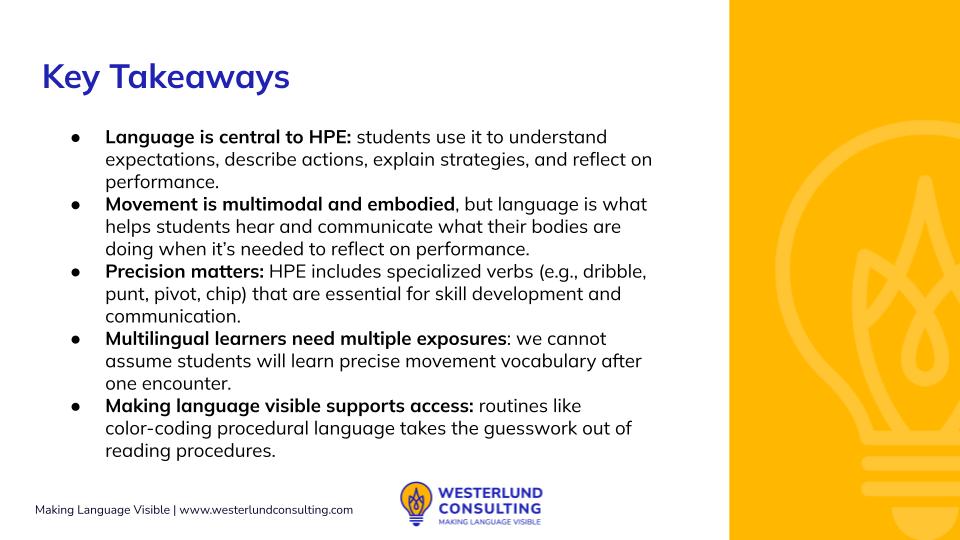
Similar to other disciplines, language in HPE is the tool students use to understand expectations, describe actions, explain strategies, and reflect on their performance. Students make meaning through language as they follow safety rules, explain consequences of not following the safety rules, teach each other strategies, and justify decisions. Whether they are learning how to navigate general space safely or analyzing the effectiveness of a game plan, they are engaging in disciplinary ways of using language.
In this blog, I’ll share how to bring language into HPE in visible and meaningful ways. Because if we can make language visible in a gym, we can make it visible anywhere.
In the WIDA ELD Standards, we talk about organization, cohesion, density, grammatical complexity, and precision of language. While precision is often talked about in ELA when it comes to shades or meaning or nuanced meanings, we often neglect to think about precision in disciplines like Health and Physical Education. Take verbs that deal with handling a ball across various sports.
- American Football: punt, snap, hand off, pass, tackle
- Soccer: dribble, pass, shoot, trap
- Basketball: dribble, pivot, shoot, rebound, pass
- Volleyball: serve, set, spike, block, dig
- Rugby: pass (lateral), kick, tackle, carry
- Golf: drive, chip, putt, swing
Each verb carries a distinct meaning tied to technique and purpose, for example, punting involves dropping the ball and kicking it before it hits the ground, while kicking can vary depending on force, direction, and context. When students learn and use this precise language, they are better able to understand instructions, describe their actions, give feedback to peers, and refine their performance. Making these verbs visible and meaningful supports both skill development and communication and reflection on their performance.
While teachers know the specialized meanings of those verbs, it’s important to remember that we cannot assume that Multilingual Learners will learn precise movement vocabulary after a single exposure. They may know those terms in their language, but it might be confusing to retain the precise verbs associated with each sport, especially when they go from sport to sport. Students need multiple, meaningful opportunities to hear, see, use, and revisit these terms in context to truly retain them. This is especially important because each sport uses different, discipline-specific verbs to describe how the body interacts with the ball or equipment.
Since we are on the topic of precise verbs, let’s take them into the context of text. In HPE, one of the most prevalent genres (not the only one, but the one with frequent flyer status) is PROCEDURES.
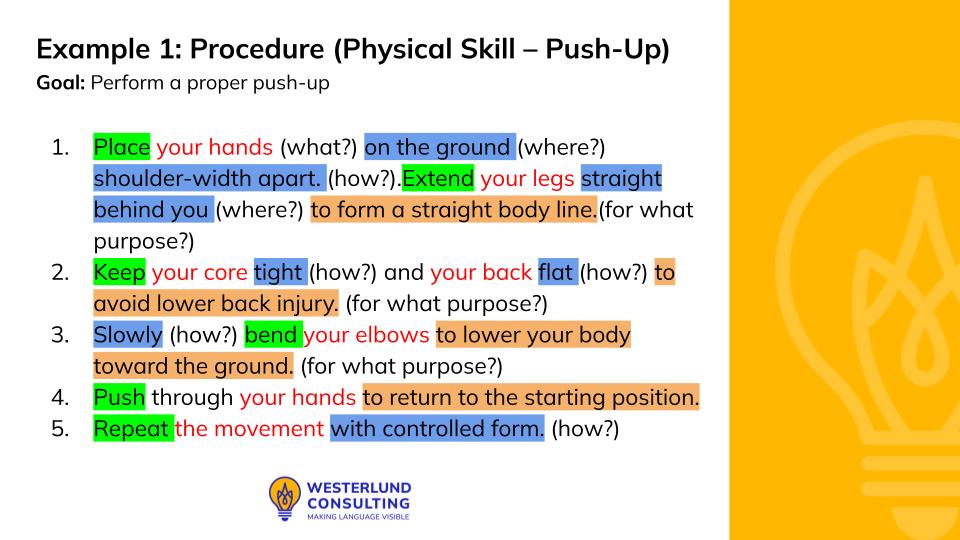
The purpose of procedures is to instruct how to teach how to do something step by step. This might include performing a physical skill, following a workout routine, or completing a health-related task safely and effectively. Let’s take a procedure for performing a push up, for example. By the way, in my training, we actually did push up, not on the floor, no worries, I’m not a drill sergeant, but on the wall. A PhyEd instructional coach led us in performing wall push ups. The procedure below is for performing floor push ups. This is how we analyzed procedural language:
Below are some activities to help you with teaching language of procedures.
1. Color-Code the Procedure (Modeling)
- Provide a short procedural text (e.g., how to dribble or pass).
- Read it aloud and think aloud as you identify language:
- Green = Verbs (actions) → push, move, step
- Red = “Whats” (body parts/equipment) → hands, feet, ball
- Blue = Details (place, manner, time, purpose) → with control, toward your partner, after passing
- Highlight together as a class.
2. Create a Class Anchor Poster
- Title: “How to Read a Procedure in HPE”
- Add three columns or sections:
- 🟢 What do I DO? (Verbs)
- 🔴 What do I USE? (Body parts/equipment)
- 🔵 How/Where/When/Why? (Details)
- Add examples from the text under each category.
- Keep this posted for ongoing reference.
3. Partner Highlight & Talk
- Students work in pairs with a new procedure.
- Task:
- One student finds and highlights verbs (green)
- One student finds body parts (red)
- Together, they find details (blue)
- Talk move: “What does this word tell us to do? Use? How?”
4. Cut-Up & Rebuild the Procedure
- Give students a cut-up version of the steps.
- Students:
- Reorder the steps
- Then color-code each step
- Debrief: How did the verbs + details help you figure out the sequence?
5. Act It Out (Embodied Reading)
- Teacher reads one step at a time.
- Students perform the action.
- Pause and ask:
- “Which word told you what to do?” (green)
- “Which word told you what to use?” (red)
- “Which word told you how or where?” (blue)
6. Missing Language Challenge
- Provide a procedure with parts removed:
- No verbs / no body parts / no details
- Students discuss:
- What’s missing?
- Why is it hard to follow?
- Then restore the language and color-code.
7. Write & Swap
- Students write their own short procedure (e.g., how to pass, dribble, or putt).
- Partner:
- Color-codes the text
- Checks: Do we have all three? (green, red, blue)
- Revise for clarity and precision.
8. Quick Reflection (Metalinguistic Awareness)
- Exit prompt:
- “How do verbs, body parts, and details help you understand a procedure?”
- “Which color helps you the most when reading instructions?”
This is the work I do with educators—supporting them in learning to see language in their disciplines and make it visible for students. Whether in HPE, art, music, literature, biology, geometry, or algebra, I help teachers uncover the language that drives learning and design instruction that connects what students do, think, and say. Because when language is visible, learning becomes accessible—and students can fully participate in the work of the discipline.
Let me know here if you want me to come and work with your general education teachers. Or simply email me at support@westerlundconsulting.com
Cheering you on,
Ruslana
About the Author
Dr. Ruslana Westerlund is an educational consultant, researcher, and professional learning facilitator specializing in disciplinary literacy, multilingual education, and Systemic Functional Linguistics (SFL). She works with schools, districts, universities, and educational organizations across the United States and internationally to support the implementation of high-quality instruction that integrates language, literacy, and disciplinary learning. Her work focuses on making language visible through the Teaching and Learning Cycle, the WIDA ELD Standards Framework (which she co-authored), and evidence-based approaches that provide multilingual learners with high challenge and high support.
Westerlund Consulting LLC is a certified Woman-Owned Business Enterprise (WBE) providing professional learning, curriculum design, instructional coaching, keynote presentations, and strategic consultation in disciplinary literacy, multilingual education, and language-focused instructional design. The company partners with educational organizations to build educator capacity and improve equitable access to rigorous, language-rich learning for all students.




Leave a Reply