Dear readers,
Big news: Making Language Visible is growing.
I’m excited to share that I’ve officially launched Westerlund Consulting, LLC as a full-time endeavor. What began as a space to think, write, and share ideas about language and learning back in 2013 has evolved into a dedicated consulting practice focused on supporting educators and systems in building pedagogical coherence for multilingual learners through Visible Language Pedagogy.
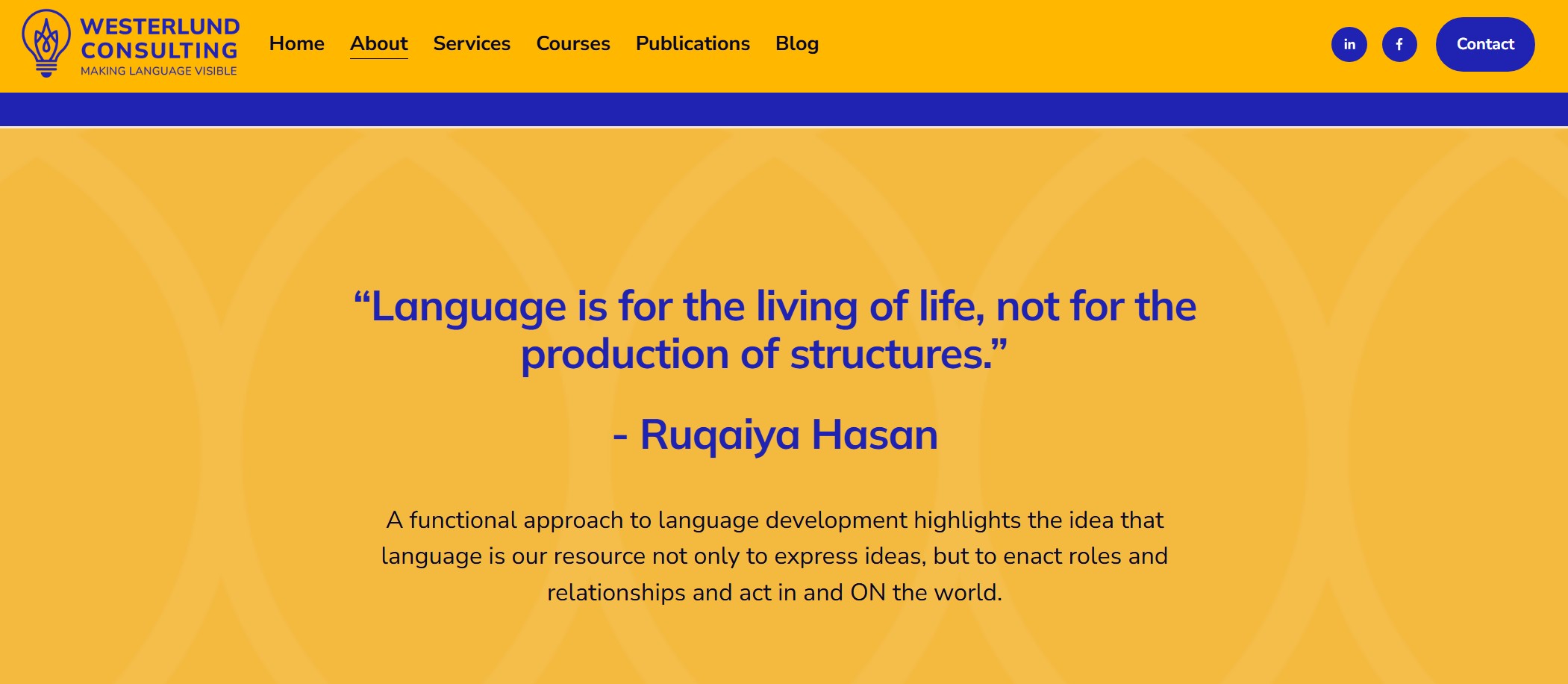
Along with this new chapter, I’m also launching a new website, a home for this work where you’ll find resources, tools, and ideas to support making language visible across disciplines.
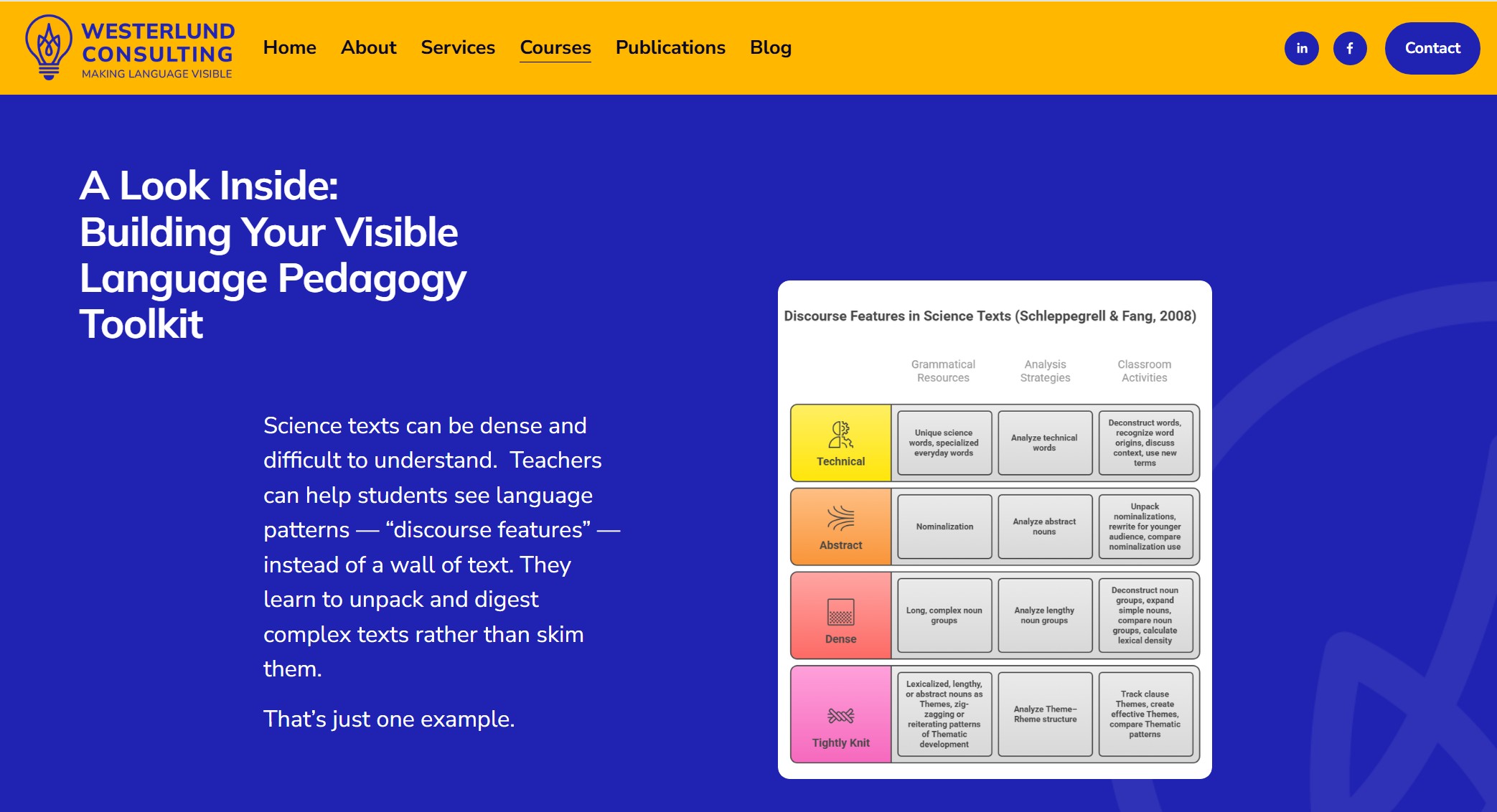
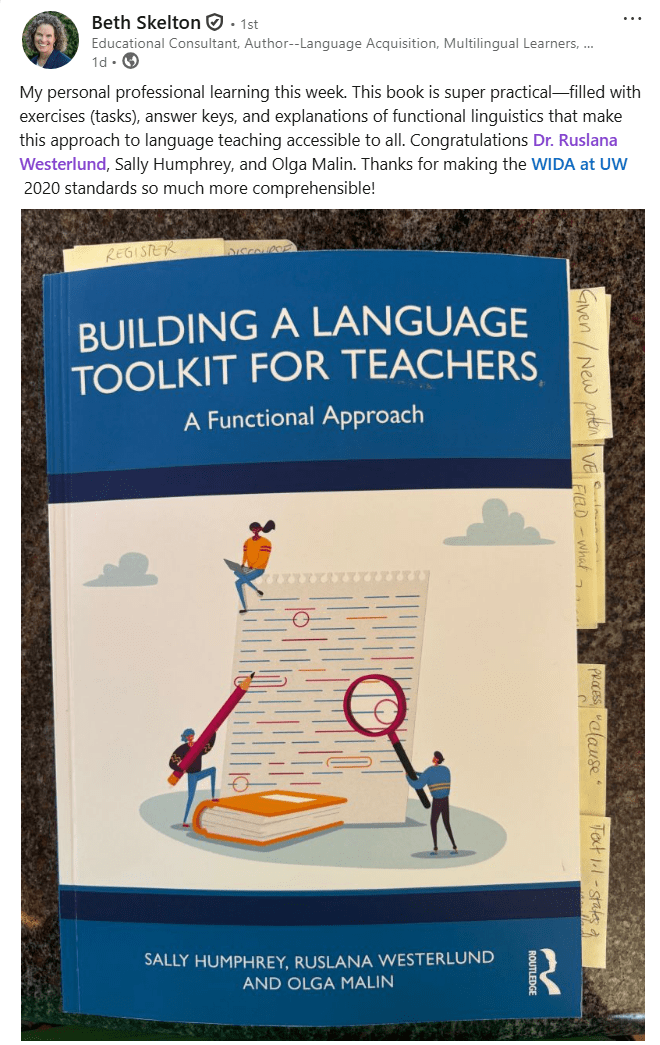
This launch also comes at an exciting time with the publication of a new book, Building a Language Toolkit for Teachers: A Functional Approach. Co-authored with Sally Humphrey and Olga Malin, the book offers a practical, classroom-focused guide grounded in Systemic Functional Linguistics and aligned to various global frameworks informed by a functional approach to language such as the Australian ACARA Standards, CA ELD Standards and WIDA ELD Standards in the US, the Common European Framework of Reference for Languages (CEFR) in Europe (Council of Europe, 2020), English syllabi in Singapore (Ministry of Education, Singapore, 2020), Indonesia (Ministry of Education, Culture, Research, and Technology of the Republic of Indonesia, 2025) and Hong Kong (Education Bureau, Government of the Hong Kong Special Administrative Region [HKSAR], 2025) (Humphrey, Westerlund, Malin, 2026).
The book has a unique pedagogical scaffolding designed as a toolkit for teachers—with task-based cycles, examples, and strategies that support educators in understanding how language works and how to explicitly teach it for disciplinary purposes such as narrating, informing, explaining, and arguing.
This work reflects a core belief: when teachers develop their pedagogical language knowledge, they are better equipped to support multilingual learners in accessing rigorous, grade-level learning.
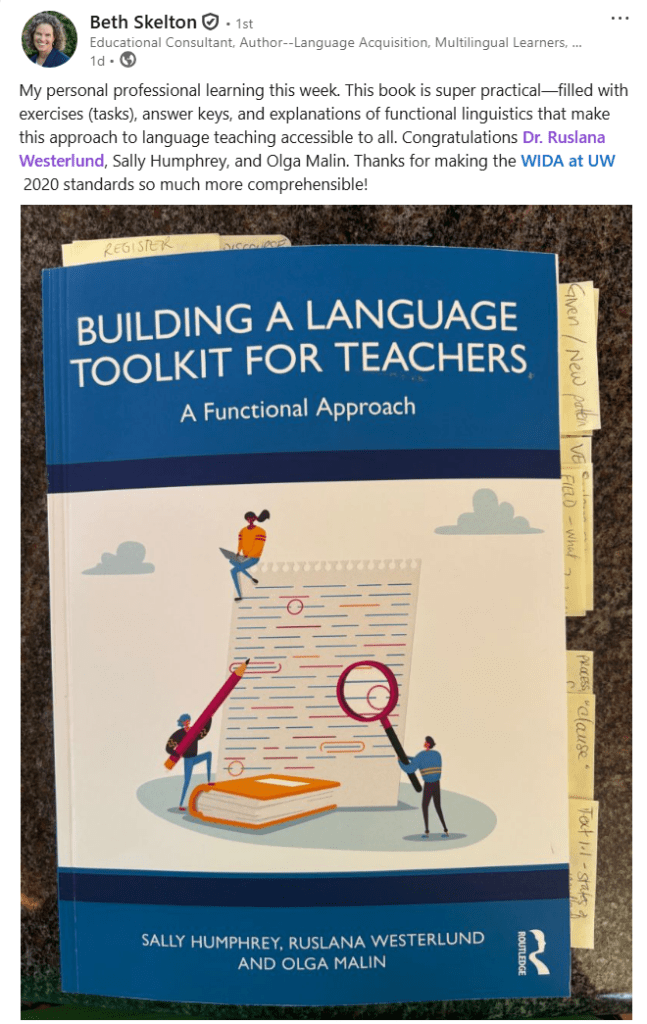
Here’s what my good friend Beth Skelton said about this book – don’t miss her handy bookmarks created with post-its! That’s an active reader! (Posted with Permission)
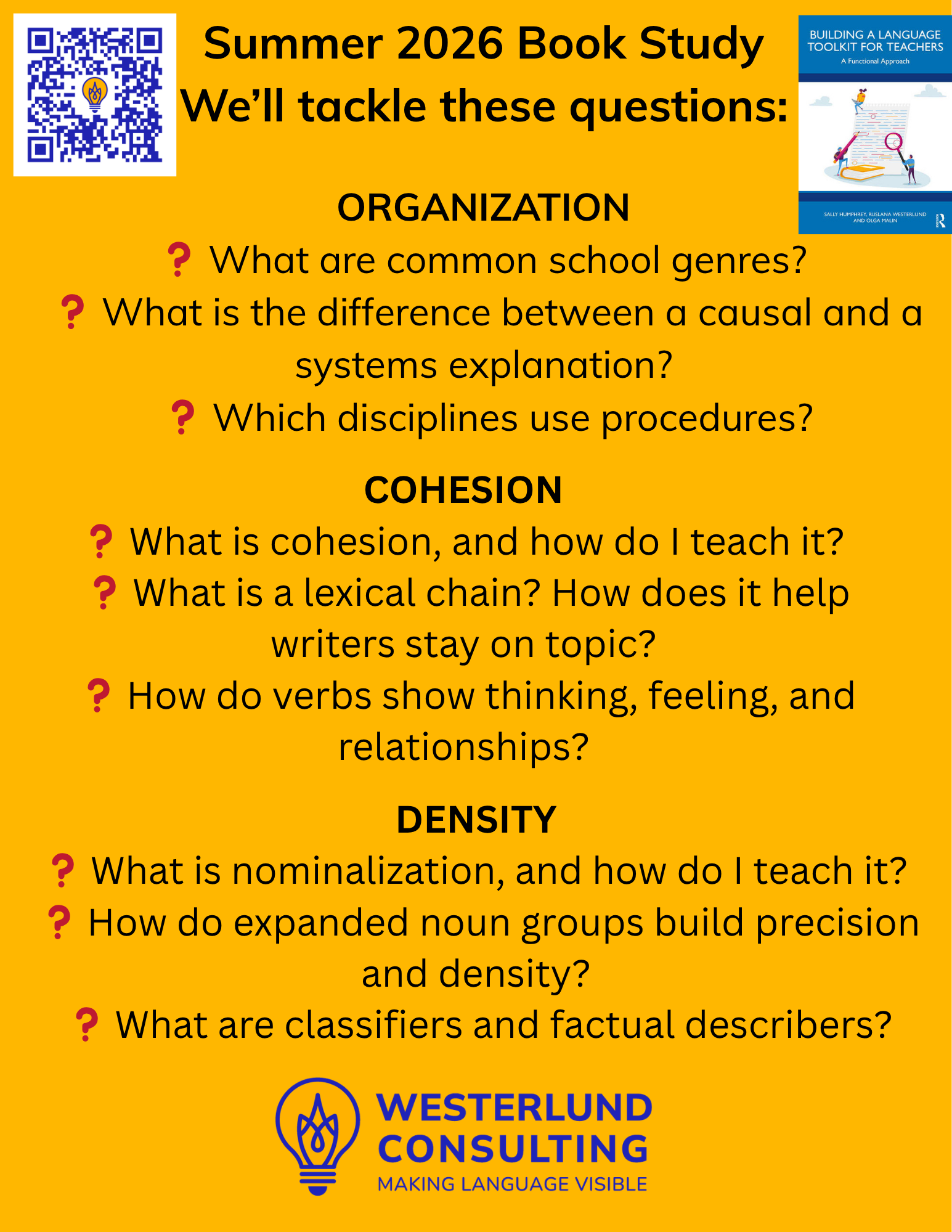
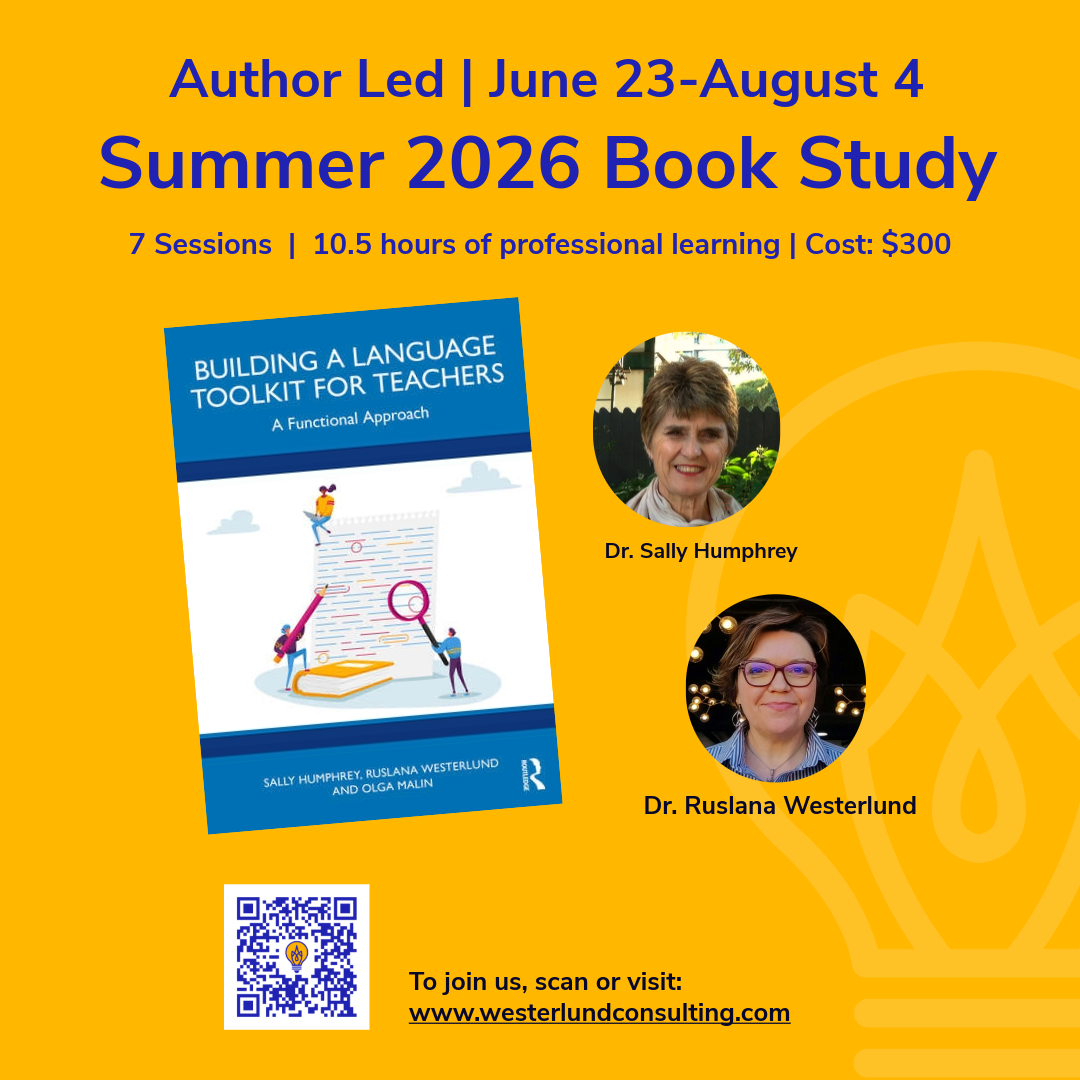
And there’s more: Sally Humphrey and I are offering author-led 7 90-minute sessions summer book study designed to help educators deepen your understanding of language as a meaning-making resource and apply a functional approach in their classrooms. Download the Syllabus below.
This book study is designed to explore questions like:
❓ What exactly is cohesion—and how do I teach it explicitly?
❓ What is a lexical chain, and how does it build meaning across a text?
❓ What is nominalization—and why does it matter for academic writing?
❓ What counts as an abstract noun, and how does it shape disciplinary thinking?
❓ What is an expanded noun group, and how does it increase precision and density?
❓ What are factual describers and classifiers, and why should I care?
❓ Why do research reports rely on generalized vs. specific participants?
❓ How do verbs do more than show action: how do they show thinking, feeling, and relationships (doing, saying, sensing, relating)?
❓ How do verbs build causality in explanations and develop character in narratives?
❓ How do adjectives communicate perspective in arguments? What does that look like in practice?
❓ How do we teach language in the service of learning, not as an isolated inventory of structures?
📚 Join the upcoming book study https://www.westerlundconsulting.com/professional-learning
🔗 Explore the new website https://www.westerlundconsulting.com/
Thank you for being part of this journey. I’m excited for what’s ahead.
Cheering you on,
Ruslana
About the Author
Dr. Ruslana Westerlund is an educational consultant, researcher, and professional learning facilitator specializing in disciplinary literacy, multilingual education, and Systemic Functional Linguistics (SFL). She works with schools, districts, universities, and educational organizations across the United States and internationally to support the implementation of high-quality instruction that integrates language, literacy, and disciplinary learning. Her work focuses on making language visible through the Teaching and Learning Cycle, the WIDA ELD Standards Framework (which she co-authored), and evidence-based approaches that provide multilingual learners with high challenge and high support.
Westerlund Consulting LLC is a certified Woman-Owned Business Enterprise (WBE) providing professional learning, curriculum design, instructional coaching, keynote presentations, and strategic consultation in disciplinary literacy, multilingual education, and language-focused instructional design. The company partners with educational organizations to build educator capacity and improve equitable access to rigorous, language-rich learning for all students.





Leave a Reply