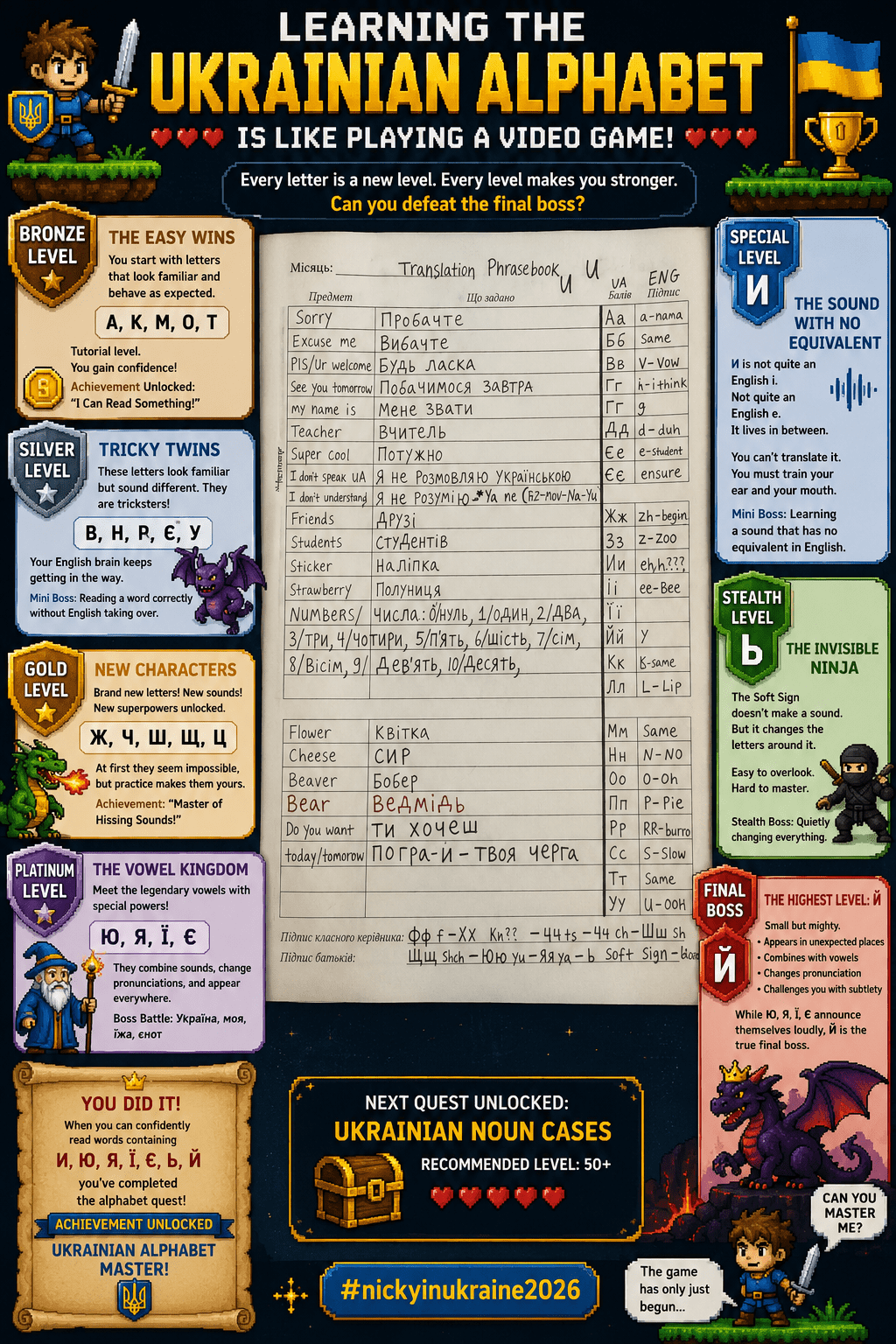
Alphabet Learning Doesn’t Have to Be Boring: Gamifying the Ukrainian Alphabet
By Dr. Ruslana Westerlund
I’ve been writing all about English in my blogs, and most of my work focused on the upper levels of the language system: Discourse and down. Well, today I’m changing things up a bit. I’m not writing about English and I’m not writing about Discourse level. I’m writing about the Ukrainian writing system called Cyrillic. My son is in Ukraine right now volunteering at a school and this blog is inspired by what he told me in a conversation this morning. Have fun learning the gaming register too – “the mini-boss” and “the final boss”
For many learners, studying a new alphabet feels like memorizing a long list of symbols. Students are often handed an alphabet chart, asked to repeat letter names, and expected to practice until they remember them. While this approach may work for some learners, it rarely sparks curiosity, motivation, or joy.
But what if learning an alphabet felt more like playing a video game?
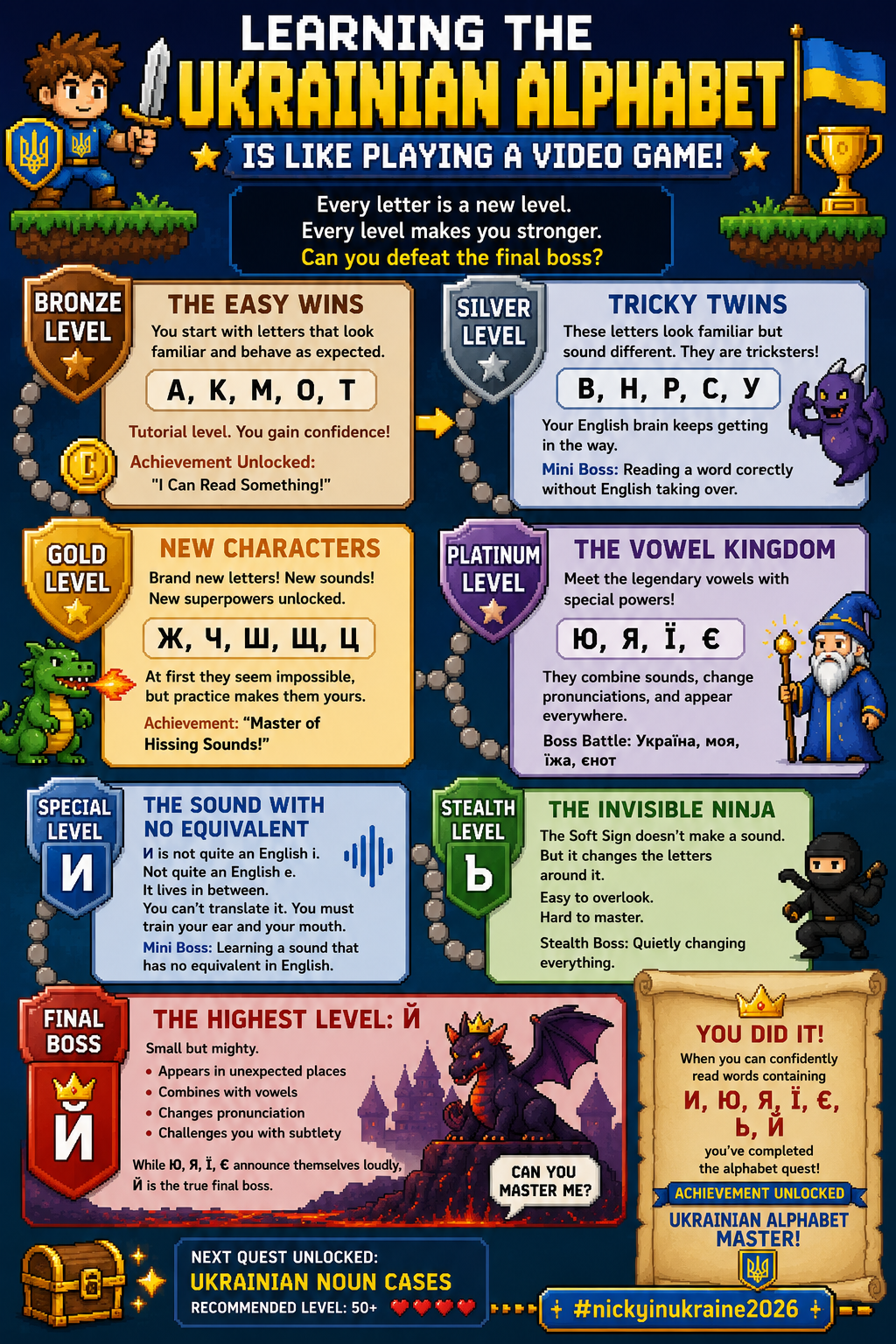
Imagine introducing the Ukrainian alphabet as a series of levels. Some letters are easy wins that learners can master quickly because they look familiar. Others become mini-bosses that challenge students to notice important differences. As learners progress, they unlock new characters, earn achievements, and develop special powers for decoding increasingly complex words.
In a recent conversation with my son (who is currently volunteering in Ukraine) about learning Ukrainian, he described learning the alphabet as a video game adventure. Letters such as А, К, М, О, and Т formed the tutorial level. Familiar-looking but deceptive letters such as В, Н, Р, and У became tricksters that challenged learners to rethink what they thought they knew. The vowel И emerged as an early mini-boss—a sound that exists somewhere between English vowels and refuses to fit neatly into familiar categories. Later levels introduced legendary characters such as Ю, Я, Ї, and Є, while the mysterious soft sign Ь acted as a stealth boss, quietly changing sounds without making one of its own. At the highest level stood Й, the ultimate boss that learners encounter only after mastering everything else.
While the video game metaphor is playful, it reflects something important about learning. Games work because they provide challenge, immediate feedback, visible progress, and a sense of accomplishment. Effective language instruction can do the same. When learners see themselves progressing through levels rather than struggling through mistakes, they are more likely to persist, take risks, and celebrate growth.
Gamifying alphabet learning does not mean turning every lesson into a competition. Instead, it means designing learning experiences that make progress visible, build curiosity, and help students view challenges as part of the journey. Whether students are learning Ukrainian, Arabic, Korean, or another language with an unfamiliar writing system, a game-inspired approach can transform alphabet learning from a memorization task into an adventure.
Bringing Gamification into the Classroom
One simple way to help students think differently about language is to ask them to imagine that the English sound system or spelling system is a video game.
What would the levels be?
Students might identify beginning sounds and simple CVC words as the tutorial level. Long vowels could become the next level, followed by vowel teams, silent letters, prefixes and suffixes, and eventually morphology and word origins as advanced levels. Many students quickly identify “ough” as a final boss!
You can extend the activity by asking students:
- What is the easiest level in the English spelling game?
- What level are you currently playing?
- Which spelling pattern is your mini-boss?
- Which spelling pattern feels like the final boss?
- What special powers have you unlocked as a reader and writer?
- What achievement badges would you earn so far?
Students can create game maps, design boss characters for difficult spelling patterns, develop achievement badges, or create posters showing their journey through the spelling system.
This activity does more than make learning fun. It encourages students to think metacognitively about their own literacy development. Instead of viewing spelling challenges as mistakes or failures, students begin to see them as levels to master. The focus shifts from “I can’t do this” to “I haven’t beaten this level yet.”
When students understand that expert readers and writers have simply spent more time progressing through the game, they are more likely to persevere through difficult challenges and celebrate their growth along the way.





Leave a Reply