In this blog, I will illustrate how to turn the WIDA Language Charts from an assessment-oriented tool to an instructional tool. The reason I’m doing it this way is because we shouldn’t be assessing students on things we haven’t taught them like cohesive devices, nominalization, noun groups, etc. So, in this blog, I’ll revisit some of those language features by hyperlinking previous blogs I wrote to tie it all together. It’s unfair to the students, and frustrating to the teachers because all assessment may show is what students can’t do (obviously they can’t nominalize YET because we haven’t taught them).
The Language Charts are organized by Discourse, Sentence, and Word – something WIDA has been consistent about in all their language frameworks. You will see below that I only focused on the Discourse Level. I’ll explain why below.
Why Focus on Discourse?
When we analyze student writing, it’s common for teachers to zoom in on the sentence level: Did students write in complete sentences? Did they use the “right” grammar? Are there vocabulary words we can add? While these concerns are valid, they often dominate so much instructional time that we miss the bigger picture: how students are actually organizing and connecting ideas across a text.
That bigger picture lives at the Discourse level.
Discourse refers to the organizational patterns, cohesion, and density of language that allow students to move beyond isolated sentences into extended arguments, narratives, or explanations. (Do you see how I’ve connected the Language Charts to the Key Language Uses? In fact, that’s the work we must do with the charts – we cannot forget the language standards. Don’t let the standards be reduced to the language charts). It’s how writers sequence their points, link evidence, build logical flow, and signal to the reader what comes next. Without explicit teaching of discourse, student writing may remain a string of well-formed sentences that never build into a coherent whole.
Too often, discourse is presented as introduction, body, and conclusion, which is a narrow and vague approach, irrespective of the social purpose and the genre the text serves. Another way discourse is taught is through “make sure your ideas flow” and “your text is organized clearly”, but students actually don’t know what that means. Just because we keep assigning and assessing those areas and adding lots of editorial comments for students to address, most of our learners are not going to learn from the margins teacher left for them. So, in my blog, I am going to demystify most of those things. In my cohesion blog, I illustrated several cohesive devices (beyond pronoun reference and transition words). In my recent Connectives in Arguments blog, I illustrated discourse-level work how different connectives show different logical relationships between ideas. Here, I will continue illustrating that Discourse level work is comprised of a set of teachable, functional language resources—like theme/rheme, given/new patterns, substitution, ellipsis, parallelism, and logical connectors—that make ideas “flow” and text stick together. This is especially critical in argument and literary analysis, where students must weave evidence, reasoning, and commentary into a cohesive whole.
That’s why in the chart below, we are focusing only on the Discourse column from the WIDA Expressive Language Descriptors. By mapping each proficiency level to instructional strategies, we highlight what teachers can do to move students from sequencing ideas (Level 1–2), to building logical connections (Levels 3–4), to crafting cohesive, audience-engaging arguments (Levels 5–6).
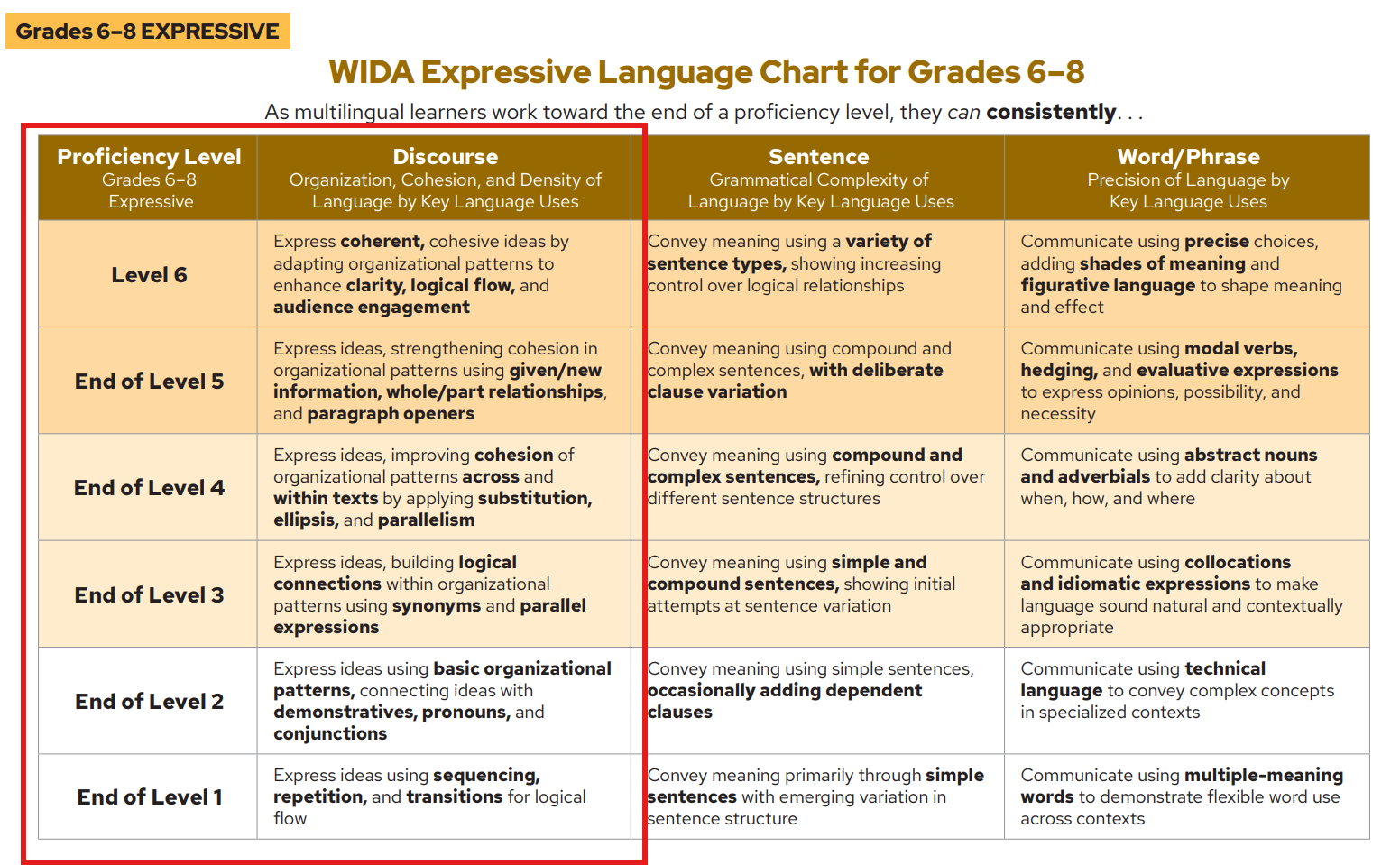
This focus matters: if students can’t organize and connect their ideas across a text, their word choice and sentence grammar—no matter how correct—won’t add up to real comprehension or powerful writing.
If you’ve been to any of my training, you know that I always start with a text to situate all the language work in the context of text.
| Stages of the Text | Text | Language Analysis |
| Background and a Theme/Claim statement Evidence – Example 1 Link (this moment shows) Evidence – Example 2. Link (this scene proves) Conclusion with final message that connects back to theme. | The movie Wonder shows kindness can make a big difference in people’s lives. Auggie, a boy with a facial difference, struggles when he first starts school, but the story highlights how others’ choices shape his experience.One example is when Summer sits with Auggie at lunch. Instead of following the crowd, she chooses kindness. This moment shows that even small actions can help someone feel included and supported.Another example is the camping trip, when Auggie’s classmates defend him from bullies. This scene proves that kindness is more than just words—it’s about being brave and standing up for someone when they need help.By the end, when Auggie is given the Henry Ward Beecher medal, the audience understands the film’s message: acts of kindness create change. Wonder reminds us that the way we treat people can transform not only one person’s life but also the whole community. | Whole Text Cohesion:Text openers and paragraph openers show how the theme unfolds and is supported by examples (evidence from the specific movie scenes). Reference (pronouns, determiners, repetition of key words)These keep the reader tracking who and what the analysis is about.Repetition of key idea: kindness (appears in every paragraph to keep the theme in focus).Pronouns: action, her decision, it, this moment → all refer back to “Summer’s choice.”Textual reference: this moment, this scene → refer back to the action in the text.Determiners: the camping trip, the end, the film’s message → signal specific parts of the movie. Lexical Cohesion (repetition & synonym chains)Using repeated or related vocabulary to tie ideas together.Chains of meaning:kindness → small actions → acts of kindness → brave choice→ courage and loyalty → symbol of how kindness has spread.Synonyms: being brave, standing upSynonyms for representing verbs for linking evidence with claim: shows, highlights, proves, reminds |
Instructional Strategies for Argument / Literary Analysis (Grade 7 ELA)
| Proficiency Level | Description | Instructional Strategies (with Wonder examples) |
| Level 6 | Express coherent, cohesive ideas by adapting organizational patterns to enhance clarity, logical flow, and audience engagement | – Model introductions that anticipate counterarguments and directly address the audience.- Use mentor texts to highlight logical flow: e.g., Although some might see Summer’s choice as small, the evidence shows it is powerful because it challenges the crowd.– Peer review: students give feedback on clarity and persuasiveness. |
| End of Level 5 | Express ideas, strengthening cohesion in organizational patterns using given/new information, whole/part relationships, and paragraph openers | – Teach “given → new” progression: start a paragraph with a reference to the previous idea, then introduce new evidence.- Use whole/part: The movie Wonder as a whole celebrates kindness, but Summer’s part in the lunch scene shows the bravery it takes to act kindly.– Sentence frames for paragraph openers: In contrast…, Building on this…, Another example is… |
| End of Level 4 | Express ideas, improving cohesion of organizational patterns across and within texts by applying substitution, ellipsis, and parallelism | – Highlight substitution: instead of repeating Summer’s choice to sit with Auggie, show how authors use this action, her decision, that moment. Full version: Auggie is nervous about school. His mom is nervous about school too. Ellipsis* version: Auggie is nervous about school. His mom is too. (the repeated words “nervous about school” are dropped but understood) – Parallelism: Auggie faces exclusion but chooses courage… |
| End of Level 3 | Express ideas, building logical connections within organizational patterns using synonyms and parallel expressions | – Create synonym banks for analysis: kindness → inclusion, empathy, support. Students revise essays to avoid repetition. – Sentence starters for logical connections: This shows…, As a result…, This highlights…– Joint construction of a paragraph where each piece of evidence is linked with synonyms and logical connectors: The lunch scene demonstrates inclusion. As a result, Auggie feels accepted. This highlights the impact of small choices. |
| End of Level 2 | Express ideas using basic organizational patterns, connecting ideas with demonstratives, pronouns, and conjunctions | – Mini-lesson: Track pronoun reference across a paragraph. Example: Summer sits with Auggie. This action shows her bravery. – Practice combining short ideas with conjunctions: Auggie feels nervous. Auggie feels hopeful. → Auggie feels nervous but also hopeful. -Have students generate simple sentences to combine into compound ones with “because, but, so”. |
| End of Level 1 | Express ideas using sequencing, repetition, and transitions for logical flow | – Cut up sentences and have students order them WITH sequencing words – remove the sequencing words and focus on the verbs as the sequencing device to show activities (FIRST) Summer shows kindness when she sits with Auggie. (NEXT) Auggie’s classmates defend him on the trip. (FINALLY) Augie receives the medal. – Provide different claim sentences and have students match them with different themes in the story. This claim goes with this theme. Now create your own claim sentence following this pattern. Theme: Kindness Auggie experiences kindness from his friends. Kindness spreads from one person to another in the story. The movie teaches that kindness can change how people see each other. Theme: Courage Auggie shows courage when he goes to school for the first time. Auggie and his family show courage in facing challenges together. The story shows that courage inspires others to be brave too. |
*More Ellipsis Practice Examples
| Full Sentences | Ellipsis Version | What’s Dropped |
| Auggie feels scared. Jack feels scared too. | Auggie feels scared. Jack does too. (Ellipsis and Substitution – feels is substituted with does). | feels scared |
| Auggie is wearing an astronaut helmet. His sister is wearing one too. | Auggie is wearing an astronaut helmet. His sister is too. | wearing an astronaut helmet |
| Auggie wants friends. Summer wants friends too. | Auggie wants friends. Summer does too. (Ellipsis and Substitution – wants is substituted with does). | wants friends |
Turning WIDA’s Language Charts into instructional tools means moving from what students can’t do to what we can teach next. When teachers use the charts to plan lessons around teachable language features—like cohesion, substitution, and logical connectors—assessment becomes a reflection of instruction, not a substitute for it.
References:


 Making Language Visible
Leave a reply to Dr. Westerlund’s Blog Organized by Categories – Making Language Visible Cancel reply