Theme and Rheme: Teaching Students How Paragraphs Make Sense
By Dr. Ruslana Westerlund
I was working with teachers on the structure of paragraphs in informational reports. We were looking at how meaning unfolds across a text. How does one sentence prepare us for the next? What holds the paragraph together?
I paused and asked the teachers, “What grammatical resources keep the text from falling apart?” “What are the language/grammatical tools that actually help the text MAKE SENSE?” Pause the reading and answer that question for yourself. The teachers in my trainings for the last 15 years were not able to answer that question. How are you doing? Do you know what resources make a paragraph make sense? What happens when a paragraph doesn’t make sense? We know what happens to student papers when the paragraph doesn’t make sense, they get markings like “unclear”, “revise for clarity”, “doesn’t make sense”.
Teachers usually know (actually, readers often do) when a text does or doesn’t “makes sense.” It’s that feeling when you read something and it’s clear. You don’t have to go back and reread to understand it, unless you are tired or reading a lexically dense text, which I wrote about earlier.
We also notice when the connections break. We re-read. We look for what “they” refers to, and who is “he” that shows up across the text and we can’t find the referent. Or “this means” and we already forgot what to look at above. We wonder where this new idea came from. We get frustrated and we quit reading and the student gets a really bad grade with markings on the margins with “Unclear.” “Doesn’t make sense.” “Revise for clarity.” But, here is the next question, to what extent do the markings on the margins students or (you in your college papers), actually learn from? Zero learning. Just shame. Close my laptop and walkaway because we don’t learn from margins on our papers.
Those comments alone do not teach students HOW to revise. What should they change? Where should they begin? If they knew how to make the connection clearer, they might have already done it.
So, if we recognize when a paragraph makes sense, how do we make that familiar knowledge strange enough to examine? How do we recognize it, name it, and teach it?
This makes me think of Gordon’s Ladder of Competence, thanks to Kerri Whipple, my dear friend who told me about it waaay back. The model describes movement from being unaware of what we cannot yet do toward doing something so fluently that it no longer requires conscious attention.
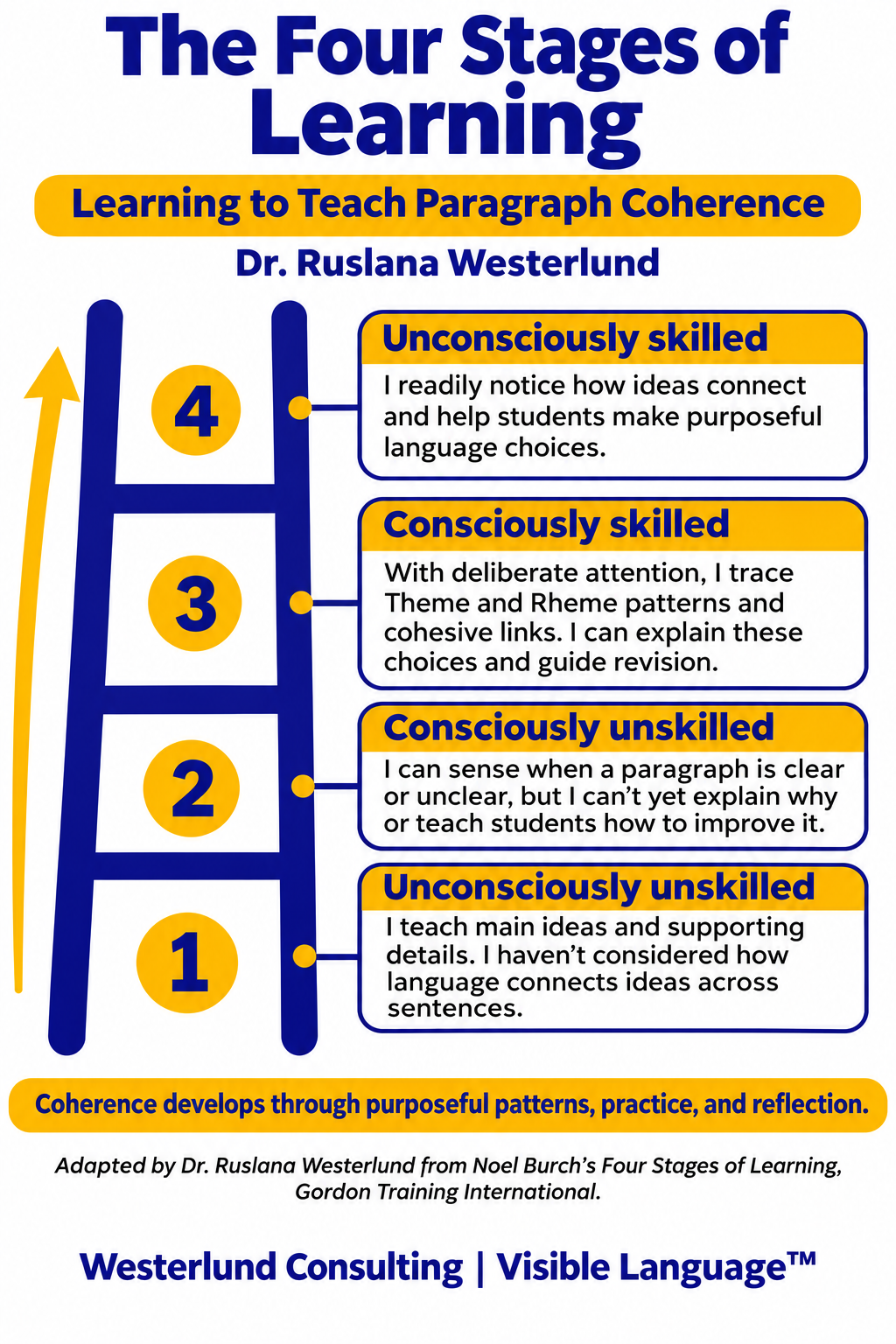
Many experienced readers operate with that kind of unconscious competence. We track participants (the whos and the whats of ideas), the happenings and the doings, connect ideas, and interpret references without stopping to explain how. We just read.
Explicit teaching asks us first to know what are the resources that help make the text stick together?
We need to bring some of that automatic processing into conscious awareness so we can show students what we are doing. This is my connection to the ladder: expertise that has become invisible to us needs to become visible again for teaching.
And there are two skills involved. Reading a paragraph fluently is one. Explaining how its language works is another. We can be highly competent at the first and still be struggling at the second. There is enough training available on phonics and word-level work, that’s why I focus on discourse-level reading skills.
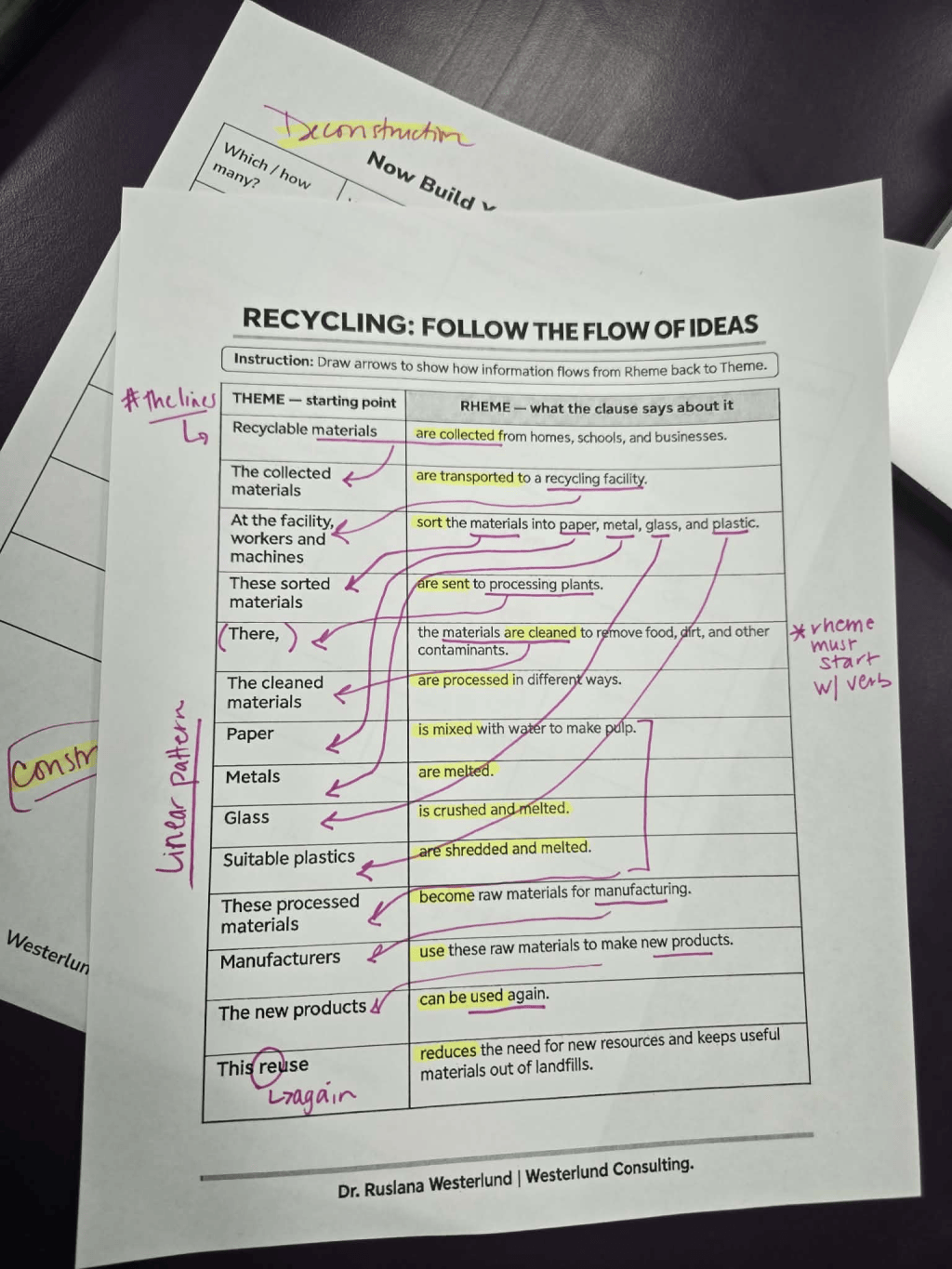
So, in my training I gave teachers a paragraph, each sentence broken into 2 parts and instead of asking only, “What is this paragraph about?” we asked, “Where does each sentence begin? What does that beginning connect to? What does the sentence add?”
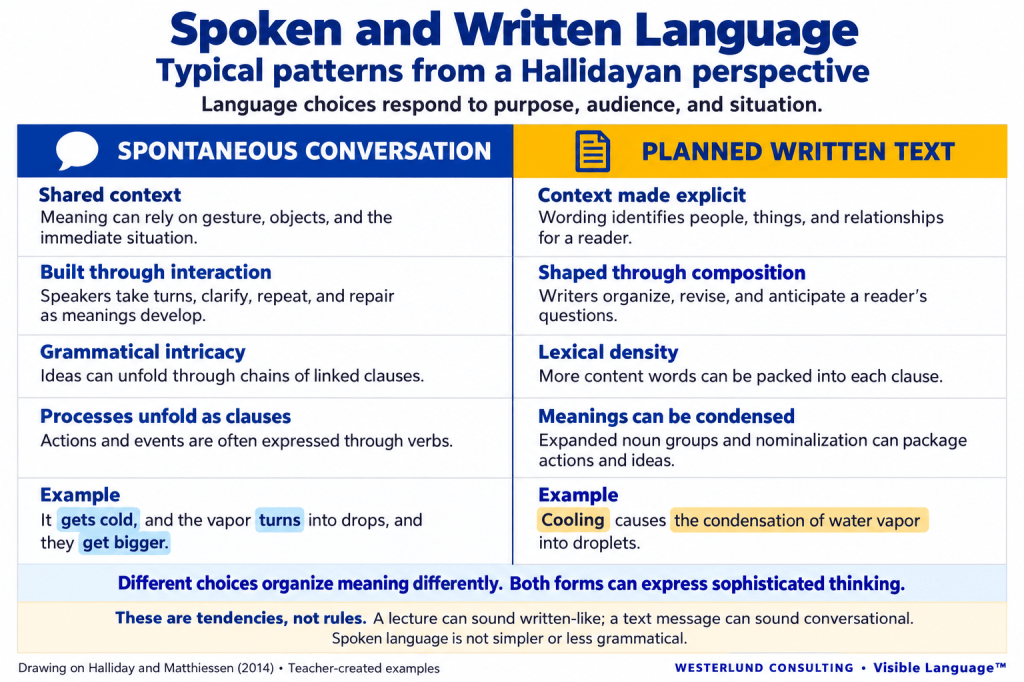
Of course, we read it for meaning first. Then look at how the ideas travel. Did you know we use grammar when read? Not, just sentence level grammar, but DISCOURSE-LEVEL GRAMMAR. We use both: sentence-level and discourse-level grammar when we read.
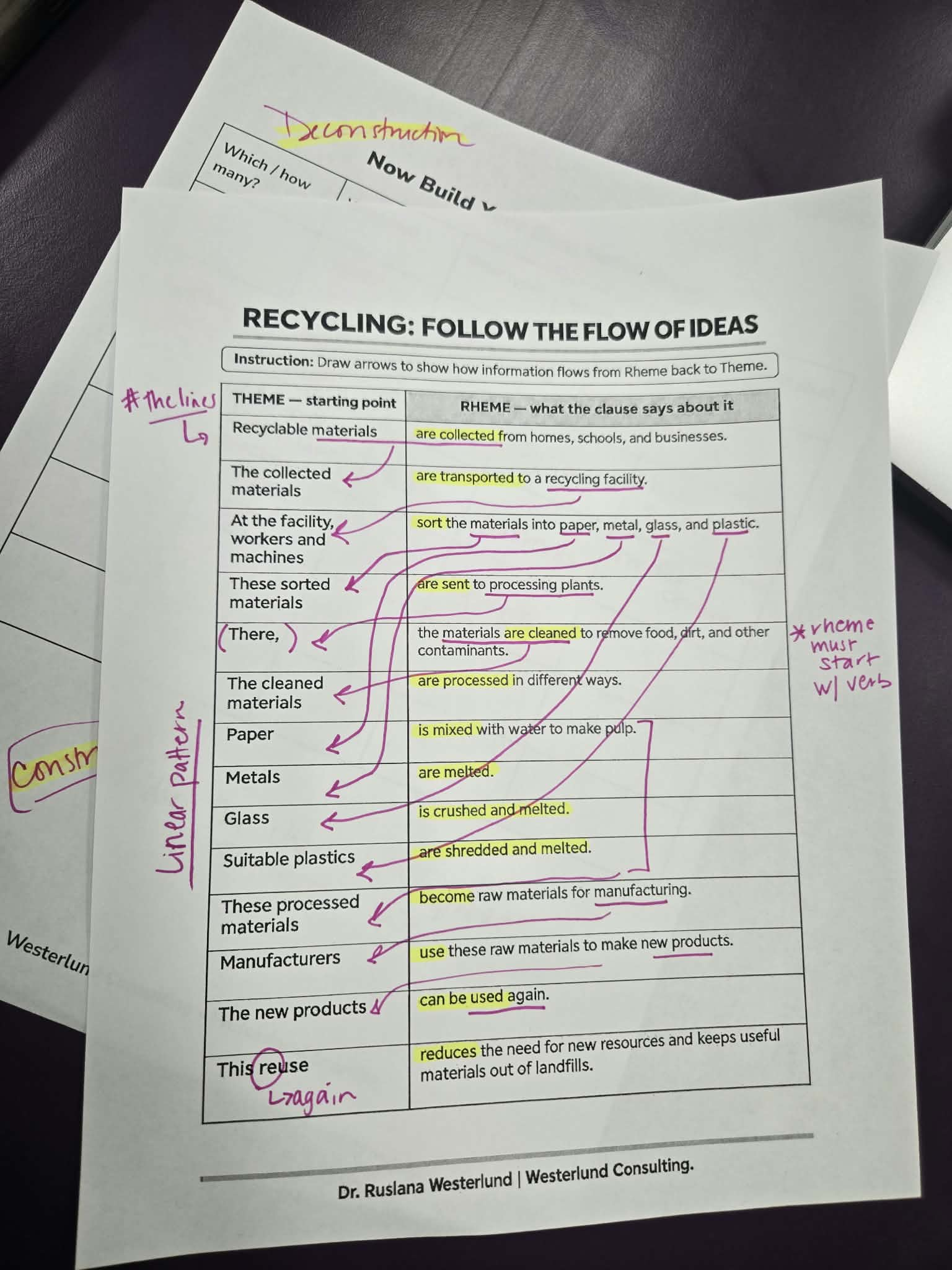
There is language doing this work. We can point to it. We can see it, we can underline it, circle it, draw arrows to it.
In SFL, Theme and Rheme give us a way to examine how messages unfold. Theme is the clause’s starting point; Rheme develops the message from there. Looking across clauses helps us see how a writer maintains a focus, introduces another one, or picks up an idea introduced earlier.
When the teachers were doing the above exercise, the sounds that were coming from teachers were
- “Ahhhh!”
- “OHHHH. Now I see it!”
- “Aha!”
- “Wait… What? How come I didn’t see this before?”
- “Where was this all my life?”
- “The mystery is solved.”
- “This more than “main idea” and “supporting detail”.
- “Oh my gosh. How did I never notice that?”
Of course, every paragraph does not follow one pattern. Sometimes several sentences begin with the same participant. Sometimes information introduced in one sentence becomes the starting point of the next. We examine the choices in relation to what the text is doing.
This gives us something concrete to teach.
And my blog wouldn’t be complete without a Dos and Dont’s List.
DOS
- DO start with meaning and purpose. What is this text trying to accomplish? How do its language choices help? Grammar is a resource for making meaning. Keep bringing the conversation back to what those choices DO.
- DO make the patterns visible. Underline starting points. Trace references. Draw arrows between connected ideas. Compare different Theme and Rheme patterns and discuss why each works where it does.
- DO turn noticing into choosing. Move from “What did this writer do?” to “What could WE do here?” Jointly construct and revise sentences. Try different beginnings, read the versions aloud, and discuss how the meaning changes.
- DO give feedback students can act on. Replace “unclear” with a specific invitation: “What does the word “there” refer to? Why? Draw the arrow to connect the two sentences.” What does “this” refer to? How far above in the text do you need to go to find what “this” refers to? That is how our knowledge becomes available to them.
DON’TS – THE REPETITION IS INTENTIONAL. I found when teaching 6th graders that students can complete the formula but they are not thinking. So, I’m here to remind you that thinking is really important for human development. I’m sure you’ve never heard that before. #canyoutellsarcasmwhenyouhearit
*If you want the exact activity I used with my teachers that you do with your students, I am available for working with your school. Just contact me on my website https://www.westerlundconsulting.com/.
- Don’t turn Theme and Rheme into another formula or a worksheet.
- Start by having students draw arrows but then move to the meanings that those patterns create by letting students talk and ask questions about the text. We are giving students ways to examine and make choices. For more types of themes and how whole text and paragraphs unfold, see our book Humphrey, Westerlund, & Malin, 2026.
And no, these choices are not random. And no, this is magic. Poof, and the paragraph “makes sense” or wave the magic wand and the paragraph is “clear”. There is a system to how meanings unfold across the text, and there is a system of grammatical resources that actually stitch the text together. Or there is a system how how the bricks are layered so that they don’t fall crumbling down. That is why it is called Systemic Functional Grammar, not “a random inventory of grammar rules.” Systemic points to organized options for making meaning; functional asks what those choices accomplish.
Grammar gives us ways to explain the choices and teach students how to make them.
Cheering you on,
Ruslana
About the Author
Dr. Ruslana Westerlund is a researcher of disciplinary literacy and CEO at Westerlund Consulting, LLC. She works with schools, districts, and educational organizations across the globe to support the implementation of high-quality instruction that integrates language, literacy, and disciplinary learning through Systemic Functional Linguistics. She is also an Executive Officer at LLEN North America (LLENA). Her work focuses on making language visible through the Teaching and Learning Cycle, the WIDA ELD Standards Framework (which she co-authored), and evidence-based approaches that provide multilingual learners with high challenge and high support.
Westerlund Consulting LLC is a certified Woman-Owned Business Enterprise (WBE) providing professional learning, curriculum design, instructional coaching, keynote presentations, and strategic consultation in disciplinary literacy, multilingual education, and language-focused instructional design. The company partners with educational organizations to build educator capacity and improve equitable access to rigorous, language-rich learning for all students.




Leave a Reply