I love when teachers ask questions during my training. Yesterday, a high school teacher asked, “What do you mean by a mentor text?”
ELA teachers will be the first to say that there are many ways to use that term. In genre pedagogy, I use mentor text to mean a model of the kind of text students are expected to produce for a particular task. It helps make the expectations of the summative assessment visible during the Deconstruction and Joint Construction stage.
Imagine students read several poems and are then asked to write an analysis of how a poet uses imagery, repetition, and other poetic devices to develop a theme. Are the poems mentor texts? For this writing task, the poems are the texts students will analyze. The mentor text is a model analysis of a poem—perhaps one the teacher writes about a poem the class already knows.
Students can then examine how the model writer presents an interpretation, selects lines from the poem as evidence, and explains how particular poetic choices contribute to the theme. They can see how the analysis unfolds across the whole text and within each paragraph.
That distinction matters when we plan instruction. Reading poems helps students understand poetry. Reading a model analysis helps them see how to write about poetry. When the final task is literary analysis, students need access to the language and structure of that genre before they are asked to produce it independently.
Another example: students might read several stories and discuss how themes or key messages. But the final task asks them to write a literary analysis. Reading stories gives students something to analyze; it does not, by itself, show them how to write the analysis.
For that task, the mentor text would be a model literary analysis, perhaps written by the teacher using a story the class already knows. Students could examine how the writer introduces an interpretation of a theme, develops that interpretation through textual evidence and analysis, and brings the argument to a close. They could also look more closely at the phases within a paragraph: where the writer makes a point, presents evidence, and explains how that evidence supports the interpretation.
The mentor text makes the writing task visible. Students can see what this particular kind of argument does, how it unfolds, and which language choices help the writer accomplish its purpose.
What does this mean for planning?
Start with the summative task. Ask: What kind of text must students produce to show what they know? Then select or write a mentor text that does that work. Yes, of course, AI can help with that, but you really need to be clear with your prompt to make sure the summative genre is clear. You can even use the WIDA Language Functions and Features in your prompt to guide the output. However, the WIDA Argue Language Functions and Features do not include Response Genre Family. Hence, you still need to use our text (chapter 3) to learn the language of the genres that were excluded in the WIDA ELD Standards.
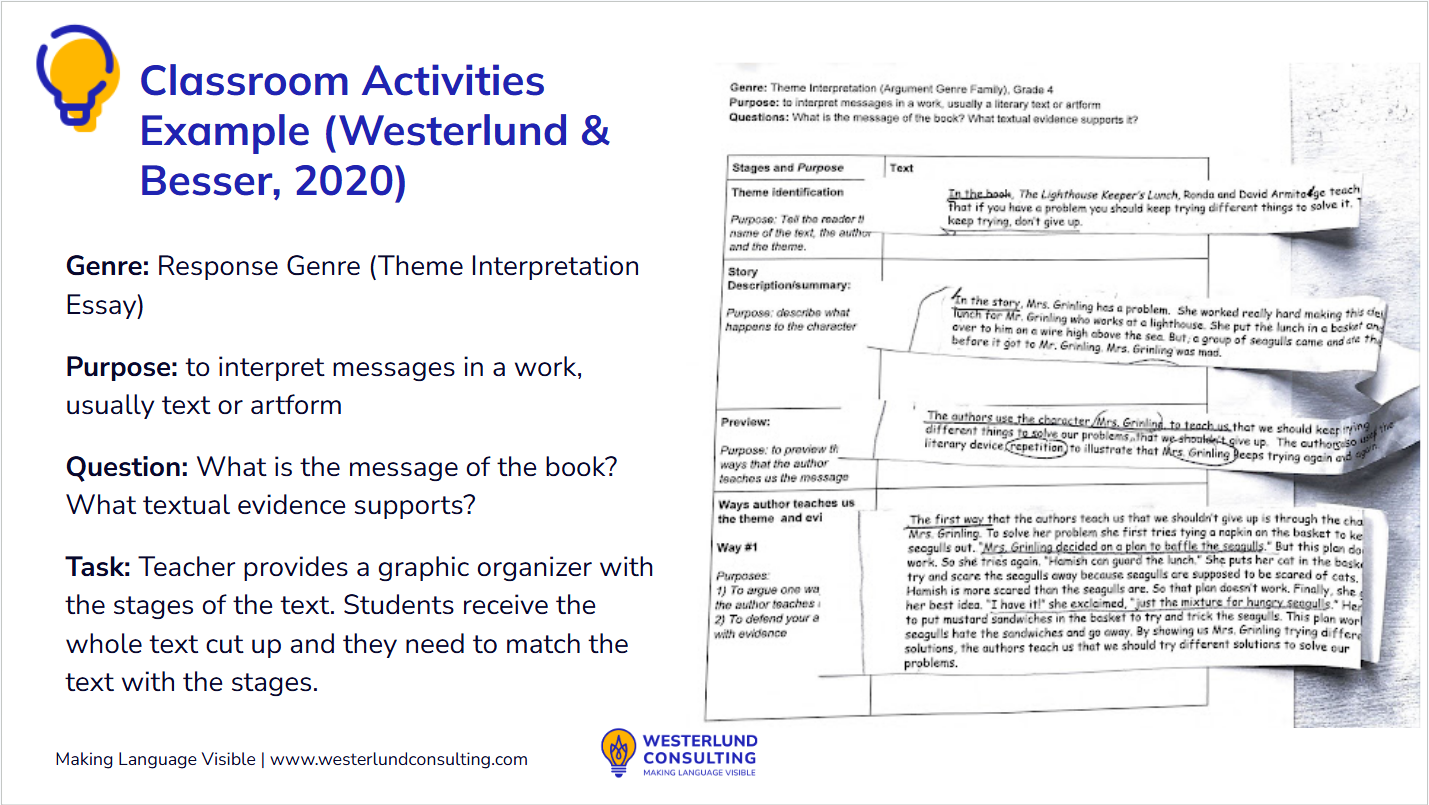
If students will write a literary analysis, the story they analyze is an essential source text. The mentor text is a model of the analysis they will write. Students need opportunities to read both, but they read them for different purposes.
A well-written mentor text lets teachers make expectations concrete. Together, during deconstruction, the class can identify its stages, examine how each paragraph develops an interpretation, and notice how the writer connects evidence to a claim about the theme. Those observations can then guide joint construction, independent writing, feedback, and assessment.
This matters for equity. When we ask students to write an analysis without showing them how one works, we leave the expectations implicit. A mentor text gives everyone a shared example to question, discuss, and learn from before they are asked to write their own.
Slide below is from my presentation of our earlier research study with Sharon Besser where we set up a control group and an SFL intervention group. The results of the intervention group were remarkable but because the pandemic shut down the schools, we didn’t collect the data from the control group. So much research was lost as a result.
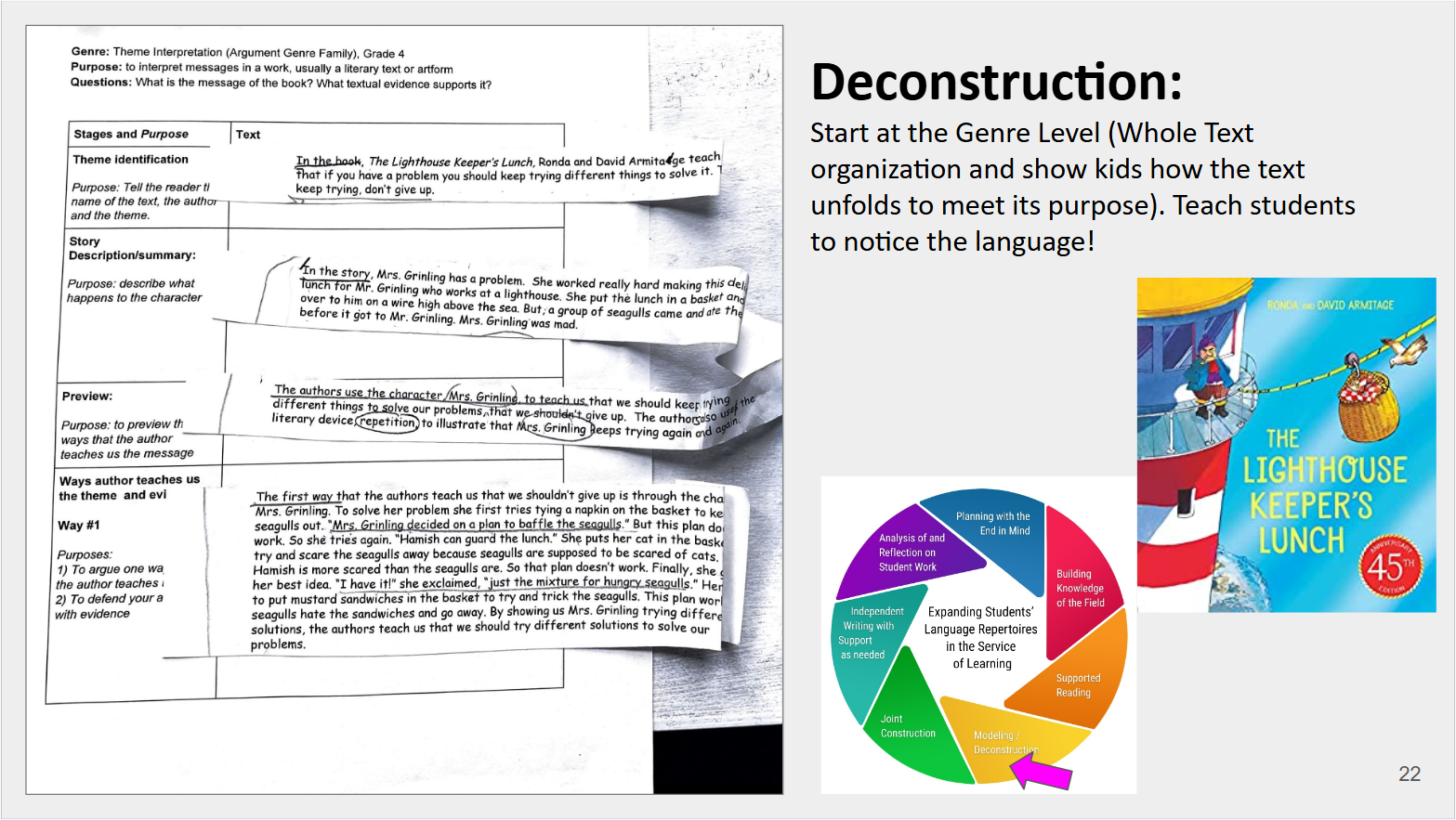
Interactive Activities for Deconstructing a Theme Interpretation
These activities use a model theme interpretation of The Lighthouse Keeper’s Lunch. Students first work out how the whole text is organized, then look more closely at how its parts work.
1. Overall Cut-Up: Put the Text Together
Give each group the model response cut into its major sections. Students arrange the pieces into an order that makes sense to a reader.
Once groups agree, ask them to explain their reasoning:
“Why does this piece come first?”
“What does the reader need to know before reaching this part?”
Reveal the original order, then have students label each section: Theme Identification, Story Description, Preview, and Ways the Authors Teach the Theme.
2. Become the Text
Give one section to each student or pair. Students stand in a line to form the complete response. Each student reads their section aloud and finishes by saying what their section does for the reader:
“I state the message of the book.”
“I give readers the story information they need.”
“I tell readers what evidence is coming.”
“I show how an event supports the interpretation.”
Invite the class to move people if the order is unclear. Read the text aloud again in its new order.
3. What Happens If I Leave?
While students are still “the text,” ask one section to step out of the line. Read the remaining sections aloud.
Ask:
“What does the reader have to figure out now?”
“Why does this section belong in the response?”
Repeat with two or three different sections. This makes the purpose of each stage visible.
4. Stage and Purpose Match
Place four stage labels on one side of the room and four purpose cards on the other. Give students excerpts from the model response. They move to the stage they think their excerpt belongs to, then find its matching purpose.
Students justify their choices using the language in the excerpt:
“This belongs in Story Description because it tells what Mrs. Grinling does.”
“This belongs in the interpretation because it explains what her actions show.”
5. Human Evidence Chain
Give students cards containing a theme claim, story events, and interpretations of those events. Students work together to form chains:
Theme claim → Event from the book → What the event shows
Some event cards may be relevant to the story but weak as evidence for the theme. Ask students to defend which cards belong in their chain and which do not.
6. Cut Up a Paragraph
Give pairs one body paragraph cut into smaller pieces: a point about how the authors teach the theme, story evidence, and an explanation of the evidence. Students reconstruct the paragraph and mark each piece:
POINT → EVIDENCE → INTERPRETATION
Then ask them to identify any place where the writer could explain the evidence more clearly.
7. Change the Audience
After reconstructing the response, ask groups to explain its organization to a student who has not yet written a theme interpretation. They can use the cut-up pieces as props, but they cannot simply read the labels. Their explanation should show why a writer includes each stage and how the stages help answer the question about the book’s message.
References
Westerlund, R., & Besser, S. (2022). Revising the Calkins units of study for multilingual learners [Conference presentation]. WIDA Conference.
About the Author
Dr. Ruslana Westerlund is a CEO at Westerlund Consulting, LLC. She works with schools, districts, and educational organizations across the globe to support the implementation of high-quality instruction that integrates language, literacy, and disciplinary learning. She is also an Executive Officer at LLEN North America (LLENA). Her work focuses on making language visible through the Teaching and Learning Cycle, the WIDA ELD Standards Framework (which she co-authored), and evidence-based approaches that provide multilingual learners with high challenge and high support.
Westerlund Consulting LLC is a certified Woman-Owned Business Enterprise (WBE) providing professional learning, curriculum design, instructional coaching, keynote presentations, and strategic consultation in disciplinary literacy, multilingual education, and language-focused instructional design. The company partners with educational organizations to build educator capacity and improve equitable access to rigorous, language-rich learning for all students.


 Making Language Visible
Leave a comment