-
Continue reading →: Meaning is not Created with Language Alone: The Power of Language in Email Communication During COVID-19.
By Ruslana Westerlund, also see http://ruslanawesterlund.com/ Since the first days of COVID-19, language in written communication has become more powerful and more noticed than ever before. As a person who analyzes language for a living and in my daily life and writes about it here, I have become aware of…
-
Continue reading →: Review “Foregrounding the disciplines” Moje 2008
Originally posted on The Nerdpress: Reference: Moje, E.B. (2008). ‘Foregrounding the disciplines in secondary literacy teaching and learning: A call for change.’ Journal of Adolescent and Adult Literacy, 52(2), 96-107. Retrieved from Academic Search Complete database (EBSCOhost). {EDIT: another SecEd student has responded to two Moje articles @Synergistic Bonding in…
-
Continue reading →: The Language of Balance v. The Language of Absolutes
The Language of Balance and The Language of Absolutes by Rob Westerlund & Ruslana Westerlund When it comes to politics and the mass media, it’s the rabid dog that barks the loudest. News agencies make their profits by having a large audience watch their newscast and commercials. Every journalist worth…
-
Continue reading →: Halliday on Spoken and Written Language
This blog serves as a repository of my favorite quotes and a few notes on Halliday, M. A. K. (1989). Spoken and written language. Oxford University Press and Language and Education, Volume 9 in the Collected Works of M.A.K. Halliday, (2007). Both Vygotsky and Halliday came to the same conclusions about the role of…
-
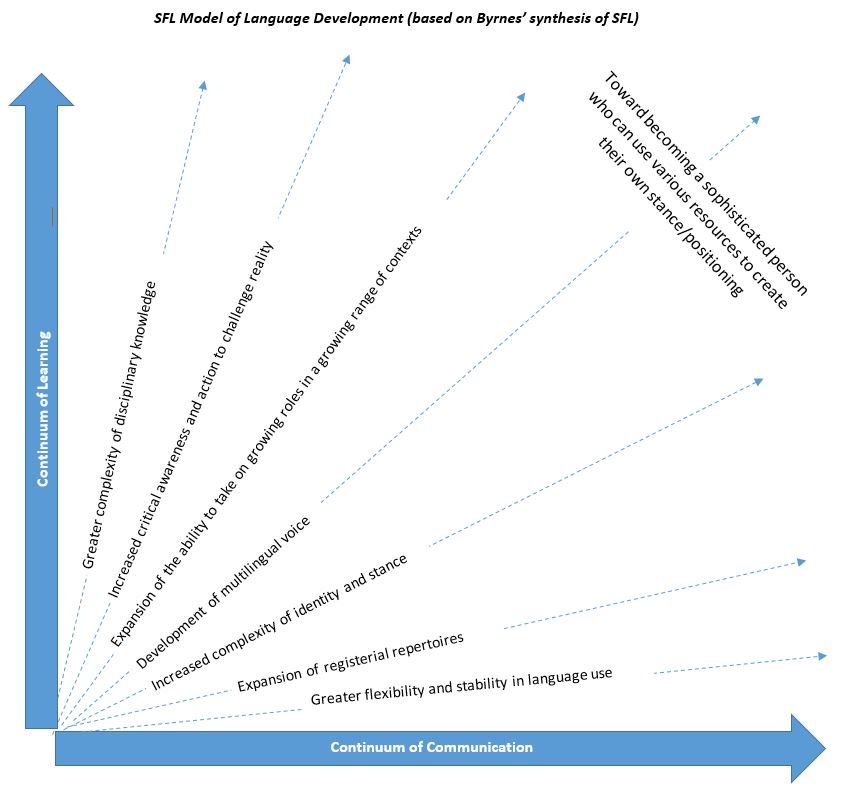 Continue reading →: Language Development from the SFL Perspective
by Ruslana Westerlund, Ed. D. The purpose of this post is to share theoretical thoughts on language development from sociocultural perspective (contrastive to psycholinguistic view), namely, Systemic Functional Linguistics. This blog, hence, will serve as a vessel for capturing syntheses from my own readings of SFL scholars. As an explicit…
-
Continue reading →: Slaves or Workers: “Grammatical Choices as Moral Choices” in History Textbooks
by Ruslana Westerlund The New York Times published an op-ed in 2015 analyzing the language used in the Texas History textbooks published by McGraw-Hill Education. The “Grammatical choices as moral choices” phrase in my title came from that article. The NYT piece references this original post where Coby Burren, a 15…
-
Continue reading →: Beyond Grammar Correction: Developing Writers Through Genre Approach
By Ruslana Westerlund I’ve been thinking about the act of writing for a while now. What is writing? What does it mean to be a writer? What are the linguistic and cultural challenges to writing for multilingual writers? In this blog, I’ll talk about what writing means to me. I’ll…
-
Continue reading →: From Speaking to Writing in a Science Classroom
By Katy J. Kobany Cumulative Project for EDUC 731: Responsive Pedagogy for ELLs, Bethel University, Teacher: Dr. Ruslana Westerlund Academic standards 8323: Water, which covers the majority of the Earth’s surface, circulates through the crust, oceans and atmosphere in what is known as the water cycle. Essential question(s) Where is water…
-
Continue reading →: What Does Language Do in History?
By Ruslana Westerlund History is often studied as facts, events or lives of historical figures. We study history to understand the past or even predict the future. If we want to build democratic classrooms, history needs to be problematized. This is not a new idea. We ask students to answer questions such…
-
Continue reading →: SFL: A Living Theory of the Living Language
By Ruslana Westerlund, a self-taught SFL Learner. For the past 3 years, I’ve been learning about Systemic Functional Linguistics. I was drawn to this theory because it offered a refreshing description of language as a dynamic resource for making meaning as opposed to a set of rules prescribed by a…
Hello,
I’m Ruslana

Proud immigrant woman business owner of Making Language Visible @Westerlund Consulting. I consult internationally on all things related to equipping all teachers with a pedagogically useful model of language. Book me at westerlundconsulting.com
Let’s connect
Join the fun!
Stay updated with our latest tutorials and ideas by joining our newsletter.