I recently saw a question from a teacher about creating objectives that combine content and language. To be helpful to the teacher with a question, I actually created a set where content and language are integrated. I used the new edition of the WIDA ELD Standards which we wrote as a team of phenomenal people like Luciana de Oliveira and Sharon Besser, among others.
When I create language goals for my trainings, I go to the Language Standards, because they are our guide for language instruction, not Can Do Descriptors, how I previously wrote here.
In this case, I went to grade level cluster 6-8, chose Social Studies, then chose Key Language Use ARGUE. Then I took one language function to focus on and created five language objectives. This should be enough for 5 lessons, depending on the extent to which you will be addressing each one.
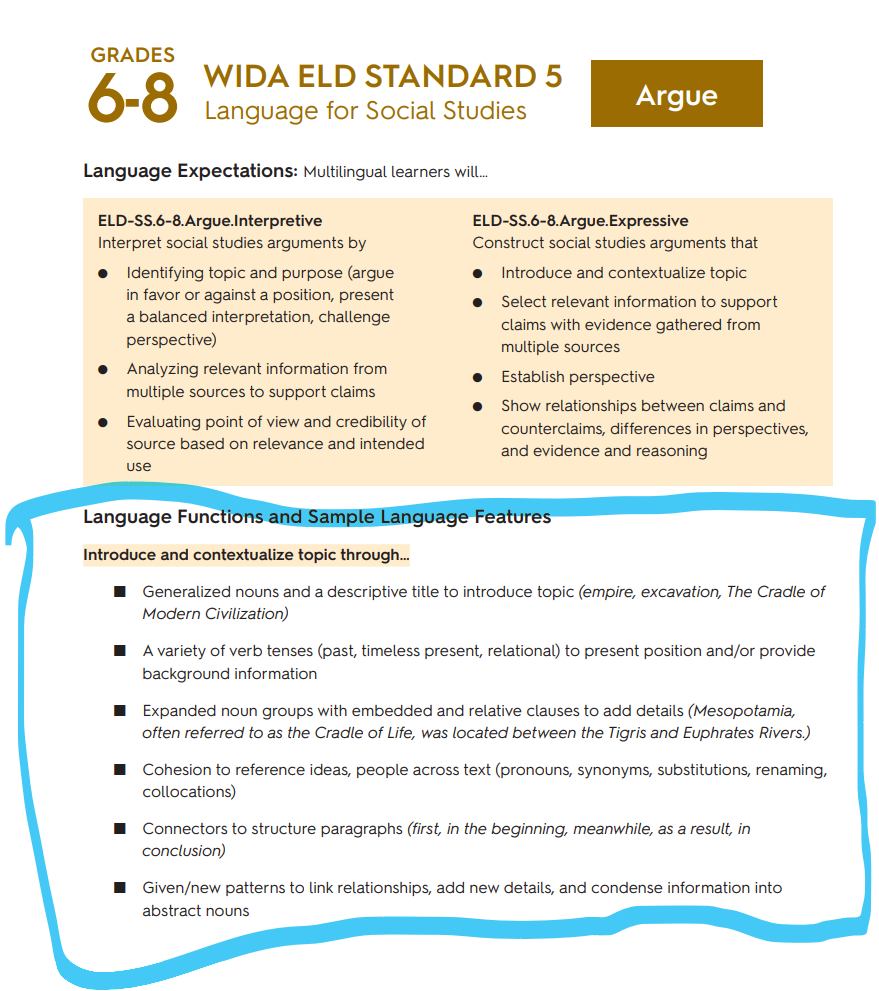
Please notice that the bolded language in each language objective is the language feature and the italicized is the function so that we connect all the grammar teaching to the function it serves, not as an inventory of structures, but as a meaning making resource.
Objective 1/Lesson 1: Students will use generalized nouns and descriptive titles to introduce a historical topic (e.g., “empire,” “The Cradle of Modern Civilization”) in a written paragraph.
Objective 2/Lesson 2: Students will apply a variety of verb tenses (past, timeless present, etc) to describe and provide background information on an ancient civilization.
Objective 3/Lesson 3: Students will expand noun groups with embedded and relative clauses to add details about a historical location (e.g., “Mesopotamia, often referred to as the Cradle of Life, was located between the Tigris and Euphrates Rivers”).
Objective 4/Lesson 4: Students will use cohesive devices such as pronouns, synonyms, and renaming to reference ideas and people consistently across a multi-paragraph argument or within one paragraph.
Objective 5/Lesson 5: Students will use transition connectors (e.g., “in the beginning,” “meanwhile,” “as a result”) to structure paragraphs in an argument about an ancient civilization’s development.
Let's do one more for ELA grades 6-8, Key Language Use NARRATE based on page 146, see below.

Objective 1/Lesson 1: Students will use verbs to describe character behaviors (e.g., “turned instinctively”), thoughts (e.g., “concerned“), and feelings (e.g., “pleased”) in a narrative to develop the complexity of a character.
Objective 2/Lesson 2: Students will expand verb groups to show the relationships between characters (e.g., “He had always admired her, but now he was unsure”).
Objective 3/Lesson 3: Students will use dialog verbs (e.g., “said,” “asked,” “whispered”) related to saying, thinking, and feeling to add nuance to conversations between characters and enhance their relationships (e.g., “Danny,” the old man said softly, “I was angry. Forgive me.”).
Objective 4/Lesson 4: Students will expand noun groups to add vivid descriptions and details about characters’ appearances, emotions, and actions (e.g., “She was tall and graceful, with a stern expression that softened when she smiled”).
Objective 5/Lesson 5: Students will apply cohesive devices (e.g., pronouns, renaming, and synonyms) to reference characters or ideas across the text to maintain coherence in character development throughout their writing.
Teacher Checklist for Character Development Language Features
Verbs to Describe Behavior, Thoughts, and Feelings
- Did I teach students how to use verbs to describe character behaviors? (e.g., “She turned instinctively”)
- Did I teach students how to use verbs to show character thoughts? (e.g., “He was concerned”)
- Did I teach students how to use verbs to express character feelings? (e.g., “She felt pleased”)
- Did I teach students how to choose verbs that describe how characters speak? (e.g., “He asked weakly”)

Expanded Verb Groups
- Did I teach students how to use expanded verb groups to show relationships between characters? (e.g., “He had always admired her but now doubted himself”)
Saying, Thinking, and Feeling Dialog Verbs
- Did I teach students how to use dialog verbs to express characters’ sayings, thoughts, or feelings? (e.g., “He whispered, ‘I was wrong’”)
- Did I teach students to vary dialog verbs to add nuance to relationships between characters? (e.g., “She murmured softly, ‘Thank you’”)
Expanded Noun Groups for Description
- Did I teach students how to expand noun groups to add details about character traits, emotions, or actions? (e.g., “He was short, but strong, with closely cut hair and a determined face”)
- Did I guide students in describing characters’ physical traits or emotions using detailed noun phrases?
Cohesive Devices (Pronouns, Renaming, Synonyms)
- Did I teach students how to use pronouns (he, she, they) to refer to characters consistently?
- Did I teach students how to use synonyms or renaming for characters to maintain cohesion in their writing? (e.g., “The boy,” “Danny,” “he”)
- Did I teach students to use cohesive devices to help readers follow their characters throughout the text?

And here’s a Student Checklist to use when checking their work.
Character Development Checklist for Student Use
Verbs to Describe Behavior, Thoughts, and Feelings
- Did I use verbs to describe what the character does? (e.g., “She turned instinctively”)
- Did I use verbs to show the character’s thoughts? (e.g., “He was concerned”)
- Did I include verbs to express the character’s feelings? (e.g., “She felt pleased”)
- Did I use verbs to describe how the character speaks? (e.g., “He asked weakly”)
Expanded Verb Groups
- Did I use expanded verb groups to show the relationship between characters? (e.g., “He had always admired her but now doubted himself”)
Saying, Thinking, and Feeling Dialog Verbs
- Did I include dialog verbs that show what characters are saying, thinking, or feeling? (e.g., “He whispered, ‘I was wrong’”)
- Did I vary my dialog verbs to add nuance to character relationships? (e.g., “She murmured softly, ‘Thank you’”)
Expanded Noun Groups for Description
- Did I use expanded noun groups to add detail to my characters? (e.g., “He was short, but strong, with closely cut hair and a determined face”)
- Did I describe physical traits or emotions using detailed noun phrases?
Cohesive Devices (Pronouns, Renaming, Synonyms)
- Did I use pronouns (he, she, they) to refer to characters consistently across the text?
- Did I use synonyms or renaming to reference characters in different ways? (e.g., “The boy,” “Danny,” “he”)
- Did I make sure my characters are easy to follow throughout the text by using cohesive devices?
Let me know if you need any more examples. I’m happy to create free resources. Just subscribe to my blog and reach out on Facebook with more questions.
At your service,
Ruslana
About the Author
Dr. Ruslana Westerlund is an educational consultant, researcher, and professional learning facilitator specializing in disciplinary literacy, multilingual education, and Systemic Functional Linguistics (SFL). She works with schools, districts, universities, and educational organizations across the United States and internationally to support the implementation of high-quality instruction that integrates language, literacy, and disciplinary learning. Her work focuses on making language visible through the Teaching and Learning Cycle, the WIDA ELD Standards Framework (which she co-authored), and evidence-based approaches that provide multilingual learners with high challenge and high support.
Westerlund Consulting LLC is a certified Woman-Owned Business Enterprise (WBE) providing professional learning, curriculum design, instructional coaching, keynote presentations, and strategic consultation in disciplinary literacy, multilingual education, and language-focused instructional design. The company partners with educational organizations to build educator capacity and improve equitable access to rigorous, language-rich learning for all students.






Leave a Reply