This week for Cohort 3 was Session 5 of our Building a Language Toolkit for Teachers: A Functional Approach book study, we explored one of the most exciting opportunities for supporting multilingual learners: cross-linguistic analysis. Rather than asking students to leave their home languages at the classroom door, we examined how teachers can leverage students’ full linguistic repertoires to demystify the complexity of English, versus continue admiring it or making jokes about how complex and crazy English is. Every language has its own complexity. Today’s complexity was about how information is condensed in the noun groups. I’ve written about this before here. In our session, we’ve looked at noun groups do similar things but in different ways across many genres, including mathematical explanations, personal recounts, narratives, and science reports. Today, I’ll contextualize the work noun groups are doing in the context of reading and writing science explanations (a genre I’m slightly obsessed with).
One of the most effective ways to support multilingual learners is to place parallel texts side by side. When students read the same scientific explanation in multiple languages, they begin to notice that although languages organize words differently, they all build increasingly precise scientific concepts through noun groups.
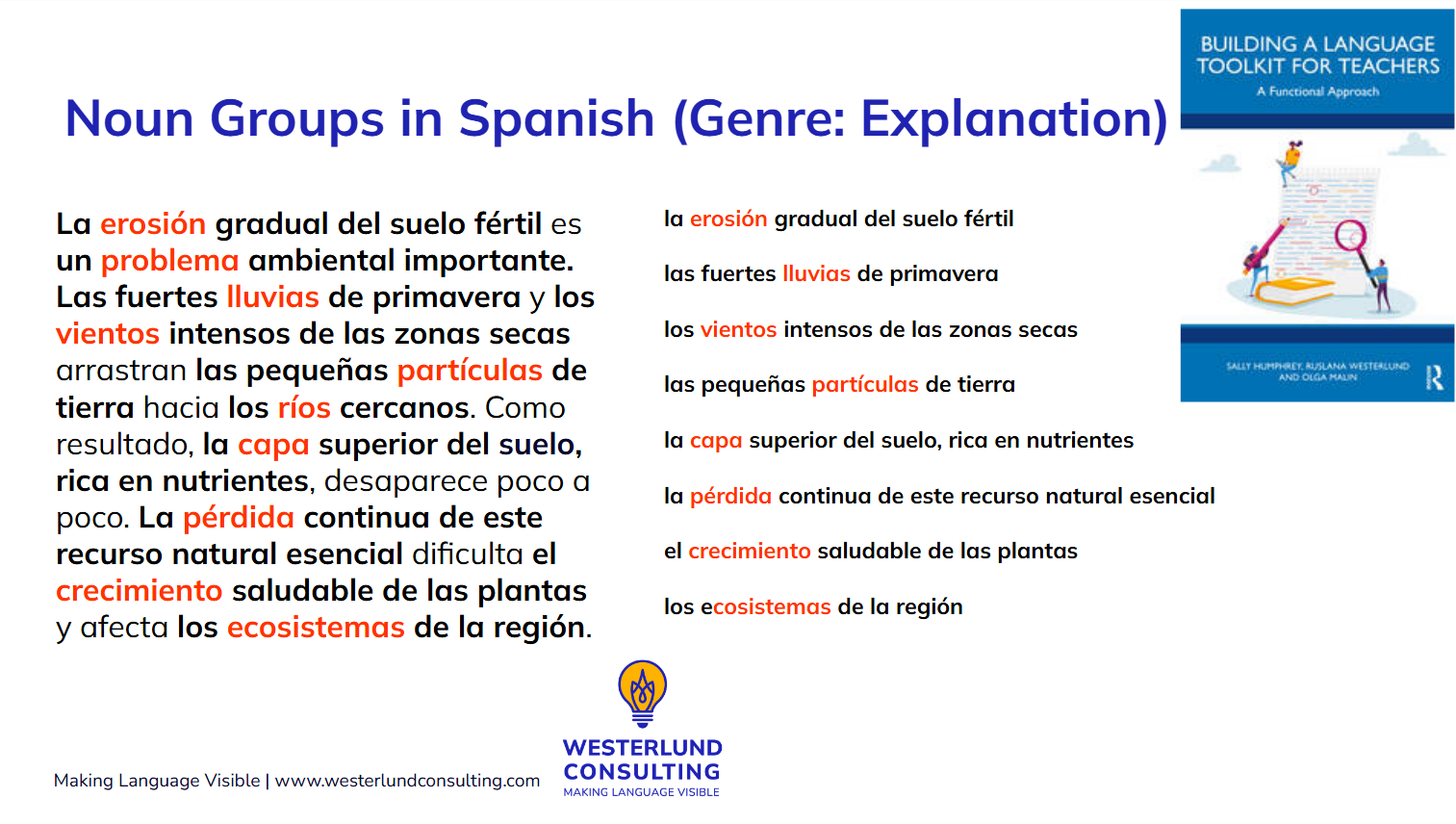
Consider this short explanation about soil erosion. Noun groups are bolded. Keep in mind, noun groups are not just participants, they can be in circumstances to to add information about where and when, etc.
English
The gradual erosion of fertile soil is an important environmental problem. Heavy spring rains and strong winds in dry regions carry small soil particles into nearby rivers. As a result, the nutrient-rich top layer of soil gradually disappears. The continued loss of this essential natural resource hinders the healthy growth of plants and affects the region’s ecosystems.
Spanish
La erosión gradual del suelo fértil es un problema ambiental importante. Las fuertes lluvias de primavera y los vientos intensos de las zonas secas arrastran las pequeñas partículas de tierra hacia los ríos cercanos. Como resultado, la capa superior del suelo, rica en nutrientes, desaparece poco a poco. La pérdida continua de este recurso natural esencial dificulta el crecimiento saludable de las plantas y afecta los ecosistemas de la región.
Ukrainian
Поступова ерозія родючого ґрунту — це важлива екологічна проблема. Сильні весняні дощі та потужні вітри посушливих районів змивають дрібні частинки ґрунту до найближчих річок. У результаті, верхній шар ґрунту, багатий на поживні речовини, поступово зникає. Постійна втрата цього важливого природного ресурсу ускладнює здоровий ріст рослин і негативно впливає на екосистеми регіону.
Looking Across the Languages
Although these texts look different, they are doing remarkably similar work. Each language constructs technical scientific concepts by expanding noun groups.
| English | Spanish | Ukrainian |
|---|---|---|
| the gradual erosion of fertile soil | la erosión gradual del suelo fértil | поступова ерозія родючого ґрунту |
| heavy spring rains | las fuertes lluvias de primavera | сильні весняні дощі |
| small soil particles | las pequeñas partículas de tierra | дрібні частинки ґрунту |
| the continued loss of this essential natural resource | la pérdida continua de este recurso natural esencial | постійна втрата цього важливого природного ресурсу |
| the healthy growth of plants | el crecimiento saludable de las plantas | здоровий ріст рослин |
The differences are grammatical representing the same concept but in slightly different ways.
- English often builds noun groups by placing describers before the noun and adding of phrases afterward: the gradual erosion of fertile soil.
- Spanish follows a similar pattern, but descriptive adjectives typically follow the noun: la erosión gradual del suelo fértil.
- Ukrainian expresses many of the same relationships through grammatical case, especially the genitive, rather than using prepositions: ерозія родючого ґрунту, ріст рослин, екосистеми регіону.
Despite these structural differences, all three languages package information into increasingly precise scientific concepts. Students are not simply learning new vocabulary—they are learning how scientific knowledge is constructed.
Classroom Implications
Reading parallel texts invites students to compare languages rather than compartmentalize them. They can identify corresponding noun groups, discuss how each language expands ideas, and recognize patterns that transfer across languages. Instead of treating multilingualism as an obstacle, this approach positions students’ full linguistic repertoires as valuable resources for learning science.
When teachers make these patterns visible, students begin to see an important truth: every language has sophisticated ways of building scientific knowledge. The forms may differ, but the meaning-making is shared.
Key Takeaways
- Of course, you’d build disciplinary knowledge first through message abundancy (read Pauline Gibbons), investigations, observations, talking, viewing, listening, setting up inquiries by taking students outside and observing erosion in their school backyard before plopping the text in front of them with a worksheet on the side. Please don’t turn this blog into a worksheet because you got excited about the grammar of noun groups and now you just can’t wait for students to become noun group geeks. Believe it happens, but don’t go there! Focus on exciting science learning and position language in the service of learning. Talk about noun groups as tools for building knowledge and showing off their knowledge through them!
- Don’t just translate to focus on content. Use translation as an opportunity to help students notice how each language constructs scientific meaning, not simply what the text says.
- Honor multilingualism as a resource for learning. When teachers make language visible across languages, students see that every language has powerful tools for thinking, explaining, and constructing knowledge.
- Compare the meaningful groups of words, not just the single words. Ask students to identify noun groups, discuss how they are expanded, and compare how each language builds technical concepts.
- Focus on meaning-making. English, Spanish, Ukrainian, and other languages organize information differently, but they all provide resources for constructing precise scientific explanations.
- Leverage students’ full linguistic repertoires. Students’ home languages are assets that can deepen conceptual understanding and develop metalinguistic awareness.
- Use authentic parallel texts whenever possible. Reading the same science text in multiple languages encourages students to make connections between content and language.
- Teach students to unpack and repack noun groups. Identifying the Thing, determiner (article) describers (factual or evaluative adjectives), classifiers (nouns or adjectives such as brown bear, blue whale, or nouns as in carbon atom, food web, line graph, and qualifiers helps students read dense scientific texts and write more sophisticated explanations.
- Look for transferable patterns. Whether a language uses adjective order, prepositional phrases, or grammatical case, students can recognize that all languages package information into increasingly complex noun groups.
- Cross-linguistic analysis supports both language and science learning. Students simultaneously build disciplinary knowledge, academic language, and a deeper understanding of how languages work.
Cheering you on,
Ruslana
About the Author
Dr. Ruslana Westerlund is an educational consultant, researcher, and professional learning facilitator specializing in disciplinary literacy, multilingual education, and Systemic Functional Linguistics (SFL). She works with schools, districts, universities, and educational organizations across the United States and internationally to support the implementation of high-quality instruction that integrates language, literacy, and disciplinary learning. Her work focuses on making language visible through the Teaching and Learning Cycle, the WIDA ELD Standards Framework (which she co-authored), and evidence-based approaches that provide multilingual learners with high challenge and high support.
Westerlund Consulting LLC is a certified Woman-Owned Business Enterprise (WBE) providing professional learning, curriculum design, instructional coaching, keynote presentations, and strategic consultation in disciplinary literacy, multilingual education, and language-focused instructional design. The company partners with educational organizations to build educator capacity and improve equitable access to rigorous, language-rich learning for all students.


 Making Language Visible
Leave a comment